
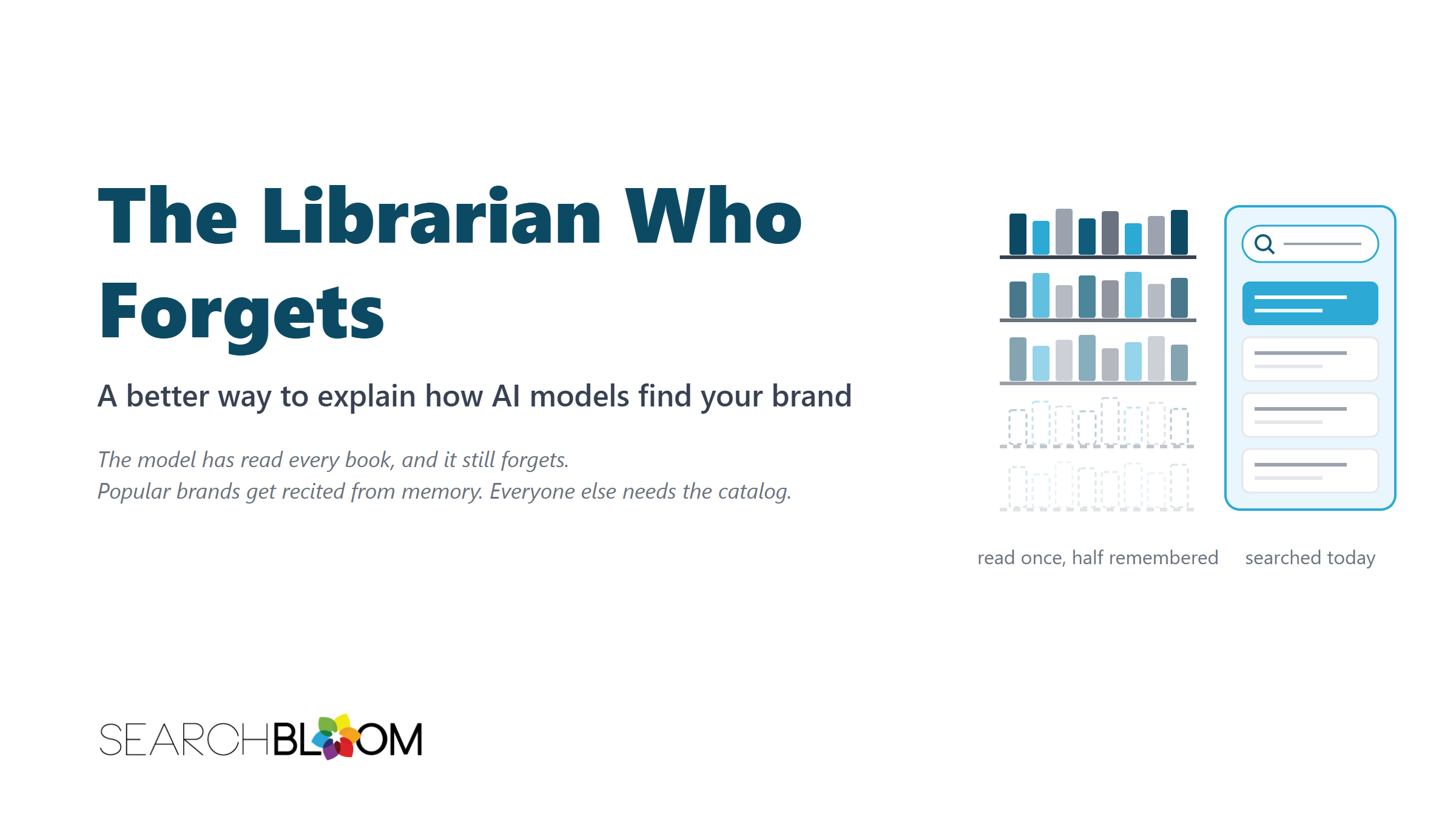

"A large language model is a librarian who has read every book in the building and still forgets. Popular brands are the books they read so often they can recite them. Everyone else had better be in the catalog."
~ Cody C. Jensen, CEO & Founder, Searchbloom


This isn't a technical paper on how neural networks work. It's the mental model I use to explain LLM visibility when a partner asks why an AI assistant keeps naming their competitor and not them, and it's the version I'd hand to a marketing leader who has 5 minutes before a board meeting. If you only have those 5 minutes, I'd spend them on the last 2 sections.
The short version:
- The model is the librarian, not the library.
- The library is the training corpus: everything the model read during training.
- What the model "knows" is memory, not a map of the shelves.
- The model doesn't store popular brands somewhere special. It remembers them better.
- RAG is the catalog computer, and it searches a second, current collection the librarian never read.
- Visibility takes both: a model that remembers you and a search that can find you.
What LLM Visibility Is and How to Measure It
What is LLM visibility, and how do you measure it?
LLM visibility is how often a large language model names, describes, and cites your brand when a buyer asks a question in your category. It applies to ChatGPT, Claude, Gemini, Perplexity, and Google's AI Overviews, and it has 2 parts: whether the model remembers your brand, and whether its search can find your pages. A brand can be strong in one and missing from the other, as 2 of the 10 brands in Searchbloom's project management test below were, so I'd report the 2 parts separately.
Measuring it takes no special access. Here's how I'd run it:
- The questions: 20 to 30 that your buyers ask and that name no brand, such as "best project management software for a 10-person agency," not "Is Asana any good?"
- The runs: each question 3 or more times per model, with search off and with search on. SparkToro's January 2026 research found under a 1 in 100 chance that ChatGPT or Google's AI returns the same list of brands in any 2 of 100 responses, so 1 run proves nothing.
- The counts: how often the model names your brand from memory, how often it names you with search on, and how often it cites your own pages. I'd log every site it cites, too, because that list shows whose pages the model trusts in your category.
- The schedule: the search side monthly, and the memory side each time a lab releases a new model, since memory only changes when a lab retrains the model.
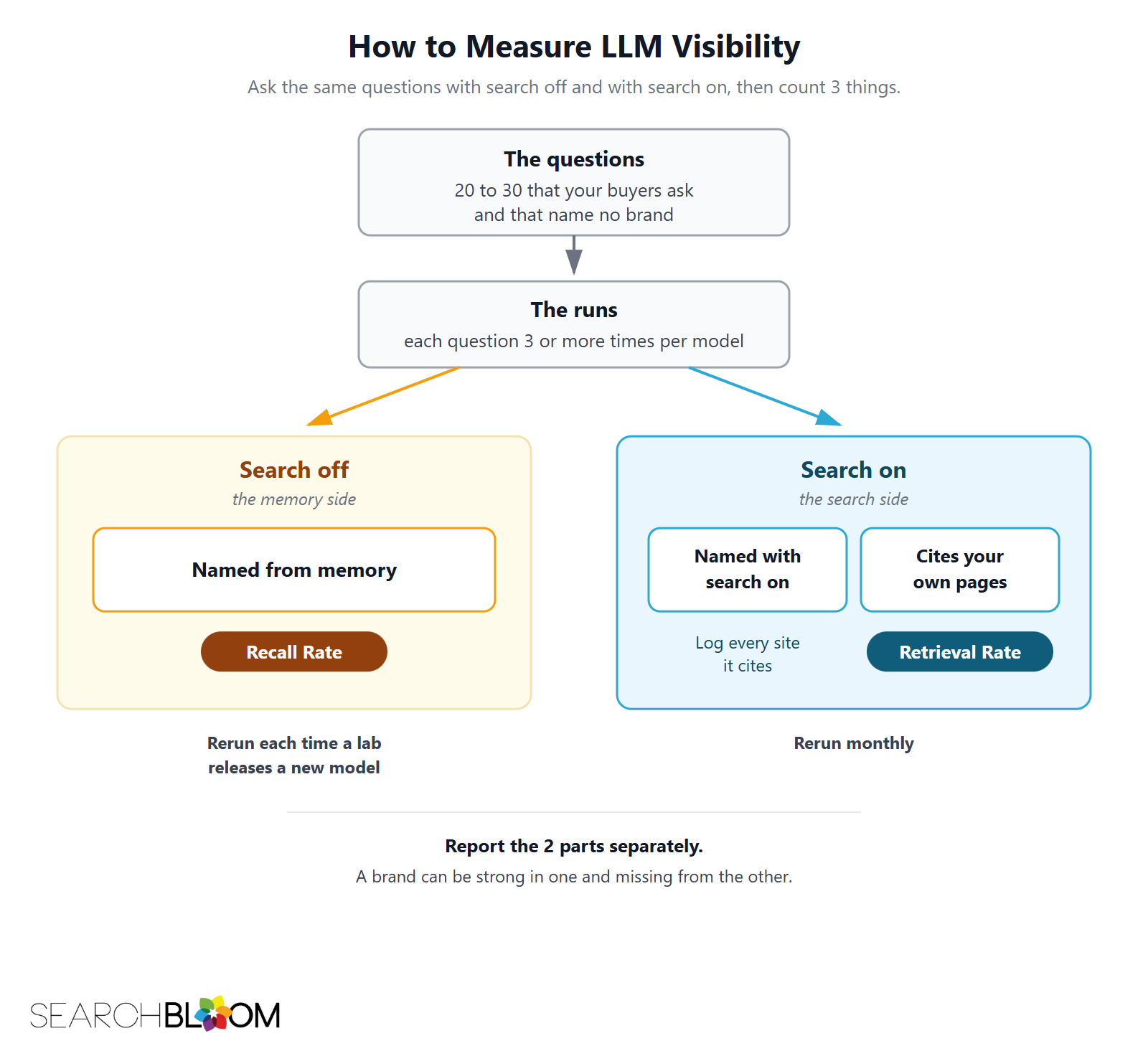
The first and last counts are what I call Recall Rate and Retrieval Rate, and they get their own section below. The rest of this post explains why the numbers split the way they do, using a librarian.
Where the Popular Library Metaphor Gets It Right
The version I hear most goes like this: the large language model (LLM) is a library, its built-in knowledge plays the librarian, and popular brands are the popular books the librarian can find without looking. Readers check some out so often they never leave the front desk. When the librarian doesn't know where something is, they walk to the computer, look it up, and bring it back. That last step is retrieval-augmented generation, or RAG.
I like this metaphor a lot, because it gets the hierarchy right. Popularity matters, and there's a fallback when memory runs out. A lot of the explanations I hear skip that fallback entirely, which is how folks end up thinking the model either knows you or it doesn't.
My disagreement isn't with the library, it's with where the knowledge lives.
Correction 1: The Model Is the Librarian, and the Corpus Is the Library
Where does the knowledge actually sit?
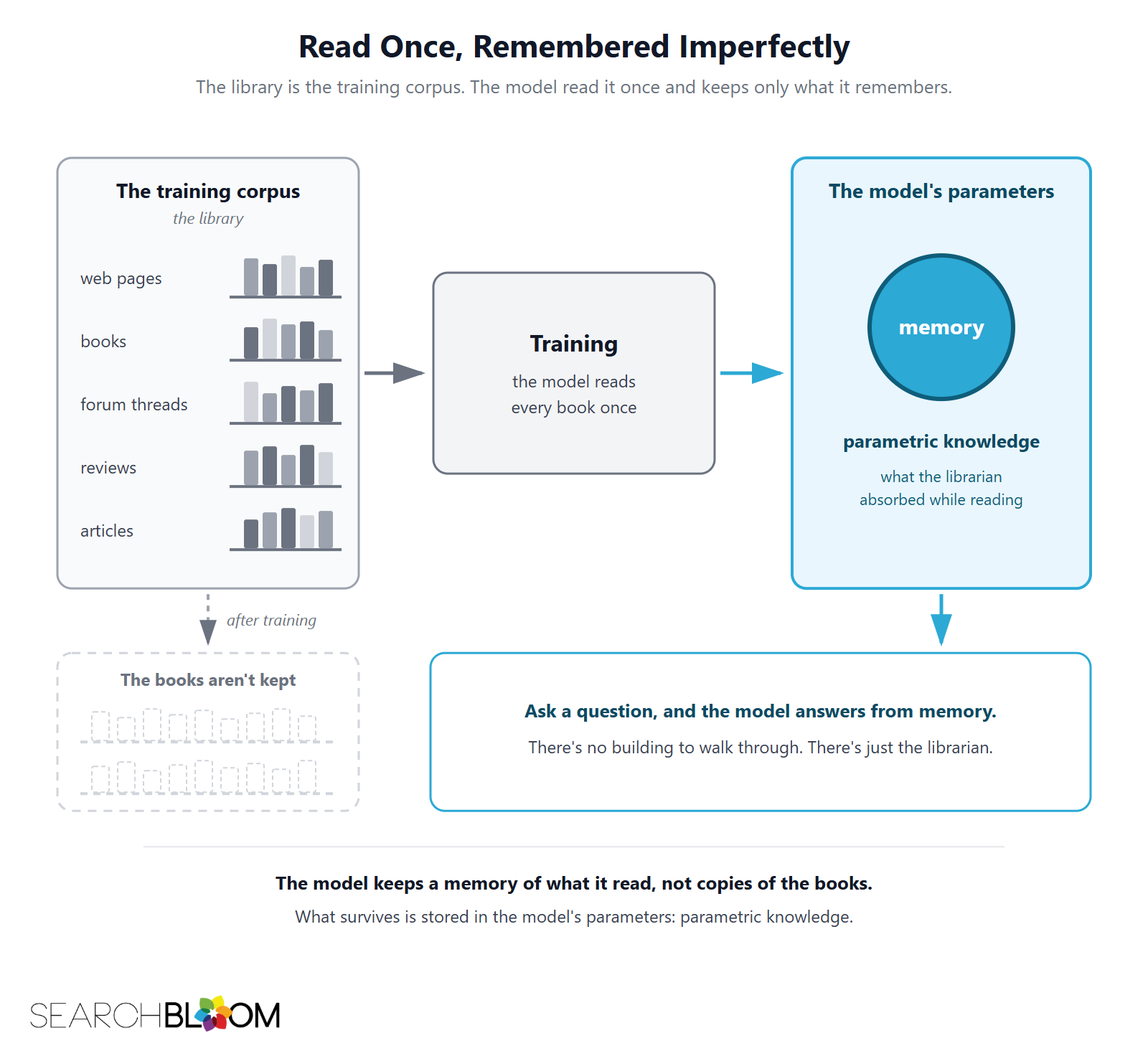
The library is the training corpus: the web pages, books, forum threads, reviews, and articles the model read during training. The model read it once. After that, all it has is what it remembers.
It doesn't keep copies of the books. What survives is what the librarian absorbed while reading, stored in the model's parameters, which is why you'll hear it called parametric knowledge. When you ask a question, there's no building to walk through. There's just the librarian.
Correction 2: Memory, Not a Map
Does the librarian know where the book is, or what's in it?
The popular version says the librarian knows where every popular book lives. The truer version: the librarian remembers what was in the books, compressed and blended together. When you ask, they don't fetch anything. They reconstruct an answer from memory.
That explains hallucinations better than any technical diagram I've seen. A hallucination is a librarian confidently summarizing a book they skimmed once, years ago, with a chapter from a different book mixed in. The librarian means well. Their memory of that book is just shaky.
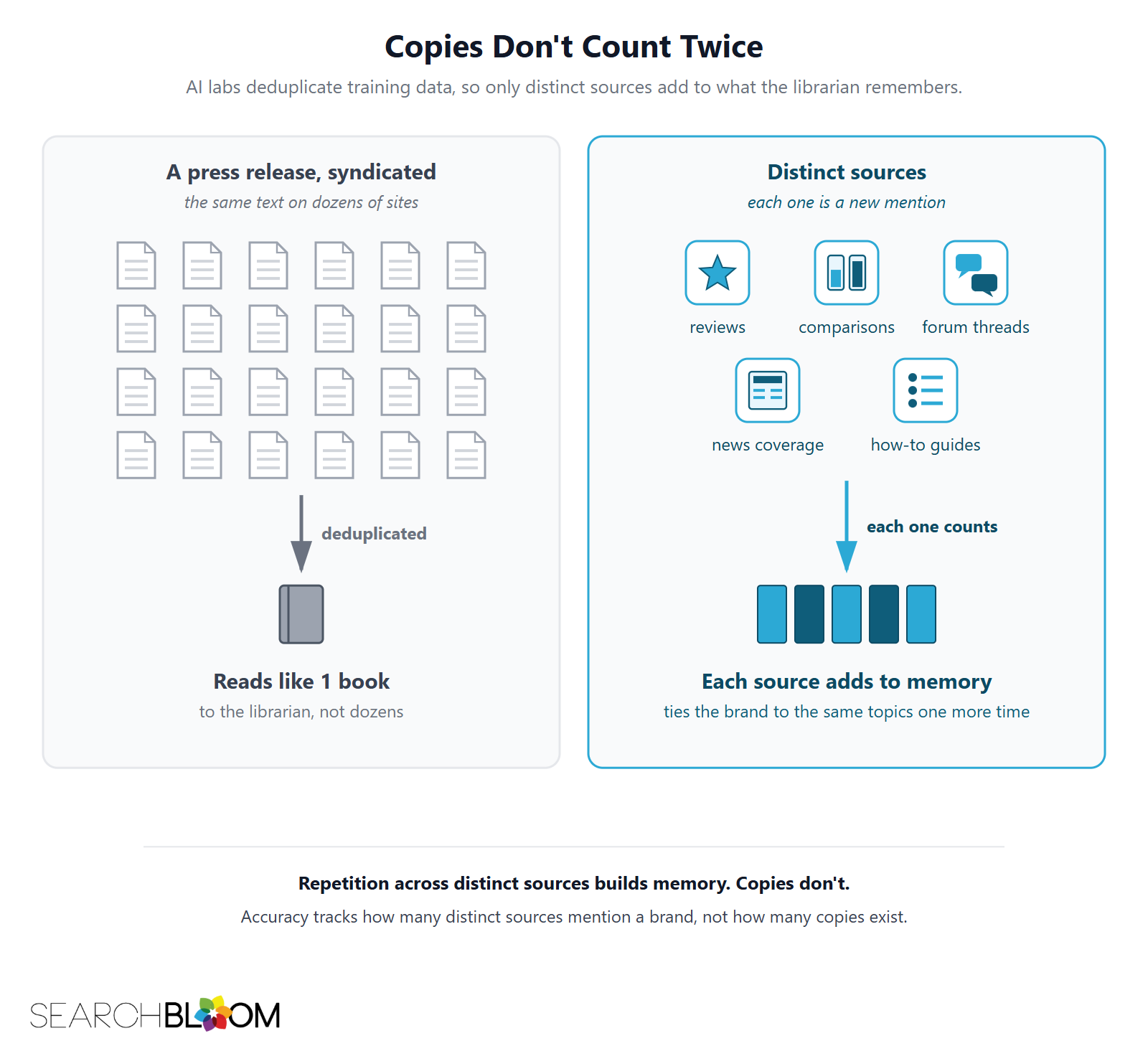
Accuracy tracks repetition across distinct sources, because each new mention ties the brand to the same topics one more time. Copies don't count twice. AI labs deduplicate training data, so a press release syndicated across dozens of sites reads like 1 book to the librarian, not dozens.
Correction 3: There Is No Front Desk
Why do popular brands come back so fast?
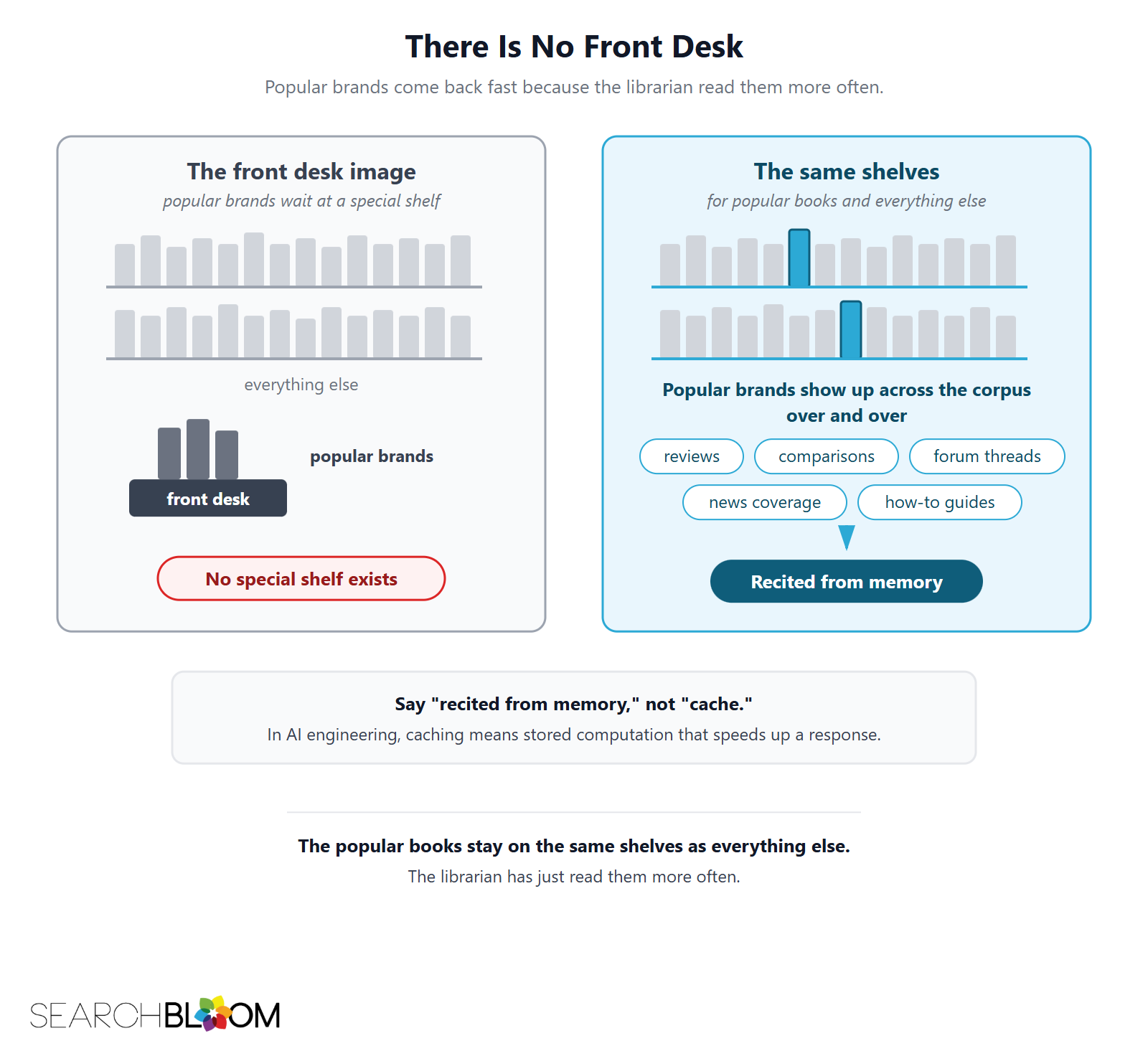
The front desk image is appealing, but no special shelf exists. Popular brands show up across the corpus over and over: reviews, comparisons, forum threads, news coverage, how-to guides. The librarian can recite them the way you can recite a phone number you dialed every day for a decade.
The popular books stay on the same shelves as everything else; the librarian has just read them more often.
I'd also steer clear of the word "cache" here. In AI engineering, caching means something specific (stored computation that speeds up a response), and an engineer on the call will fixate on it. "Recited from memory" says the same thing without the detour.
Correction 4: The Computer Searches a Second Collection
What happens when memory runs out?
This is where the popular version is closest to right. With RAG, the librarian walks to the computer, runs a search, pulls the relevant passages, reads them, and answers from what they found.
The nuance: the computer isn't searching the old library. It searches a separate, current collection, such as a live web index or a company's own documents. That's how a model can answer questions about things published after its training cutoff.
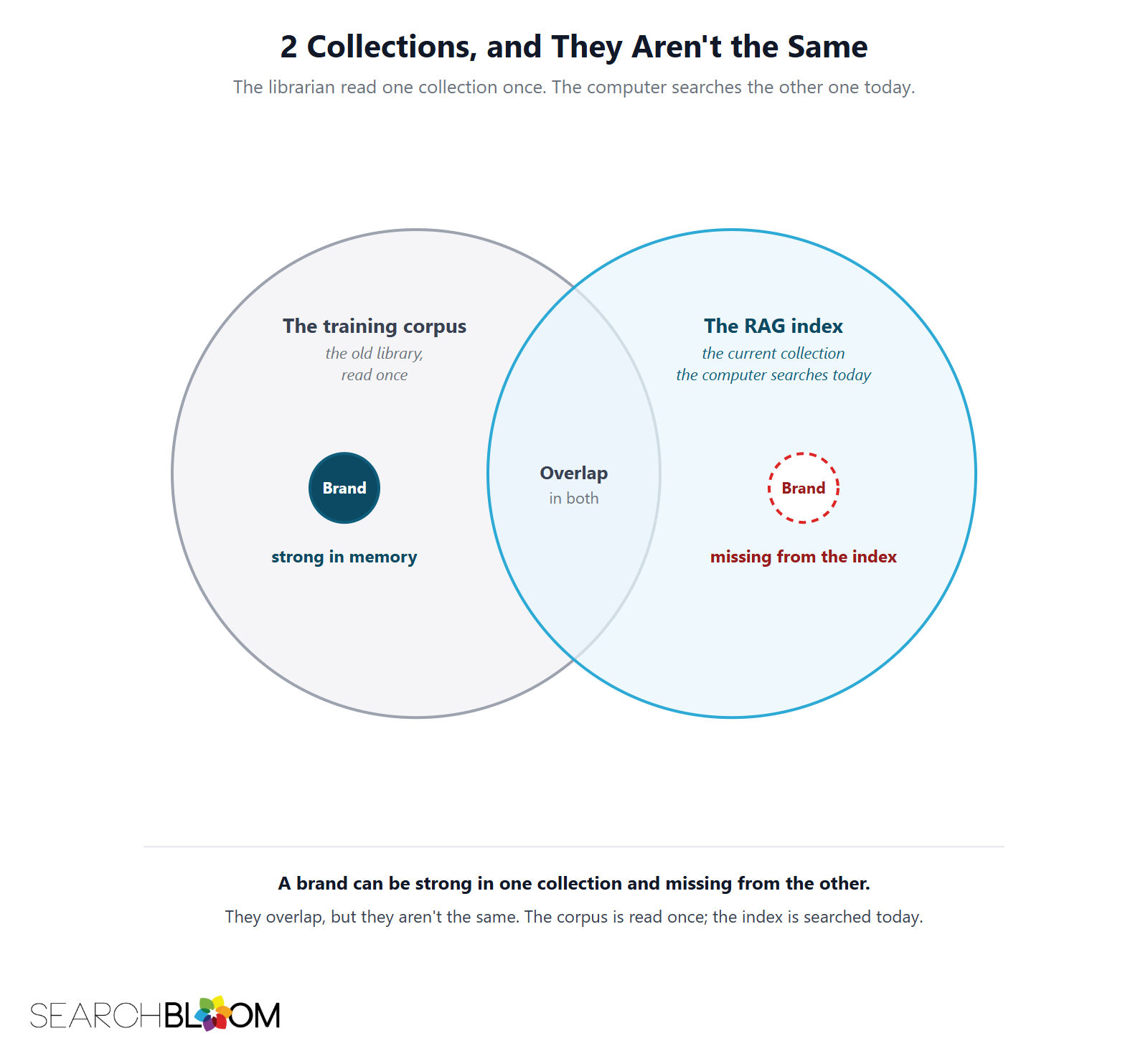
So there are 2 collections in this story. The corpus is the old library the librarian read once and can't reopen. The RAG index is the collection the computer searches today. They overlap, but they aren't the same, and a brand can be strong in one and missing from the other.
3 consequences matter for any brand:
- If your page isn't in the index, it doesn't exist to the computer. If a crawler can't reach a page or the index never adds it, no search on that index can pull it.
- If your page is in the index but ranks 40th, it probably still won't make the cut. The librarian usually reads the top few results, not the whole list.
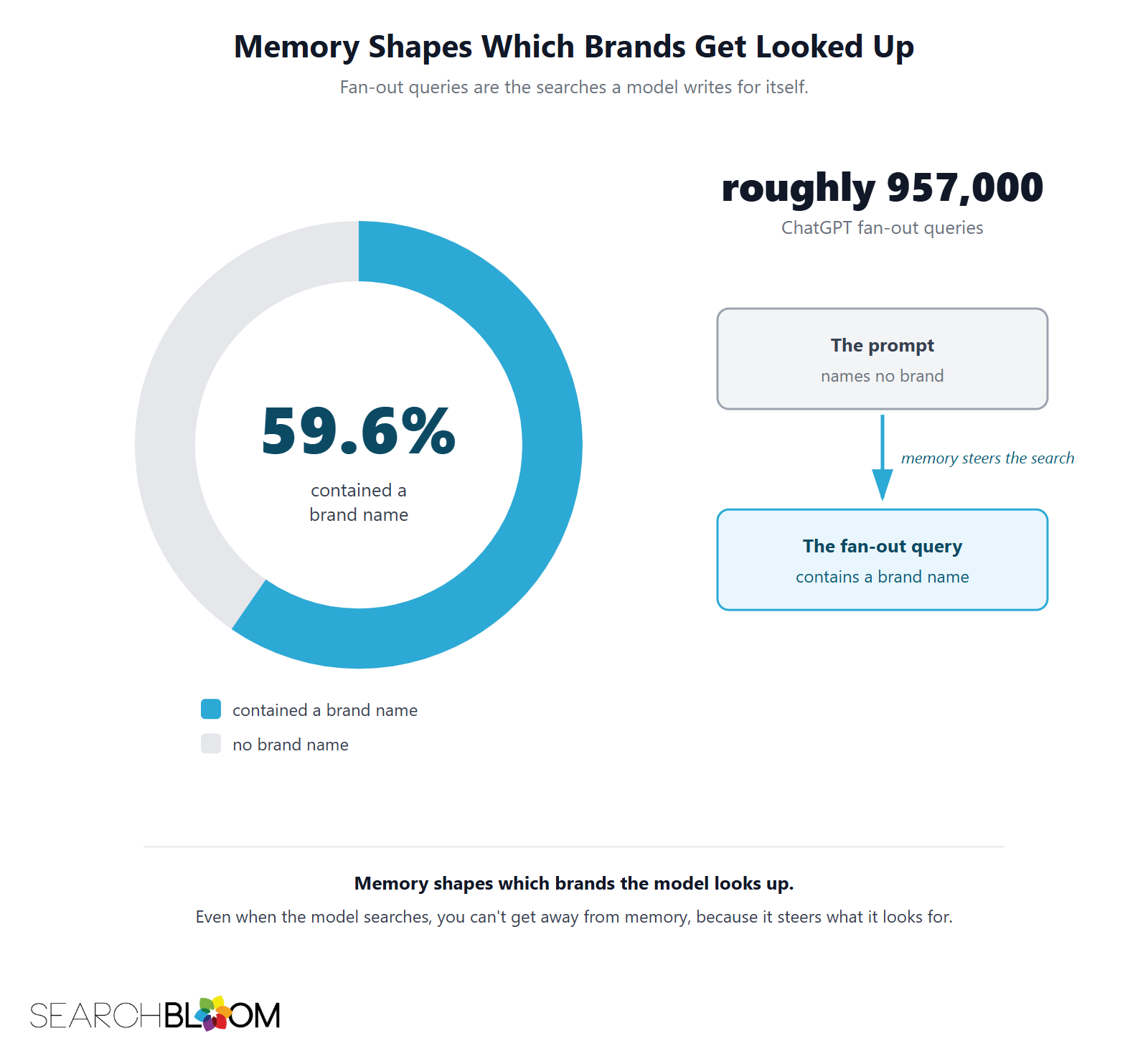
- The librarian decides whether to search, and often what to search for. If they think they already know the answer, they may skip the search and answer from memory. Even when they do search, you can't get away from memory, because it steers what they look for. In Graphite's research on parametric knowledge optimization, 59.6% of roughly 957,000 ChatGPT fan-out queries (the searches a model writes for itself) contained a brand name, even though the prompts behind them named no brand, so memory can shape which brands the model looks up in the first place.
The next question is who stocks that second collection. Searchbloom tested it in project management software: 25 questions that named no brand, asked 3 times each of GPT-5.5, Claude Sonnet 5.5, and Gemini 3 Flash, with search off and on. With search on, the 3 models produced 1,590 citations, and only 14.6% pointed to the 10 brands' own sites. The most-cited site was a project management vendor outside the 10, whose "best tools" list posts drew more citations than any brand's own site. Most of the catalog is other people's pages.
The Librarian Who Forgets
Here's the version I came up with:
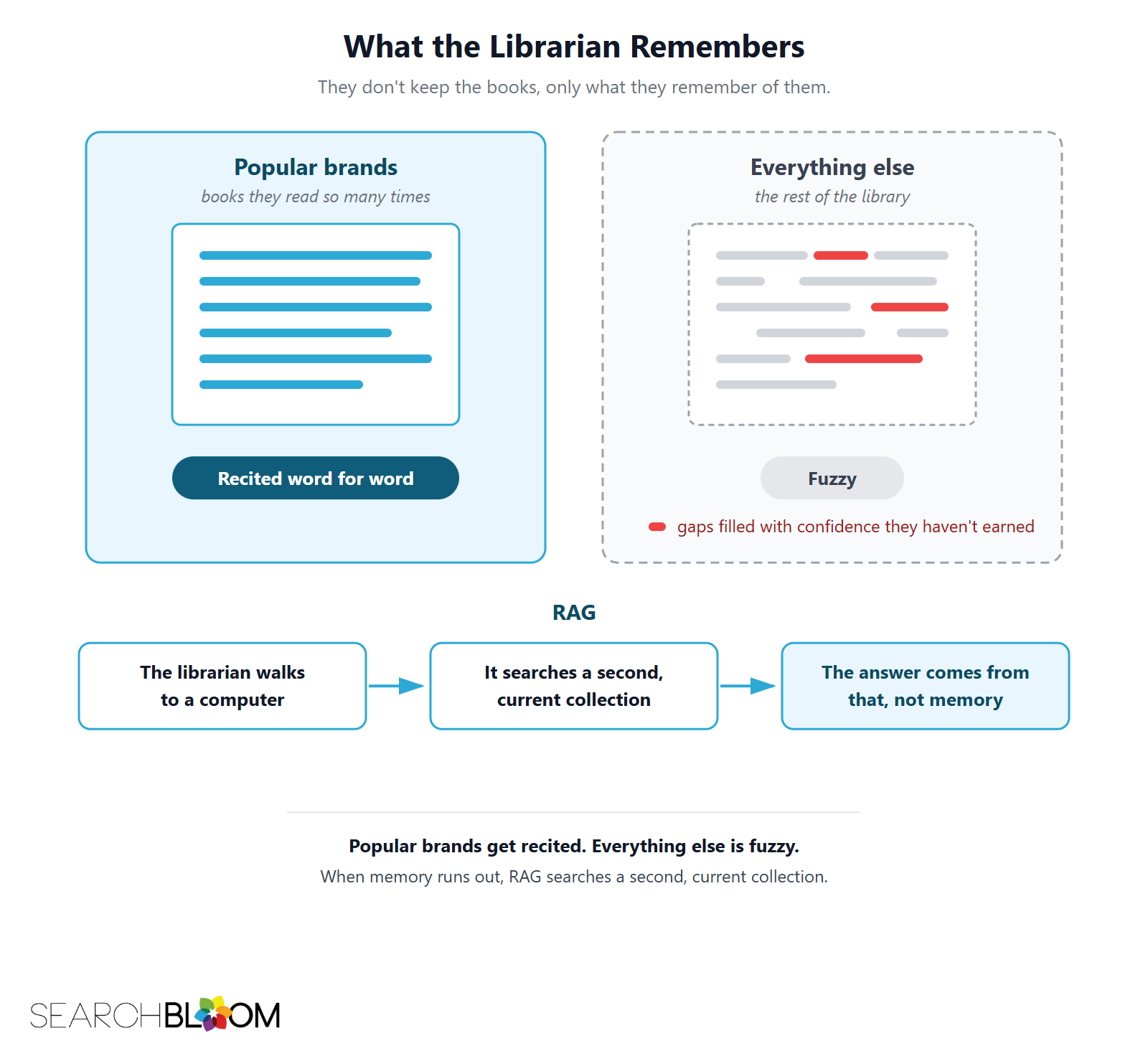
A large language model is a librarian who has read every book in the library, the training corpus, and still forgets. They don't keep the books, only what they remember of them. Popular brands are books they read so many times they can recite them word for word. Everything else is fuzzy, and sometimes they fill the gaps with confidence they haven't earned. RAG is the librarian walking to a computer that searches a second, current collection, reading what comes back, and answering from that instead of memory.
2 Shelves, 2 Measurements
How do you know which shelf your brand is on?
If the librarian has 2 ways to find you, you need 2 ways to measure your LLM visibility. I'd track them separately, with 2 measurements I call Recall Rate and Retrieval Rate:
- Recall Rate: the percentage of category prompts, with search turned off, where the model names your brand. This measures memory.
- Retrieval Rate: the percentage of search-enabled answers in your category that cite your pages. This measures the catalog.
Put them side by side and every brand lands in 1 of 4 spots:
| Retrieved | Not retrieved | |
|---|---|---|
| Remembered | The librarian's favorite. I'd protect it. | Coasting on reputation. Your content isn't earning the pull, and memory doesn't refresh itself. |
| Not remembered | Winning searches today without the broad presence to be recalled tomorrow. | The librarian has never heard of you, and the computer can't find you. |
The same test put real brands in all 4 boxes:
- The librarian's favorite: Monday.com. Named in 76% of answers from memory and 89% with search on, with its own site cited in 16% of search-on answers.
- Coasting on reputation: Notion. Named in 64% of answers from memory, but only 43% once the computer searched, and the models cited its own pages in under 1%.
- Winning searches without the memory: Wrike. Named in only 26% of answers from memory, but 40% with search on, with its own site cited in 8%.
- Unknown to both: Airtable. Rarely named either way (19% from memory, 13% with search on), and almost never cited (1%).
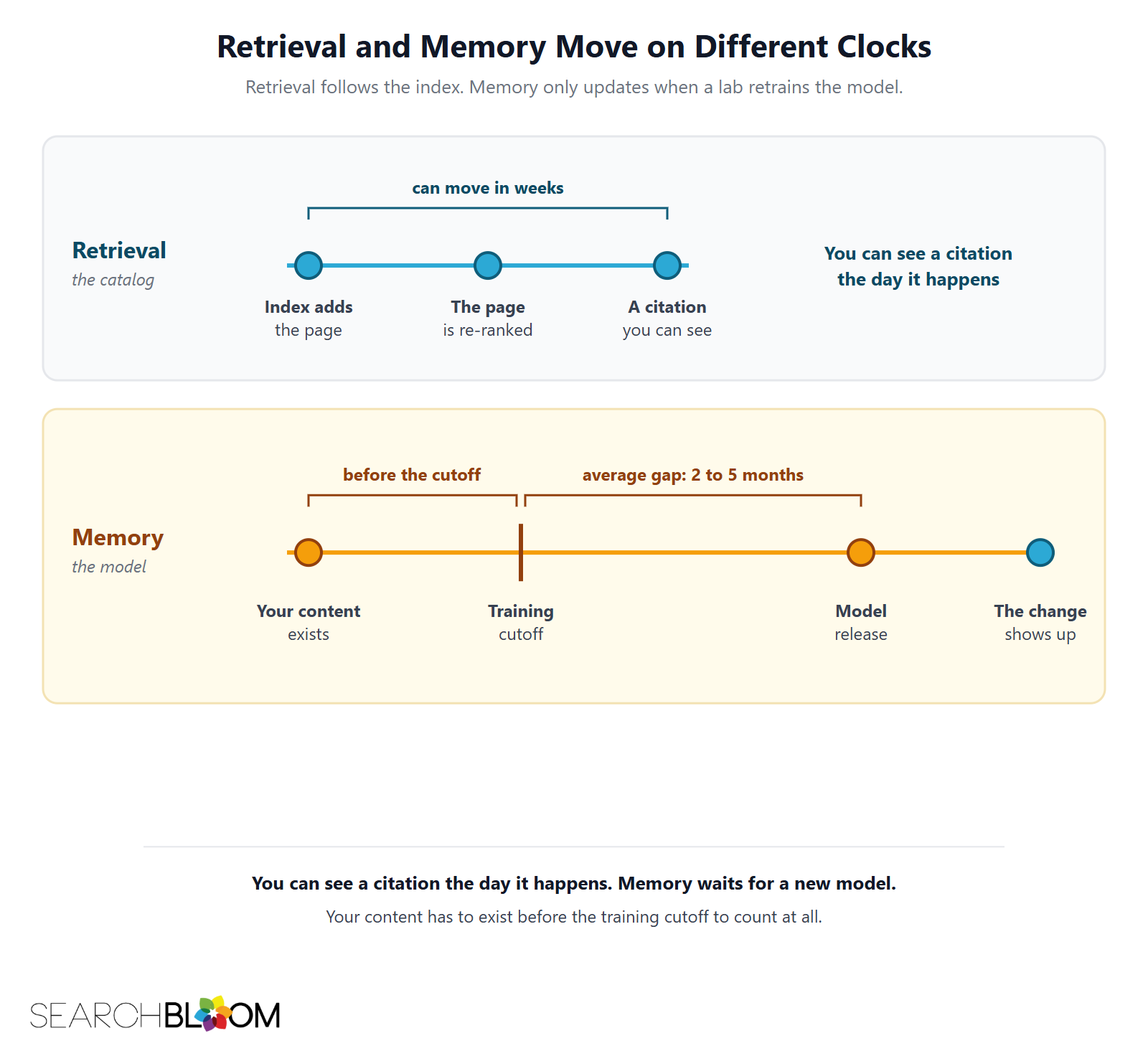
The 2 move on different clocks. Recall is downstream of how often and how consistently your brand appears across the web, especially on third-party sites, and it changes slowly because it only updates when a lab retrains the model. Retrieval is downstream of whether the index holds your pages, whether they rank, and whether they hold passages a model can lift cleanly. It can move in weeks, because a search index can add and re-rank a page without waiting for a new model. Pages that add information gain, net new information the other results don't have, give the librarian a reason to pull yours over the 9 others on the screen.
Working Both Shelves
What do you do about it?
The memory shelf has a name now. Gregory Druck, Ethan Smith, and Bevin Benson at Graphite call it parametric knowledge optimization: influencing what lands in the training set so the model describes and recommends your brand better. Their data backs up the 2-shelf view. A brand's visibility with search turned off predicted its visibility with search turned on, which means memory doesn't only matter when the computer is off. It shapes the answers when the computer is on, too.
It's also slow. For models released since July 2026, Graphite measured an average gap of 2 to 5 months between a model's training cutoff and its release, and your content has to exist before that cutoff to count at all.
The catalog shelf is the work I've been calling Corpus Engineering: designing, structuring, expanding, maintaining, and optimizing the body of content that represents your brand so retrieval systems can find it and use it. (Yes, "corpus" is doing double duty here. In Corpus Engineering, it means your brand's body of content, not the model's training library.)
My read is that the 2 overlap more than they compete. An accurate, consistent description of your brand, published on many distinct sites that crawlers can reach, is what the retrieval index serves today and what the next training run reads tomorrow. The catch is measurement. You can see a citation the day it happens, while a change in memory only shows up when a lab releases a new model, so the memory side asks for more patience than most marketing budgets like to give.
The Bottom Line
A large language model is a librarian who has read every book in the building and still forgets. Popular brands are the books they read so often they can recite them. Everyone else had better be in the catalog.
I'd measure both shelves before deciding where to spend. Which one you work on first is your call.
