
The MERIT Framework for AI Search Optimization
A Practical Framework for AI Search Optimization
A Practical Framework for AI Search Optimization

The MERIT Framework was originally published in October 2025. This April 29, 2026 update incorporates research and tools released since the original publication, including findings from AirOps's March 2026 AI Search Playbook, SparkToro's January 2026 AI visibility research, Profound's 2026 controlled experiment on serving Markdown to AI bots, the launch of Cloudflare's Markdown for Agents (February 2026), Ahrefs Firehose (March 2026), and Alertmouse (October 2025).
This update also expands the Transformation pillar (renamed from Transform) with three new strategies addressing narrative consistency, reputation alignment, and organizational evolution, bringing the framework to thirteen strategies. The five-pillar structure remains unchanged.
Answer Engine Optimization (AEO), sometimes expanded as AI Engine Optimization, has emerged as a distinct discipline that complements traditional SEO. AEO is also referred to as AI Search Optimization, AI SEO, or Generative Engine Optimization (GEO). While SEO remains foundational for ranking in search results and LLMs, AI SEO focuses on being cited in AI-generated answers across platforms like ChatGPT, Copilot, Perplexity, Google AI Overviews, Claude, Gemini, and other large language models (LLMs).
Good traditional SEO will naturally surface brands in LLMs over time, but ranking position alone does not determine which URLs get cited. AirOps's March 2026 analysis found that about 60% of AI Overview citations come from URLs that do not rank in the top 20 organic results.
AI systems disproportionately favor deep pages and unexpected sources that satisfy specific subqueries within a larger query. Traditional SEO gets you eligible. The strategies across MERIT's other pillars determine which of your URLs are surfaced. Traditional SEO and AI SEO are two distinct but complementary disciplines.
Tool and platform recommendations throughout this document are accurate as of October 2025. The AI optimization landscape evolves rapidly, and readers should verify current tool capabilities, pricing, and availability before implementation.
Statistics cited in this whitepaper are drawn from published industry research and studies available as of October 2025. Where specific dates are referenced (e.g., "February 2025", "June 2025"), these represent the publication or data collection dates of the cited sources. All sources are hyperlinked for verification and further reading.
Examples and case studies presented throughout this document are representative illustrations based on observed patterns and outcomes across multiple implementations. They are designed to show practical application of the strategies rather than document specific client engagements.
Research published since the October 2025 release of the MERIT Framework reinforces its core principles. AirOps's March 2026 analysis of AI search behavior across about 15 million data points produced findings that align directly with MERIT's pillars:
These independent findings, alongside the volatility research discussed in Strategies 9 and 10, show that the MERIT Framework's strategic logic is being substantiated by subsequent industry research.
While there is substantial overlap between these disciplines, AI SEO requires specific strategies beyond traditional SEO alone. This guide presents the MERIT framework as a structured approach to accelerating AI visibility.
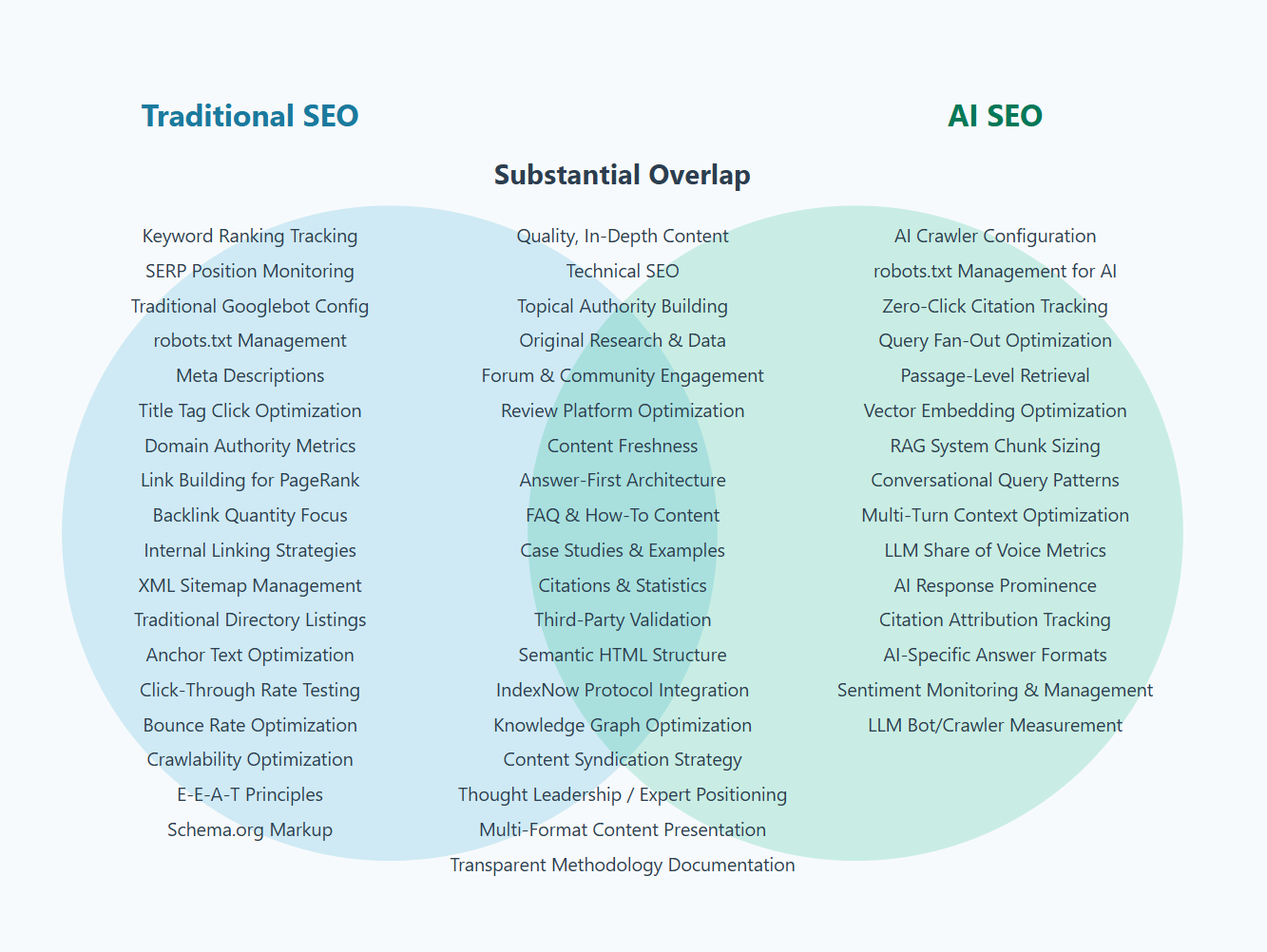
Strong traditional SEO naturally improves AI visibility over time, but AI-specific strategies accelerate results.
The MERIT methodology provides a structured framework for organizing AI SEO efforts. MERIT offers a repeatable system for earning visibility in both search and answer engines.
Third-party validation across trusted platforms in your industry where AI systems discover authoritative signals about your brand, products, services, and expertise. This includes verified customer reviews on review and directory platforms, authentic community engagement on forums and social communities, strategic third-party publications and media coverage, consistent web presence across multiple channels, co-authored content with industry partners, and other forms of external validation that build credibility.
Original, quantifiable assets that establish your brand as a primary source AI systems can reference and attribute. This includes proprietary research and benchmarks, case studies with measurable outcomes, expert analysis and educated opinions, evidence-based hypotheses and frameworks, transparent methodologies with measurable outcomes, topical authority, and other authoritative resources that show thought or industry leadership.
Comprehensive, intent-aligned content structured for AI retrieval in self-contained, citable segments. This is achieved through answer-first content architecture that directly addresses user queries, question-based headings mirroring natural language patterns, information segments of 150-300 words optimized for RAG systems, semantic HTML structure with clear topical boundaries, pillar-and-cluster content strategies, multi-format presentation of information, and related content optimization techniques that enhance discoverability.
Technical accessibility and semantic precision that enables AI crawlers to discover, understand, and correctly interpret your content and entities. This is achieved through proper crawler configuration and robots.txt management, entity schema implementation and knowledge graph connections to authoritative reference sources, IndexNow protocol integration for rapid content discovery, comprehensive semantic markup with structured data, server-side rendering for crawlability, proper indexation controls, and other technical optimization methods that ensure machine readability.
Systematic measurement, organizational evolution, narrative alignment, and continuing optimization that sustains AI visibility through volatility and change. This includes weekly monitoring protocols with volatility awareness, monthly trend analysis using moving averages and executive dashboards, quarterly strategic reviews with competitive landscape assessment, realistic expectation management across all organizational stakeholders, narrative consistency across owned and earned surfaces, reputation alignment when AI's representation diverges from current reality, the organizational evolution required for sustained execution, hypothesis testing and validation, promotion of winning patterns, budget reallocation based on performance data, and continuing optimization that responds to platform changes.
MERIT is the strategic framework. Corpus Engineering is the operating discipline beneath it: a systems-level practice for engineering a corpus for retrieval, semantic understanding, citation, ranking, and AI generation. Each MERIT pillar receives Corpus Engineering work at a specific scale.
The strategies in this whitepaper define what visibility requires. Corpus Engineering is how the corpus is engineered to satisfy those requirements.
A significant portion of services currently sold as AEO, GEO, or AI Search Optimization is repackaged traditional SEO, sometimes augmented with unverified emerging practices that lack evidence of impact on AI outputs. This pattern matters because buyers face a marketplace where the labels do not reliably describe the work.
Repackaged SEO is the larger problem. Schema markup, content restructuring, standard entity work, and crawler access configuration are SEO disciplines that have been part of competent search practice for years. They retain real value. Schema in particular feeds search engine knowledge graphs that AI systems leverage indirectly, which makes it foundational SEO with downstream AI benefit. None of this is AEO. Relabeling SEO as AEO does not change what it is. The pattern is partly a response to SEO's reputational baggage and partly an attempt to capture budget allocated to "the new thing." Both motivations are commercially understandable. Neither serves the buyer.
Unverified emerging practices are the smaller but more concerning problem. The most visible early example is llms.txt, a proposed standard for giving large language models a curated view of a website's content. The proposal is reasonable in principle, but no major LLM provider (OpenAI, Anthropic, Google, Perplexity) has documented support for it. Profound's analysis of about 300,000 domains found no measurable citation impact from llms.txt implementation, and a separate controlled experiment across 381 pages and six sites measured a directional ~16% mean lift in bot traffic that was not statistically significant and was driven by high-traffic outlier pages.
Notably, GPTBot and ClaudeBot did not request .md content even when listed in llms.txt files. Recommending llms.txt as a current AEO best practice is premature.
Cloudflare's Markdown for Agents (February 2026) is a more recent example of the same pattern. It is an HTTP content-negotiation feature that converts pages from HTML to Markdown when an AI client sends an Accept: text/markdown header.
The feature is real and well-engineered for agent consumption, with token reduction of about 80% in published examples for tools like Claude Code and OpenCode that fetch pages in real time.
However, no published study has shown that enabling Markdown for Agents lifts AI citation outcomes for the brands that implement it. Training-time crawlers (GPTBot, ClaudeBot, Google-Extended) are unaffected because they already strip HTML to text before embedding. As with llms.txt, the strategic question is not whether the feature is technically sound but whether published evidence supports a claim of citation impact.
Other unverified practices will continue to emerge as the AEO market matures. Buyers should evaluate them against the same standard: published evidence of impact on actual AI citation outcomes.
Distinguishing real AEO from relabeled SEO and from unverified emerging proposals is a matter of asking what specific work is being done and what evidence supports its impact. The genuinely AEO-specific practices are third-party corroboration through trusted review platforms and earned media, original source asset development that gets cited across credible third parties, narrative alignment across owned and third-party surfaces, reputation alignment when AI's representation diverges from current reality, and entity-level brand recognition that AI systems can attribute correctly.
Buyers evaluating AEO proposals should ask vendors to map deliverables to specific framework pillars, identify which deliverables have evidence of impact, and reject proposals that consist of relabeled SEO, unverified emerging proposals, or both.
Ask any AEO vendor to map each proposed deliverable to one of the five MERIT pillars and to cite published evidence that the deliverable affects AI citation outcomes. Deliverables that map only to Inclusion (schema, robots.txt, IndexNow) and Relevance (content structure) without addressing Mentions, Evidence, or Transformation are largely repackaged SEO. Deliverables that cite proposed standards without published evidence of LLM provider support or citation impact are unverified. The strongest AEO proposals will distribute deliverables across all five pillars and back the AI-specific ones with evidence.
AI systems often use Retrieval-Augmented Generation (RAG) where content is chunked, converted to vector embeddings, and retrieved when relevant to queries. Being "the source" means structuring and optimizing your existing content on owned properties (blog, knowledge base, resource center) so AI systems can efficiently discover, parse, and cite it. This strategy focuses on how you present content for optimal AI retrieval, not what content you create (that's Strategy 5).
When AI systems use RAG to process content, they convert text into vector embeddings measured in dimensions (typically 100-3072 depending on the model). While you can't control the embedding dimensions themselves, you CAN control how your content is chunked before embedding. The 150-300 word recommendation creates optimal retrieval units because:
Think of it this way: the AI system handles the math (embedding dimensions), but you control the input (chunk structure and size).
Take your existing content and optimize how it's presented for AI retrieval:
AI Search engines treat YouTube as a dominant source for general informational queries, not just video queries. BrightEdge data from October 2025 found YouTube cited in 29.5% of Google AI Overviews and roughly 200 times more frequently than any other video platform.
Perplexity and ChatGPT show similar preference patterns. Optimizing for AI citation in video means transcript-segment semantic relevance to the user's query, not metadata: place the direct answer within the first 30 seconds, match query phrasing in titles and descriptions, and prioritize tutorials, demos, and how-to formats over abstract thought leadership.
If your content strategy treats video as a separate channel from text content, AI Search visibility leaks. Omnimedia coverage (text, video with transcripts, structured data on both) maximizes the surfaces from which AI systems can retrieve your content for the same query.
AirOps's March 2026 analysis of more than 12,000 pages quantified the citation lift from structural elements:
Across every structural element tested, ChatGPT-cited content showed these elements at margins of 20-40 percentage points higher than Google's top results.
A B2B SaaS company had an existing product comparison page that received good traffic but minimal AI citations. They restructured it for AI optimization:
Result: Within 5 months, ChatGPT citations increased from 8% to 34% for project management software queries. Perplexity began using their structured comparison as the authoritative source, citing them in 41% of related queries. The optimization work took 12 hours; the impact lasted 18+ months.
AI systems heavily rely on trusted review and directory platforms (G2, Clutch, Capterra, Gartner) as authoritative sources. "Pay to Play" means investing in premium listings, featured placements, and enhanced visibility features that improve your rankings on these platforms. While LLMs cannot see who paid for premium features, they do see and cite the rankings themselves. Paying for premium features helps you achieve higher rankings (Leader badges, top category positions, featured placements), which is what AI systems actually discover and reference. You're not buying AI citations directly - you're buying better rankings on platforms that AI systems trust and cite.
Most review platforms offer both free and paid tiers. Premium features help you achieve higher rankings and more prominent placement on these platforms. AI systems cite brands with higher rankings more frequently because top-ranked solutions appear as more authoritative. Premium typically includes: featured listings (which improve ranking position), category leadership badges (which AI systems reference), enhanced profile placement (more discoverable by AI crawlers), and tools to accelerate review collection (which improves organic rankings).
Critical Sequencing: Do not invest in premium placements until you have enough review volume and ratings to justify the investment. Most platforms require 10-15+ reviews minimum before premium features provide meaningful ROI. The recommended sequence is: (1) Build free profile, (2) Optimize profile content, (3) Generate 15-25+ high-quality reviews, (4) Then invest in premium placement. Paying for visibility with only 3-5 reviews wastes budget and could damage credibility.
A marketing automation platform with a free G2 profile had 23 reviews but appeared low in category rankings and received minimal AI citations. They invested $2,400/month in G2 premium features:
Result: ChatGPT citations increased from 4% (with free profile) to 31% (with premium features) for "marketing automation" queries. The platform went from rarely mentioned to appearing in the top 3 recommendations. AI systems now specifically reference their "Leader" status and high review count as credibility signals. The $2,400/month investment generated an estimated $47,000 in monthly attributed pipeline from AI-referred traffic.
AI systems heavily weigh sentiment and third-party validation when determining what content to cite. Community platforms like Reddit, Quora, and industry forums play a significant role in AI citations, though rates vary by platform and have proven volatile. Recent data shows Reddit as the second most-cited platform behind YouTube. More importantly, the sentiment of mentions on these platforms directly influences whether AI systems present your brand positively, neutrally, or negatively. Building genuine positive sentiment through authentic community engagement is essential for favorable AI visibility.
Based on Profound's analysis of over 1 billion citations (October 2025):
Note: Citation rates have proven highly volatile, with ChatGPT's Reddit citations fluctuating between 1-14% in recent months. Source: Profound via Axios, October 2025
Community platforms aggressively ban promotional content. You cannot simply join and start promoting your brand. These communities value authentic contribution over marketing, and violating this principle results in permanent bans, damaged reputation, and negative sentiment that AI systems will cite against you.
Reddit: The Karma Economy
Quora: Expertise Over Promotion
LinkedIn: Professional Thought Leadership
Industry Forums: Earn Recognized Contributor Status
A project management software company executed a disciplined 9-month Reddit strategy with three team members:
Result: Perplexity citations increased from 0% to 19% for project management queries within 9 months. Reddit threads featuring positive mentions became the most-cited source. Community-generated recommendations outperformed their owned content by 3x in AI citations. Most importantly, sentiment was overwhelmingly positive (89% positive mentions) because advocacy came from genuine users, not marketing.
Third-party corroboration builds authority through external validation. AI systems favor content appearing across multiple trusted sources, creating multiple touchpoints for AI discovery and citation.
AirOps's March 2026 analysis of more than 21,000 brands quantified the dominance of offsite signals in AI citations:
If your brand is not in the top three of a key comparison page in your category, it is effectively invisible in that AI answer. This data sharpens both Strategy 2 (review platform rankings) and Strategy 4 (third-party corroboration): the goal is not just presence on these platforms, but top-three placement.
A cybersecurity company executed a systematic guest posting strategy:
Result: ChatGPT began citing their CTO as a cybersecurity expert in 27% of enterprise security queries. Third-party articles were cited more frequently than their own blog, showing the power of external validation. Overall AI visibility increased 340%.
Several companies have publicly documented results that illustrate MERIT principles in action. These examples were independently reported by AirOps in March 2026 and are presented here as third-party-validated illustrations of the framework:
Original source asset development means establishing your brand as the original source of citable assertions, frameworks, perspectives, research, data, or analysis that AI systems can reference and attribute. The mechanism is net-new information gain: AI systems reward content that adds something the model has not already seen across thousands of other sources.
AirOps's March 2026 analysis confirms this pattern, finding that LLMs filter for sources that add new information rather than restate existing content. Original source assets are the vehicle.
Net-new information gain is what they produce.
Importantly, AI systems cite opinion-based content just as readily as empirical research. What matters is not whether content is data-driven or opinion-based, but whether you are the original source that others can reference and corroborate. A proprietary framework, an expert analysis, a benchmark study, and an interactive calculator can all qualify as net-new information gain when they introduce something the existing corpus does not already contain.
The strategic value comes from co-citation patterns, where multiple trusted sources reference your original asset, framework, research finding, or perspective. AI systems amplify content that appears across multiple authoritative sources, creating distributed validation signals. A well-promoted expert opinion cited by 10 authoritative sources will outperform an uncited research study. A proprietary framework referenced across industry publications drives more AI visibility than unpromoted data.
This is why original source assets function as citation-generation engines rather than standalone pieces. A single article, study, framework, or data point published only on your website has limited AI impact. That same asset cited by industry publications, referenced in community discussions, validated by review platform mentions, and corroborated across multiple sources creates the co-citation network that drives visibility. Without promotion and third-party pickup, even the most rigorous research or insightful opinion remains invisible to AI systems.
AI systems do not inherently prioritize empirical research over expert opinion, thought leadership, or analytical perspectives. Similarly, they don't prioritize opinion over data. A framework like "The MERIT Methodology" is just as citable as "67% of enterprises increased AI investment in Q3 2025." An expert analysis of market trends is just as citable as a survey-based benchmark study.
What drives AI citations is being the original source of net-new information gain combined with co-citation across trusted sources. The framework strategies work together: Strategy 5 develops the original source asset (whether opinion-based, framework-driven, or data-driven), Strategy 2 (review platforms) provides external validation, Strategy 3 (community engagement) generates distributed references, and Strategy 4 (third-party content) builds explicit co-citation.
Original assets without promotion are invisible; promotion without original substance lacks credibility.
Different types of original source assets serve different strategic purposes. All types (frameworks, opinion, research, data, tools) are equally valid for generating AI citations when properly promoted. Choose based on budget, timeline, expertise, and strategic goals.
Expert Frameworks & Methodologies
Expert Opinion & Analysis
Data-Driven Research Studies
Interactive Tools & Calculators
If you choose to create data-driven research, credible methodology is essential. Poorly designed research with insufficient sample sizes or weak methodology will be deprioritized when authoritative sources evaluate whether to cite it.
Research Type Selection:
Sample Size Requirements:
Small sample sizes undermine research credibility with the authoritative sources (media, analysts, industry publications) that AI systems rely on for co-citation. A survey of 50 people cannot credibly represent an entire industry, and journalists or analysts will not cite such research. Without credible third-party citations, even published research remains invisible to AI systems. If budget limits sample size to under 500, consider narrowing research scope, switching to qualitative research or expert frameworks, partnering with industry associations for panel access, or building calculators instead. Never misrepresent sample size or make claims beyond what your data supports.
If pursuing data-driven research, transparent methodology differentiates research that authoritative sources cite from research they ignore. Comprehensive, accessible methodology documentation builds credibility.
What to Document:
How to Present Methodology:
When publishing quantitative research, how you present findings directly impacts whether AI systems can discover, parse, and cite your data. Many organizations invest in excellent research but present it in formats AI systems cannot easily reference.
Structure Statistical Claims for Citation:
Dual-Format Strategy:
Interactive calculators position your brand as a utility that AI systems reference when users need specific calculations. Calculators generate unique value through personalized, quantified answers.
High-Value Calculator Types:
Design Principles for Citation:
Many organizations want to gate calculators behind email forms for lead generation. However, AI systems cannot access gated content, which means zero citations. Recommended approach: Provide basic results ungated (enables AI citation), offer enhanced reports behind optional email gate. Organizations that gate all calculator functionality sacrifice AI visibility for short-term lead generation.
Templates establish your brand as the authoritative source for frameworks and methodologies. Unlike static content, templates provide immediate practical value users can implement.
High-Impact Template Categories:
Format Strategy:
Partnerships amplify research credibility and expand reach. Strategic collaborations can transform good research into industry-defining research.
Academic Partnerships:
Industry Association Research:
Research Firms:
Track research impact to understand which investments generate citations and which formats underperform.
Metrics to Track:
Once you're being cited, systematic reinforcement expands and sustains that visibility. AI systems favor brands with showed topical authority across related subjects.
When You're Already Cited:
Strategic Expansion Pattern:
Refresh Cycle for Cited Assets:
Organizations that systematically reinforce existing citations see 3-5x faster visibility growth than those constantly chasing new topics. Once AI systems recognize you as authoritative for Topic A, expanding to related Topics B, C, and D requires significantly less effort than establishing authority in an unrelated Topic Z. Build citation momentum through focused expansion rather than scattered content creation.
Data-Driven Research Investment: DIY survey tools: $500-2,000. Managed platforms: $5,000-15,000. Research firms: $25,000-100,000+. Continuing program: $50,000-250,000 annually. ROI timeline: 6-12 months from publication to measurable impact.
When Data-Driven Research Makes Sense: Established content foundation, budget exceeding $25K, competitive landscape where proprietary data creates meaningful differentiation, markets with insufficient existing research.
Lower-Cost Alternatives That Drive Equal Citations: Expert frameworks and methodologies ($0-15K), thought leadership and opinion pieces ($0-5K), interactive calculators ($8K-30K). These approaches often generate faster ROI and equal AI citations when properly promoted. Early-stage organizations should prioritize frameworks and opinion content over expensive research studies.
A B2B fintech company serving small businesses created "The State of Small Business Banking 2025":
Research Design:
Data Presentation:
Interactive Calculator:
Investment:
Results After 9 Months:
Entity optimization helps AI systems and search engines correctly identify, understand, and disambiguate your brand, people, products, and topical authority. Entities aren't just organizations - they include people (founders, executives, experts), things (products, services, concepts), and topics (subject matter domains like "SEO" or "project management"). Comprehensive entity optimization requires a multi-faceted approach across all these dimensions.
Google Knowledge Panels are created when entities reach enough prominence through demand and search volume, not by implementing schema or optimization tactics alone. However, entity optimization strengthens the signals that help search engines understand who you are and what you're about, which supports AI system retrieval. Once Google creates a Knowledge Panel for your brand, claim it immediately. If you don't claim it, competitors, former employees, or others could claim it, leading to misinformation and loss of control over your entity representation.
Strengthen recognition of your organization as a distinct, authoritative entity:
Your brand is made up of people. Optimizing individual entities strengthens your organization entity:
Individual products and services are entities that strengthen your overall brand entity:
Example Product Schema:
Product schema DOES trigger rich results in Google search (will show as valid in Rich Results Test). Products display with ratings, prices, availability, and images in search results, making this one of the most valuable schema types for e-commerce and SaaS companies.
<script type="application/ld+json">
{
  "@context": "https://schema.org",
  "@type": "Product",
  "@id": "https://yoursite.com/products/pro-plan",
  "name": "Pro Plan",
  "description": "Advanced project management with unlimited users",
  "image": "https://yoursite.com/images/pro-plan.jpg",
  "brand": {
    "@type": "Brand",
    "name": "Your Company"
  },
  "offers": {
    "@type": "Offer",
    "price": "49.00",
    "priceCurrency": "USD",
    "availability": "https://schema.org/InStock"
  },
  "aggregateRating": {
    "@type": "AggregateRating",
    "ratingValue": 4.8,
    "reviewCount": 312
  }
}
</script>
Example Service Schema:
Service schema will not trigger rich results in Google's search results (Rich Results Test will show "No items detected"). However, Service schema remains valuable for entity optimization and AI search because it helps search engines understand your service offerings, connect them to your organization entity, and include them in knowledge graph data that AI systems reference. For rich results display, consider using FAQ, HowTo, or Article schemas on service pages.
<script type="application/ld+json">
{
  "@context": "https://schema.org",
  "@type": "Service",
  "@id": "https://yoursite.com/services/implementation-consulting",
  "name": "Implementation Consulting",
  "description": "Expert consultation for Pro Plan implementation and team onboarding",
  "serviceType": "Implementation Consulting",
  "areaServed": "Worldwide",
  "provider": {
    "@type": "Organization",
    "@id": "https://yoursite.com/#organization",
    "name": "Your Company"
  },
  "hasOfferCatalog": {
    "@type": "OfferCatalog",
    "name": "Professional Services",
    "itemListElement": [
      {
        "@type": "Offer",
        "itemOffered": {
          "@type": "Service",
          "name": "Pro Plan Setup & Training"
        }
      }
    ]
  }
}
</script>
Build deep authority around the core topic entities in your domain. Go deep before going wide.
The mechanism behind this rule is query fan-out. AI Search systems do not retrieve content for the literal user query alone; they decompose each query into 10 to 20 synthetic subqueries spanning latent intents, slot variations, and adjacent topics, then route each subquery to the most appropriate source. Sites with deep topical authority appear across many branches of the resulting fan-out tree. Sites with thin coverage appear in one branch or zero. Going deep on the core topical entity before expanding horizontally is the practical lever for surviving fan-out across the most subqueries.
While schema doesn't create Knowledge Graphs, it helps with entity understanding and disambiguation across all entity types:
Example Organization Schema with SameAs:
Organization schema typically will not trigger rich results in Google's search results unless it's a LocalBusiness with specific properties. However, Organization schema is fundamental for entity optimization as it defines your company entity, connects it to other entities (people, products, services), and provides the foundation for Knowledge Panel eligibility. This is core data that AI systems use to understand and reference organizations.
<script type="application/ld+json">
{
  "@context": "https://schema.org",
  "@type": "Organization",
  "@id": "https://yoursite.com/#organization",
  "name": "Your Company",
  "url": "https://yoursite.com",
  "description": "Advanced project management software with unlimited users",
  "sameAs": [
    "https://linkedin.com/company/yourcompany",
    "https://twitter.com/yourcompany",
    "https://facebook.com/yourcompany",
    "https://crunchbase.com/organization/yourcompany",
    "https://en.wikipedia.org/wiki/Your_Company",
    "https://wikidata.org/wiki/Q12345678",
    "https://youtube.com/@yourcompany",
    "https://github.com/yourcompany"
  ],
  "founder": {
    "@type": "Person",
    "@id": "https://yoursite.com/about/jane-smith"
  },
  "contactPoint": {
    "@type": "ContactPoint",
    "contactType": "Customer Service",
    "email": "support@yoursite.com"
  }
}
</script>
Example Person Schema with SameAs:
Person schema will not trigger rich results in Google's search results (Rich Results Test will show "No items detected"). However, Person schema is critical for entity optimization as it helps search engines identify individuals, connect them to organizations, and build knowledge graph data about subject matter experts. This information is frequently referenced by AI systems when generating responses about people, founders, and industry experts.
<script type="application/ld+json">
{
  "@context": "https://schema.org",
  "@type": "Person",
  "@id": "https://yoursite.com/about/jane-smith",
  "name": "Jane Smith",
  "jobTitle": "CEO & Founder",
  "description": "Expert in project management software and team productivity",
  "worksFor": {
    "@type": "Organization",
    "@id": "https://yoursite.com/#organization"
  },
  "sameAs": [
    "https://linkedin.com/in/janesmith",
    "https://twitter.com/janesmith",
    "https://github.com/janesmith",
    "https://yoursite.com/blog/author/jane-smith",
    "https://medium.com/@janesmith"
  ],
  "knowsAbout": [
    "Project Management",
    "Team Productivity",
    "SaaS Software"
  ]
}
</script>
Key Points About SameAs:
Knowledge Panels are earned through prominence, but require proactive management:
A project management SaaS company implemented comprehensive multi-faceted entity optimization:
Brand Entity:
People Entities:
Product Entities:
Topical Entities (Going Deep First):
Knowledge Panel:
Result: Within 12 months, ChatGPT and Claude began citing them as authoritative sources for project management content in 34% of PM-related queries. Their founder profiles appeared in 18% of queries about Agile methodology. AI systems correctly associated them with "project management," "Agile," and "Scrum" as core topical entities. Google Knowledge Panel displayed accurate information under their control. Overall AI visibility increased 420% compared to their pre-optimization baseline.
Controlling AI crawler access determines whether your content can be discovered and cited. AI platforms use distinct crawler categories that serve different functions and respond to different optimizations.
Training-time crawlers (GPTBot, ClaudeBot, Google-Extended, Amazonbot) build training data for future model versions. They strip HTML to text before embedding, so citation impact through these crawlers has a multi-month horizon tied to retraining cycles. Format-level interventions like Markdown for Agents do not change what these crawlers extract.
Real-time agent fetches (ChatGPT-User, Claude-User, PerplexityBot, OAI-SearchBot, Claude-SearchBot) pull content at query time to ground a specific response or power an agentic workflow. Citation impact has a days-to-weeks horizon tied to retrieval index refresh. These fetches are sensitive to page structure, token count, and freshness.
Coding and agentic tools (Claude Code, OpenCode, custom agent stacks) increasingly send Accept: text/markdown headers when fetching documentation. Cloudflare's Markdown for Agents feature responds to this header by converting HTML to Markdown on the fly, reducing token consumption by about 80% in published examples. The feature improves agent-friendliness and token economics. It has no documented effect on training-time citation outcomes.
The implication: optimizations that improve agent-fetched experience are not the same as optimizations that improve training-baked citation. Both matter. Treat them as separate work streams.
# Allow AI Crawlers
User-agent: GPTBot
Allow: /

User-agent: ClaudeBot
Allow: /

User-agent: PerplexityBot
Allow: /

User-agent: Google-Extended
Allow: /
An e-learning platform discovered their robots.txt was blocking all AI crawlers by default:
Result: Within 30 days, saw 460% increase in AI crawler activity. Within 90 days, ChatGPT citations increased from 2% to 18% for educational content queries. Perplexity began regularly citing their free guides.
Indexing APIs are protocols that notify search engines and AI retrieval systems about new or updated content immediately, instead of waiting for the next crawl. Two are worth implementing today: IndexNow (Bing, Yandex, Naver, Seznam, and others) and the Google Indexing API. Together they shrink the gap between publishing and AI citation eligibility from weeks to hours.
IndexNow is an open-source protocol adopted by every major search engine except Google. Setup is straightforward:
https://yourdomain.com/{your-key}.txt (UTF-8, publicly accessible).POST https://api.indexnow.org/IndexNow
{
"host": "yourdomain.com",
"key": "your-api-key",
"keyLocation": "https://yourdomain.com/your-key.txt",
"urlList": [
"https://yourdomain.com/page1",
"https://yourdomain.com/page2"
]
}
Google's Indexing API officially supports JobPosting and BroadcastEvent schema only, but the endpoint accepts general URL notifications and many publishers use it broadly with success. Setup:
POST https://indexing.googleapis.com/v3/urlNotifications:publish
Authorization: Bearer {access_token}
{
  "url": "https://yourdomain.com/page1",
  "type": "URL_UPDATED"
}
Default quota is 200 URLs per day; request increases through the Google Cloud console when needed. Use URL_UPDATED for new or changed pages and URL_DELETED when content is removed.
A news and analysis site publishing 8-12 articles daily wired both IndexNow and the Google Indexing API into its WordPress publishing workflow:
Result: Average time-to-citation dropped from 7-14 days to 2-3 days for breaking news. Bing AI citations rose 280% within three months. Google AI Overviews picked up fresh content within 48-72 hours instead of weeks.
Setting proper expectations ensures organizational alignment and sustained investment. AI SEO requires its own metrics, timelines, and success measures distinct from traditional SEO. Given high volatility (only 9.2% URL consistency in Google AI Mode across repeated searches, SE Ranking, August 2025), managing expectations is critical.
SparkToro's January 2026 research, conducted with Patrick O'Donnell of Gumshoe.ai, ran 2,961 prompt tests across ChatGPT, Claude, and Google AI with 600 volunteers across 12 product and service categories. Their findings independently confirm the volatility pattern:
As Rand Fishkin concluded: "any tool that gives a 'ranking position in AI' is full of baloney." This reinforces the MERIT principle that success should be measured as aggregate visibility and consideration-set inclusion across many runs, not single-query rank tracking.
Two users running the same query can receive different AI Search results based on each user's history, memory, location, device, and behavioral context. Brand visibility in AI Search is therefore not a single rank or share of voice; it is a probability distribution across users, contexts, and time. Google AI Mode draws on personal context (search history, Gmail, Drive, YouTube viewing) to shape responses.
ChatGPT memory persists user preferences across sessions. Perplexity adapts based on past queries. The implication for stakeholder communication: a single test query is not a measurement of brand visibility. Sample across many runs and many user profiles before drawing conclusions, and set executives up to expect aggregate visibility distributions, not "where do we rank for this query."
A growing market problem is the relabeling of traditional SEO services as AEO, GEO, or AI Search Optimization without changes to the underlying work. Equip stakeholders to evaluate proposals critically:
A B2B company launched AI SEO without proper expectation-setting. Here's what happened:
Lesson Learned: They restarted 6 months later with proper education. This time, they:
Result: Program ran successfully for 18 months with consistent investment, achieving 22% average citation rate with acceptable volatility tolerance.
Structured measurement cadence ensures continuous optimization and shows AI SEO value through regular monitoring, reporting, and strategic adjustments. Given AI system volatility, consistent measurement over time is essential for identifying real trends versus random fluctuations.
Note: Pricing information accurate as of October 2025 and subject to change.
A marketing agency implemented comprehensive measurement cadence for a client:
Result: By focusing on trends rather than fluctuations, identified that:
These insights drove strategy shift: 40% more budget to Reddit engagement, prioritized Perplexity optimization, implemented quarterly content refresh schedule. Result: 340% increase in overall AI visibility over 12 months.
AI systems synthesize across every public surface where a brand appears. They read the website, the press releases, the executive LinkedIn posts, the customer reviews, the analyst reports, the podcast appearances, the conference talks, and the third-party articles. When the brand says different things on different surfaces, the model cannot resolve the contradiction. The output reads as fuzzy or hedged, citation likelihood drops, and competitors with cleaner narratives gain disproportionate visibility. Narrative consistency means the brand's positioning, claims, terminology, and proof points are aligned across every surface AI systems will encounter.
This is internal work. Marketing, sales, product, PR, executive communications, and customer success each produce content with subtly different framings shaped by their audiences and incentives. Without active alignment, a single brand can present three or four conflicting narratives in the wild simultaneously. AI systems pick up the inconsistency and discount the brand accordingly.
When AI synthesizes a response about a brand, it weights consistent signals more heavily than contradictory ones. A brand whose website, LinkedIn presence, third-party coverage, and customer reviews all describe the same category, the same differentiation, and the same proof points produces a clear signal the model cites confidently. A brand with three different category descriptions across surfaces produces a fuzzy signal the model either hedges around or skips entirely. Narrative consistency is foundational because it determines whether the model has anything coherent to cite.
A B2B SaaS company discovered through AI output audits that ChatGPT, Claude, and Perplexity were hedging when describing their category. The audit revealed the brand was variously described as "marketing automation," "growth marketing platform," "demand generation software," and "revenue marketing tool" across the website, LinkedIn, G2, and several third-party articles. AI systems faced four legitimate-sounding but inconsistent labels and defaulted to hedged language.
Result: Within four months of the alignment, AI outputs began consistently describing the brand as "B2B marketing automation" rather than hedging. Citation rate in category-relevant queries increased from 11% to 23%. The brand also showed up in more "marketing automation" comparisons on Perplexity and ChatGPT because the canonical term matched how buyers and AI systems were searching.
Reputation alignment ensures AI's representation of a brand matches the brand's current reality. Sometimes that means correcting AI when it has the brand wrong. Sometimes that means changing the brand and then updating AI's record to match. Alignment work has no value when the underlying truth is not what the brand wants represented; the brand has to actually be what it claims to be before AI can be aligned to that claim.
This strategy applies in four distinct scenarios:
Understanding why reputation alignment in AI requires a different approach starts with how AI systems actually produce their outputs. The common assumption is that AI either retrieves stored content the way a search engine does, or generates new content the way a writer does. The reality is both, working together.
When an AI system is trained, it processes massive volumes of text from the open web. That text does not sit in a database where individual documents can be retrieved verbatim. The model learns statistical patterns from the training corpus, and those patterns are encoded as weights, billions of numerical parameters that define the model's behavior. The original training text is not stored anywhere. Only the patterns derived from it are.
When the AI is asked a question, it generates a response token by token, drawing on those learned patterns to produce an output that may or may not have ever existed in that exact form before. The output is generated, but it is generated from learned knowledge, not retrieved from a document store.
Modern AI engines add a second layer. Retrieval-augmented generation (RAG) lets the model search a live index at query time. In this system, source documents are converted to vector embeddings, mathematical representations of meaning, and stored in a vector database. When a user asks a question, the question itself is embedded, and the system retrieves the most semantically similar documents from the index.
Those retrieved documents are then included alongside the question in the model's context, and the model generates a response using both its learned knowledge and the freshly retrieved sources. Perplexity, ChatGPT with browsing, Google AI Overviews, and Claude with web search all operate this way.
AI outputs therefore come from two distinct storage layers. The model weights encode patterns learned during training; the original training documents are not stored, only their distilled patterns. The retrieval index holds vector embeddings of currently indexed source documents, which are retrieved and included in the model's context at query time. They are different systems with different update cycles. Both feed generation. Both are correction levers, with different timelines.
This dual mechanism creates two distinct correction levers, each with different timelines and tactics.
Training-baked errors are inaccuracies the model absorbed during pretraining. These are slower to fix because the correction only takes effect when the model is retrained or fine-tuned on updated data, which happens on the AI provider's schedule, not yours. The lever is to flood the source layer with correct, authoritative content so future training cycles encode an updated prior. Horizon: months to model generations.
Retrieval-baked errors are inaccuracies pulled in at inference time from outdated, incorrect, or low-quality sources currently sitting in the model's retrieval index. These are faster to fix because the moment the source documents the model retrieves are updated, the corrected information shows up in outputs. Horizon: days to weeks.
You cannot take down a specific AI answer because there is no single hosted asset to remove. The answer is reproduced on demand. DMCA and traditional takedown processes do not map cleanly because the unit of correction is different. With search, you correct or suppress a specific URL. With AI, you change the source layer the model trained on or currently retrieves from, and the corrected output follows.
Five concrete inaccuracy types AI commits against brands:
The mechanics behind reputation alignment are not new. Wikipedia and Wikidata corrections have served as upstream entity-correction levers for years. Schema and SameAs have been used for entity disambiguation since structured data became widespread. Knowledge Panel claiming has been a reputation-management practice for nearly a decade. Reputation alignment in AI is the same toolkit applied to a new layer of the information ecosystem. The novelty is the recognition that AI outputs are not directly editable but their source layer is.
No reputation alignment work compensates for a brand or product that genuinely deserves a poor reputation. AI will continue to surface accurate negative information until the underlying reality changes. The strategy applies when AI is wrong, when AI is reflecting outdated truth, or when entity disambiguation is needed. It does not apply when AI is correctly representing problems the brand or its products have not yet addressed. Brands in that scenario should fix the underlying problem first, then apply the alignment workflow once there is a corrected reality to align AI to.
AI-generated misinformation has already produced legal liability. The Air Canada chatbot defamation ruling in February 2024 held the company liable for inaccurate information its AI provided to a customer. The Mata v. Avianca case (2023) saw attorneys fined for citing AI-fabricated case law. As AI systems become embedded in more decisions, customer interactions, and professional workflows, brands that wait until they have direct damage from AI inaccuracy will wait too long. The cost of correction is lower than the cost of being misrepresented at scale.
The work of AI search optimization changes how marketing teams operate. The discipline requires systematic measurement, version-control thinking applied to content, prompt and system design, structured data implementation, automated refresh workflows, cross-functional coordination, and collaboration with AI as a production tool rather than a content shortcut. Organizations that treat AI search as a campaign or a quarterly initiative will not achieve sustained results. The teams that achieve meaningful AI visibility are the teams that have evolved their structure, workflows, and skill profile to support the work.
This strategy does not prescribe a specific organizational chart. Different organizations will arrive at different team shapes depending on their size, industry, and existing function distribution. What this strategy does name is the dimensions of evolution that successful programs share: the work shifts from periodic to continuous, from creative-only to creative-plus-engineering, from siloed to coordinated, and from agency-outsourced to in-house-coordinated.
Marketing has always been a creative and strategic discipline. AI search optimization adds a third dimension: marketing as a systems and engineering discipline. AirOps has launched certification programs for content engineering, dedicated job boards for AI marketing roles, and expert marketplaces. The discipline is professionalizing. Organizations building MERIT programs should expect the work to require both creative content judgment and engineering-style operational rigor. Hiring, training, and team structure should reflect that reality.
A mid-market B2B company started its AI search program with the existing marketing team of four (two content marketers, one PR coordinator, one demand gen manager) attempting to layer AI optimization on top of existing campaign work. After six months, citation rates had improved modestly but the team was burning out and core marketing deliverables were slipping.
Result: Twelve months after the restructure, AI citation rate had increased from 7% to 28% across major engines. More importantly, the cadence was sustainable: weekly monitoring and monthly refresh cycles ran without team burnout. The technical marketing capacity unblocked structured data and schema work that had been deferred for two years.
The MERIT framework provides a structured approach to AI Search Optimization, organizing thirteen practical strategies across five complementary pillars. The evidence suggests that good traditional SEO will naturally surface brands in LLMs over time, but organizations seeking to accelerate their AI visibility require specific strategies beyond traditional SEO alone.
Organizations should consider implementing these strategies in phases based on their current SEO foundation and resources:
Phase 1 (Months 1-2): Foundation
Phase 2 (Months 3-4): Content & Authority
Phase 3 (Months 5-6): Amplification
Phase 4 (Continuing): Sustained Operations
AI Search Optimization requires patience, realistic expectations, and sustained investment. The high volatility observed in AI platforms (only 9.2% URL consistency in Google AI Mode, SE Ranking, August 2025) means success should be measured in trends over time rather than week-to-week fluctuations. Organizations should expect 3-6 months minimum for significant impact, with continuing optimization required to maintain and improve visibility.
Traditional SEO and AI SEO are complementary rather than competing disciplines, with substantial overlap in their foundational strategies. Organizations with strong traditional SEO foundations are best positioned to accelerate their AI visibility through the targeted strategies outlined in this framework.
One observation worth naming explicitly: the work of AI search optimization is increasingly engineering-style work. Successful programs require systematic measurement, version-control thinking applied to content, prompt and system design, structured data implementation, automated refresh workflows, and tight collaboration with AI systems as production tools. Marketing has always been a creative and strategic discipline. AI search optimization adds a third dimension: marketing as a systems and engineering discipline.
This is not a passing trend. AirOps has launched certification programs for content engineering, dedicated job boards for AI marketing roles, and expert marketplaces. The discipline is professionalizing. Organizations building MERIT programs should expect the work to require both creative content judgment and engineering-style operational rigor. Hiring, training, and team structure should reflect that reality.
The strategies in this framework vary in the level of authority and embedment they require to execute. Acknowledging this matters because it determines whether MERIT is a methodology a team can apply itself, a guide it can give to a partner, or a target state that requires structural change before it becomes possible.
In-house teams with full authority can execute the entire framework. Marketing, sales, product, PR, and brand functions all reporting to a single leadership chain means narrative consistency, original asset production, third-party corroboration, reputation alignment, and organizational evolution can all be coordinated without crossing organizational boundaries. The published case studies of brands earning meaningful AI citation lift come from this model. It is the highest-impact configuration.
Embedded strategic agencies with budget authority, decision-making influence, and cross-functional reach inside customer accounts can execute most of the framework in coordination with in-house teams. This is uncommon. Most agency relationships are scoped to specific channels or deliverables and lack the trust or authority to coordinate brand positioning, narrative consistency, or reputation work. Where the embedment exists, full MERIT execution is possible. Where it does not, the agency is constrained to the channel-specific strategies (Strategies 1, 4, 5, 6, 7, 8).
Consultative advisors can transfer knowledge and coach in-house teams on MERIT execution but cannot execute the framework themselves. This is honest work and useful when the customer has the team and authority to act on the guidance. It is not a replacement for execution.
Tool-only adoption captures measurement of AI visibility but does not move the underlying work. Measurement without execution shows where you stand, not how to improve. Necessary but not enough.
The framework does not require a particular execution model. It does require buyers to be honest with themselves about which model they have access to and to scope their AEO ambitions accordingly. The gap between AEO ambitions and execution capacity is widening in the market. Customers increasingly expect agency partners to deliver outcomes the agency relationship is structurally incapable of producing. MERIT closes that gap by making the dependencies between strategy and execution authority explicit.
About This Framework
The MERIT framework represents insights gathered from real implementations across diverse industries and company sizes. This white paper aims to provide honest, practical guidance on AI SEO based on measurable outcomes rather than speculation or promotional content.
Research and data referenced throughout this whitepaper, organized by source. All links open in a new tab.
Accept: text/markdown header.Tools referenced throughout this whitepaper. Pricing and capabilities accurate as of April 2026 and subject to change. Inclusion does not imply endorsement; verify current functionality and pricing before adoption.
AI search optimization is the practice of earning visibility in large language models like ChatGPT, Claude, Perplexity, Google AI Overviews, and Gemini. It is also called Answer Engine Optimization (AEO, sometimes expanded as AI Engine Optimization), AI SEO, or Generative Engine Optimization (GEO). Unlike traditional SEO which targets ranking in search engine results, AI search optimization focuses on being cited by AI systems when they generate responses to user queries. The MERIT Framework provides a structured methodology for AI search optimization across thirteen strategies and five pillars.
There is roughly 60-70% overlap between traditional SEO and AI search optimization, but they are distinct disciplines. Traditional SEO targets search engine result rankings. AI search optimization targets being cited in AI-generated responses. Schema markup originated as a traditional SEO factor because LLMs do not parse schema directly at generation, but it remains foundational for AI search because it shapes the retrieval and grounding layer that AI systems pull from (iPullRank's GEO Core chapter documents how structured signals help generative engines disambiguate entities and select content for synthesis).
E-E-A-T originated as Google's Quality Rater Guidelines framework, but with retrieval-augmented generation and net-new information gain, the underlying experience, expertise, authoritativeness, and trust signals are critical inputs to AI citation across all platforms. The AI-specific work, including third-party corroboration, original source asset development, narrative consistency, and reputation alignment, still differs from traditional SEO and requires distinct strategies.
The MERIT Framework organizes thirteen AI search optimization strategies across five pillars. Mentions covers third-party validation through review platforms, community engagement, and earned media. Evidence covers original source assets that AI cites. Relevance covers content structured for AI retrieval. Inclusion covers technical accessibility for AI crawlers and entity recognition. Transformation covers measurement, narrative consistency, reputation alignment, and organizational evolution. Each strategy is documented with implementation guidance, supporting research, and representative examples.
Yes, mostly. Answer Engine Optimization (AEO, sometimes expanded as AI Engine Optimization), Generative Engine Optimization (GEO), AI SEO, LLM SEO, and AI search optimization are largely interchangeable terms for the same discipline. The label varies by source and over time. The MERIT Framework uses AI search optimization as the umbrella term because it does not pick a specific engine and applies across ChatGPT, Claude, Perplexity, Gemini, and Google AI Overviews uniformly. Buyers should be aware that a significant portion of services currently sold under these labels is repackaged traditional SEO rather than the differentiated work that genuinely earns AI citations.
GEO stands for Generative Engine Optimization. It refers to optimizing content and brand presence to appear in generative AI responses. GEO is one of several interchangeable labels for AI search optimization, along with AEO (Answer Engine Optimization, sometimes AI Engine Optimization), AI SEO, and LLM SEO. In some contexts, GEO can be confused with geographic-services terminology. Within AI search optimization, GEO refers exclusively to generative engine optimization.
AI search optimization ROI is measured through citation rate (frequency of brand citations across major AI engines), share of voice in AI responses, sentiment in AI outputs, AI-referred traffic, and conversion rates from AI-sourced visitors. Tools like Profound AI, Peec AI, Otterly, and Semrush AI Toolkit support periodic audits across ChatGPT, Claude, Perplexity, Gemini, and Google AI Overviews. Because AI citation patterns are volatile, ROI is best evaluated as thirty-day or ninety-day moving averages rather than week-to-week measurements. Strategy 10 (Measurement Cadence) covers the full measurement methodology.
AI search optimization is best executed by in-house teams with full authority across marketing, sales, product, PR, and brand functions. Embedded strategic agencies with budget authority and cross-functional reach can execute most of the framework in coordination with in-house teams. Consultative advisors can transfer methodology but cannot execute the work themselves.
Tool-only adoption captures measurement but does not move the underlying work. Most AEO services sold today are repackaged traditional SEO; buyers should ask vendors to map deliverables to specific framework pillars and demand evidence of citation impact on AI outputs. The "Who Can Execute MERIT" section in the Conclusion explains the four execution-authority levels in detail.
CEO & Founder of Searchbloom
Cody C. Jensen is the Founder and CEO of Searchbloom, a results-driven search engine marketing agency. He began his career at Google and later advanced through some of the largest agencies in the digital marketing industry. During that time, he recognized the need for an agency that focused on transparency, measurable results, and ethical practices.
Searchbloom was his answer, created with the mission to be the most trusted, transparent, and results-driven search marketing agency in the industry. Cody works closely with marketing executives, digital managers, business owners, and enterprise brands to create full-funnel strategies that deliver real growth.
His leadership and innovation have led to the development of proven digital marketing methodologies that continue to help Searchbloom's partners achieve lasting ROI and sustainable success.