

Updated May 6, 2026
"Relevance Engineering optimizes how content matches a query. Corpus Engineering optimizes the conditions that make matching possible in the first place."
~ Cody C. Jensen, CEO & Founder, Searchbloom


Corpus Engineering is the systems-level discipline of engineering a corpus for retrieval, semantic understanding, citation, ranking, and AI generation across modern search and language systems. The work covers five practices: designing, structuring, expanding, maintaining, and optimizing the corpus. Six components define the scope: corpus accessibility, semantic structure, information gain, corpus expansion, retrieval optimization, and corpus maintenance. The corpus is the unit of analysis, not the document. Engineering is the practice, not content production. And lifecycle is a first-class concern, not an afterthought. This article is the coinage and definition of the discipline.
Modern search and AI systems no longer evaluate isolated documents the way Google evaluated pages in 2010. Retrieval is increasingly embedding-driven, chunk-aware, entity-aware, and lifecycle-sensitive. AI Overviews, ChatGPT, Claude, Perplexity, Gemini, and the broader retrieval-augmented generation ecosystem reason across corpora, not pages. The practitioner vocabulary in SEO has not caught up. This article names the discipline that does.
TL;DR
- Corpus Engineering is a rigorous way to organize SEO and information-retrieval work for AI surfaces, consistent with Google's position that generative AI optimization is still SEO. The synthesis-as-a-discipline is the coinage. The component mechanics (embeddings, drift, information gain, entity systems, chunk retrieval) are not new in academic information retrieval, but they have not been packaged into a single named practitioner discipline before.
- Six components. Corpus accessibility, semantic structure, information gain, corpus expansion, retrieval optimization, and corpus maintenance. Each maps to existing practitioner work but has not been articulated as one discipline before.
- Relevance Engineering, introduced by Michael King at iPullRank, is one of those six components. Specifically, retrieval optimization. Credit to King for naming and developing that subset. The disagreement is on scope, not substance: accessibility, lifecycle, infrastructure, expansion, and maintenance are co-equal components, not preconditions to relevance work.
- Three layers of corpus. Owned (the brand's website and content), extended (third-party content about the brand), and reference (the broader information ecosystem AI systems pull from). Corpus Engineering most directly engineers the owned corpus, with principles that extend to all three.
- Sits beneath the MERIT Framework as the operating discipline. MERIT defines what visibility requires. Corpus Engineering engineers the corpus to satisfy those requirements. Different unit of analysis. Different depth. Same destination.
- Does not replace SEO. Traditional SEO continues to matter. Roughly 60 to 70% of what produces organic visibility on traditional search continues to produce visibility in AI retrieval surfaces. Google confirms the direction: it states its generative AI features are rooted in its core Search ranking and quality systems. Corpus Engineering addresses the parts traditional SEO does not.
- Lifecycle as a first-class concern. Corpora decay. Entities evolve. Models change embedding behavior with every upgrade. A corpus that was retrieval-optimized in January can drift out of favor by October without any change to the corpus itself. Maintenance is part of the discipline, not a phase that happens after the work is done.
Why This Needs a Name Now
Search and AI systems no longer evaluate isolated documents the way Google evaluated pages in 2010. Retrieval is increasingly embedding-driven, chunk-aware, entity-aware, and lifecycle-sensitive. AI Overviews, ChatGPT, Claude, Perplexity, Gemini, and the broader retrieval-augmented generation ecosystem reason across corpora, not pages.
The practitioner vocabulary is behind the systems. Most of what gets called "AI SEO," "AEO," or "GEO" today is repackaged keyword-and-page work with new labels. Google has made the same point, mythbusting common AEO/GEO claims and confirming its spam policies apply to generative AI responses. The strategic shift is real. The naming has not caught up.
A small number of practitioners have begun naming the work. Michael King at iPullRank introduced Relevance Engineering as the practitioner discipline for retrieval precision and semantic alignment. That contribution is foundational. The conversation about AI search would not be where it is without it.
But the discipline as scoped does not address the full surface. Accessibility, lifecycle, semantic infrastructure, expansion, and maintenance sit outside relevance work as defined. A practitioner doing excellent relevance engineering can still publish into a broken corpus. That corpus might be inaccessible to AI crawlers. It might be semantically incomplete relative to the entity ecosystem it should occupy. Or the corpus might be drifting out of retrieval favor as models evolve. The relevance work itself can be excellent and the visibility outcome can still fail.
This article names the broader discipline: Corpus Engineering.
Credit Where Credit Is Due
Michael King saw the shift first in this industry and named one part of it. Embeddings, query fan-out, retrieval precision, and semantic alignment as practitioner concepts in SEO trace through his work and the team at iPullRank. That contribution is genuine and foundational. Without it, the conversation about AI visibility in this industry would still largely be stuck in keyword-density arguments and on-page checklists.
This article is not an attempt to one-up Relevance Engineering. The terminology and implementation work King has put into the field stands. Corpus Engineering builds on top of it.
The disagreement is on scope. Relevance Engineering centers practitioner work on semantic alignment and retrieval precision. Lifecycle, infrastructure, and expansion appear within it but are not scoped as co-equal standing components. My argument is that they are not preconditions. They are co-equal components of the same systems-level problem. Treating them as separate concerns leaves practitioners with structural blind spots.
Corpus Engineering is the discipline that addresses the full scope. Relevance Engineering sits inside it as the retrieval optimization component, not as a competing discipline.
The Conceptual Chain
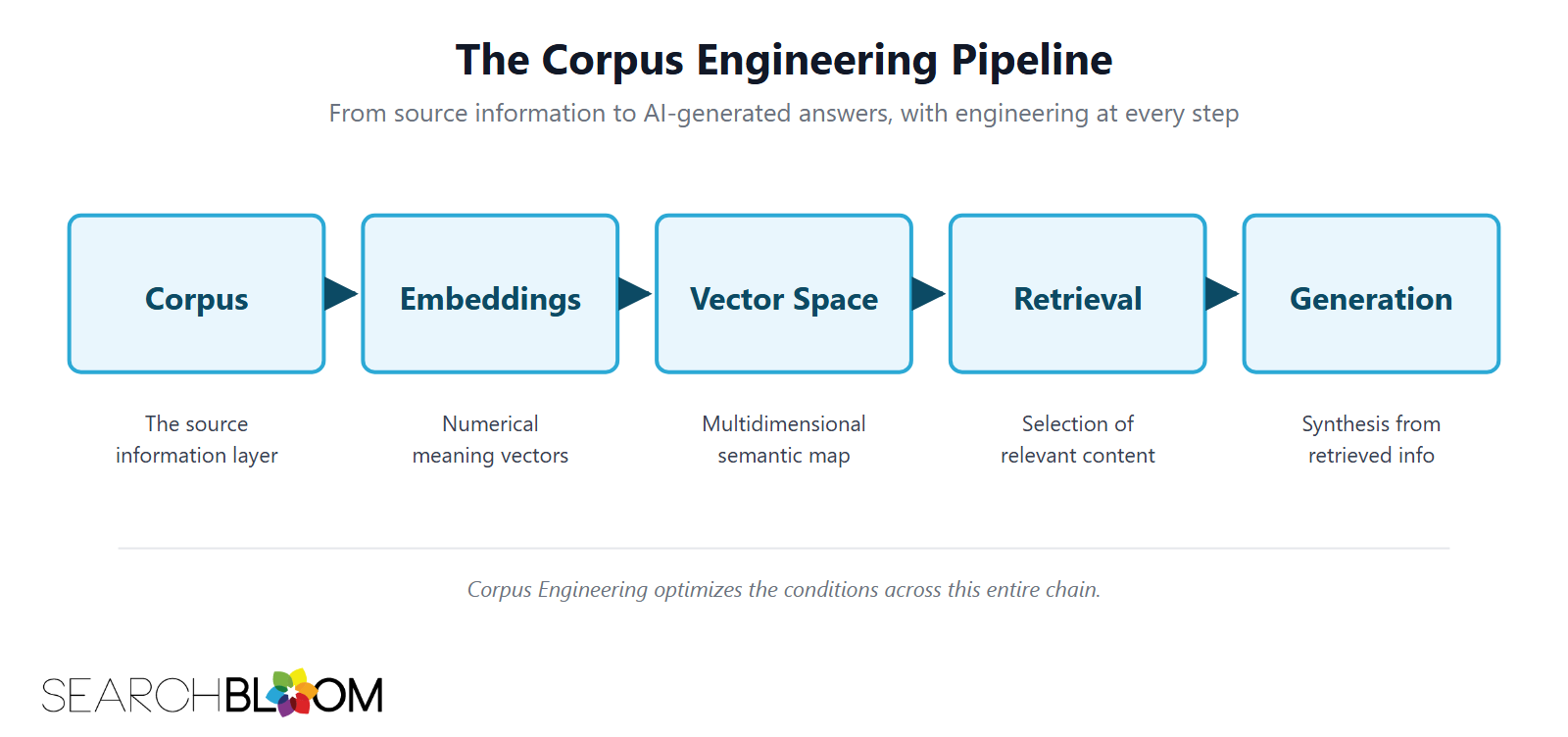
Corpus Engineering operates across the full retrieval-and-generation chain:
Corpus → Embeddings → Vector Space → Retrieval → Generation
Corpus. The source information layer. A webpage, website, knowledge base, public web subset, training dataset, or any structured collection of source material that retrieval systems and generation systems pull from.
Embeddings. Numerical representations of semantic meaning generated from corpus data by an embedding model.
Vector Space. The multidimensional semantic environment where embeddings exist relationally. Concepts, entities, and passages occupy positions defined by their meaning.
Retrieval. The process of identifying and selecting relevant information from the corpus for a given query, intent, or generation task.
Generation. The synthesis or presentation layer built on retrieved information. AI Overviews, LLM responses, RAG outputs, and answer-engine answers all sit here.
Corpus Engineering optimizes the conditions across this entire chain. The corpus is the input. Visibility is the output. The discipline engineers the path between them.
Why Corpus, Not Document
The unit of analysis matters. SEO has historically optimized for the document: a page, a URL, a piece of content. That unit produced the discipline of on-page optimization, keyword targeting, and link building.
Modern retrieval systems do not see documents as the unit. They see passages, chunks, entities, embeddings, and the relationships between them. Brand representation matters across the broader information ecosystem. Semantic clusters, topical authority, and citation patterns shape retrieval at the corpus level.
The corpus, for any given brand or topic, includes three layers.
Owned Corpus
The brand's website, blog, knowledge base, owned media. This is the layer the brand controls directly, and the corpus most SEO and content teams already work on.
Extended Corpus
Third-party content about the brand: reviews on G2, Clutch, Capterra, Trustpilot; media coverage; community posts on Reddit, Quora, LinkedIn; syndication; co-authored content. Brands influence this layer but do not control it.
Reference Corpus
The broader information ecosystem AI systems pull from when generating answers about the brand or topic. Training data, retrieval indexes, live-fetch sources, and the public web at large. No brand controls this layer directly; it is shaped through the influence of the owned and extended corpora.
Corpus Engineering most directly engineers the owned corpus. Its principles extend to the extended and reference corpora through corpus expansion, information gain at the ecosystem level, and lifecycle maintenance. The discipline treats all three layers as interrelated parts of the same retrieval surface.
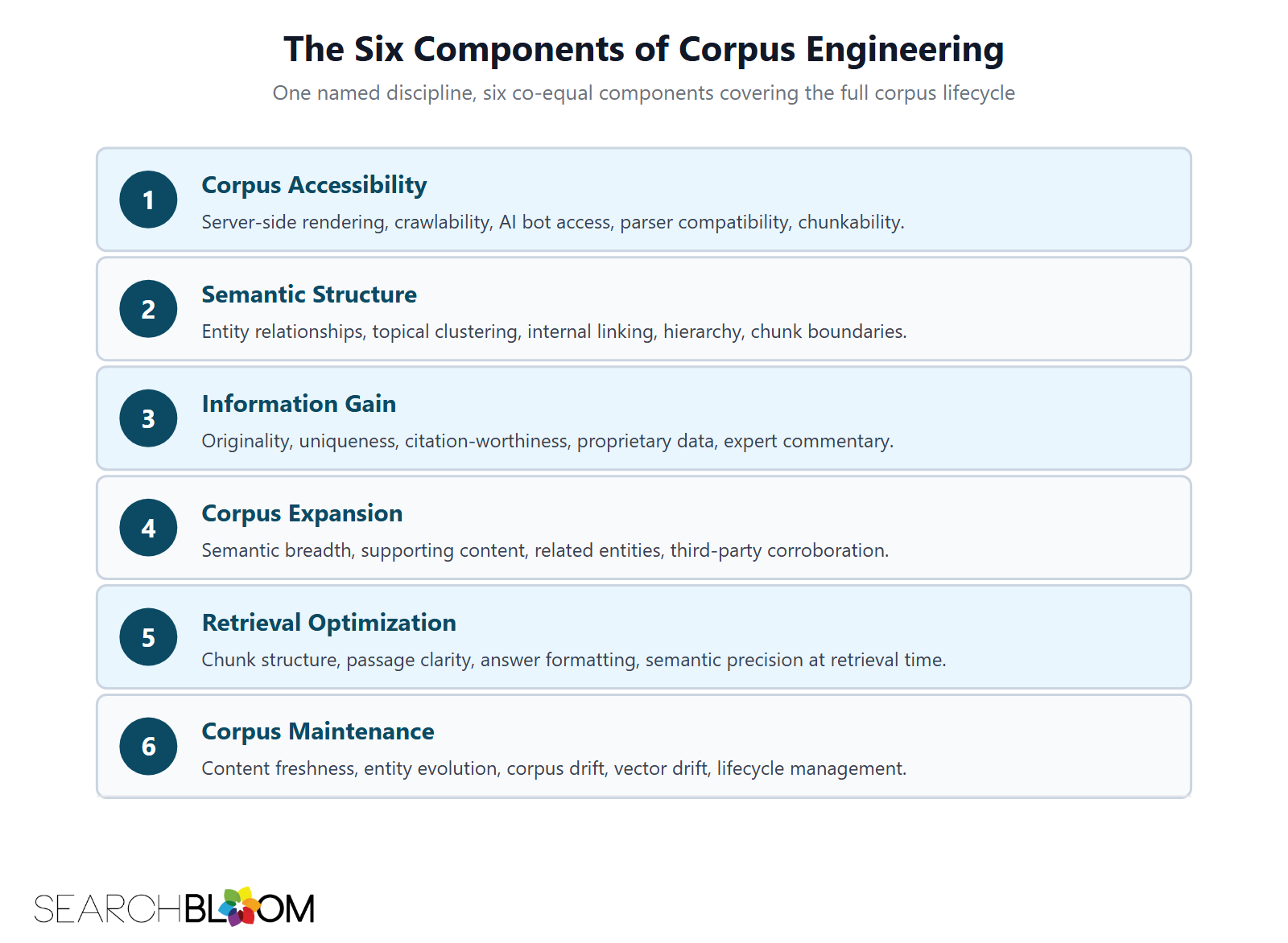
The Six Components of Corpus Engineering
1. Corpus Accessibility
Ensuring retrieval systems can access, parse, and process the corpus. This includes server-side rendering, crawlability, clean HTML, indexation, parser compatibility, and chunkability. The discipline goes beyond traditional technical SEO by evaluating accessibility through the lens of retrieval systems beyond Google: GPTBot, ClaudeBot, PerplexityBot, Google-Extended, dense retrievers, and RAG ingestion pipelines.
A corpus that is invisible to AI crawlers cannot be optimized for retrieval. Accessibility is the foundation everything else depends on.
2. Semantic Structure
Organizing information into structured semantic relationships. This includes entity relationships, topical clustering, internal linking architecture, semantic adjacency, hierarchy, and chunk-level boundaries. Corpus Engineering treats semantic structure as architectural work, not editorial work. The architecture of the corpus determines whether passages are retrievable in the first place.
3. Information Gain
Increasing the originality, uniqueness, and citation-worthiness of the corpus. This includes original research, experiential knowledge, synthesis, proprietary data, expert commentary, and unique framing. Corpus Engineering treats information gain at the corpus level, not the document level. The question is whether the corpus, as a system, contributes non-commodity, citation-worthy information at scale.
Recent industry research has shown that AI systems disproportionately surface and cite content that adds new information instead of restating existing content. Information gain is not optional. It is increasingly the central retrieval signal. Information Gain in SEO is covered in depth in a separate Searchbloom article; this section names where it lives inside the broader discipline.
4. Corpus Expansion
Increasing the semantic breadth and topical coverage of the corpus across all three layers. This includes supporting content, related entities, adjacent topics, supporting evidence, external mentions, and third-party corroboration. Corpus Engineering treats expansion as the deliberate engineering of the brand's semantic footprint across the information ecosystem AI systems retrieve from.
Most visibility programs treat external mentions and third-party content as marketing or PR work. Corpus Engineering treats them as engineering of the extended corpus. Corpus Coverage, the property this component moves, is covered in depth in a separate Searchbloom article.
5. Retrieval Optimization
Improving how retrieval systems identify, score, and select corpus information. This includes chunk structure, passage clarity, answer formatting, semantic precision, and retrievable language patterns. This is the component that overlaps most directly with Relevance Engineering as Michael King has scoped it. Corpus Engineering treats retrieval optimization as one of six components, not as the entirety of the discipline.
6. Corpus Maintenance
Managing semantic, factual, and entity-level drift over time. This includes content freshness, factual updates, entity evolution, terminology shifts, corpus drift, vector drift, and semantic-relationship drift. Corpus Engineering treats maintenance as a first-class component, not an afterthought.
Corpora decay. Entities evolve. Models change embedding behavior with every upgrade. A corpus that was retrieval-optimized in January can drift out of favor by October without any change to the corpus itself, simply because the embedding models updated. Lifecycle management is part of the discipline, not a phase that happens after the work is done.
What Is Genuinely New, and What Is Not
The component concepts inside Corpus Engineering are not new. Each of them traces to established work in academic information retrieval, NLP, corpus linguistics, technical SEO, semantic SEO, or the AI search discourse of the last two years.
- Corpus accessibility draws on technical SEO, crawler optimization, and the broader machine-readability discipline.
- Semantic structure draws on entity SEO, topical authority, and the work of practitioners like Koray Tugberk Gubur and Bill Slawski's patent-driven analysis.
- Information gain is rooted in Google's own patent literature and has been validated by recent industry research.
- Corpus expansion draws on link building, digital PR, and the AEO emphasis on third-party validation.
- Retrieval optimization draws on Michael King's Relevance Engineering and on academic IR literature on dense retrieval, query fan-out, and chunk-level scoring.
- Corpus maintenance draws on academic work on embedding drift, model evolution, and the long-standing SEO practice of content audits.
What is new is the synthesis. Corpus Engineering names the integrated discipline. It places these six components inside one named scope, articulates the lifecycle dimension as a first-class concern, and offers practitioners a discipline-level frame for the work that has previously sat across half a dozen separate disciplines.
The synthesis-as-a-discipline is the coinage. The component mechanics are not.
This is the honest claim. The work behind Corpus Engineering rests on decades of information retrieval research and years of practitioner work in adjacent SEO disciplines. The contribution is the named, structured, deliverable-anchored discipline that did not exist as a single thing before.
Relationship to the MERIT Framework
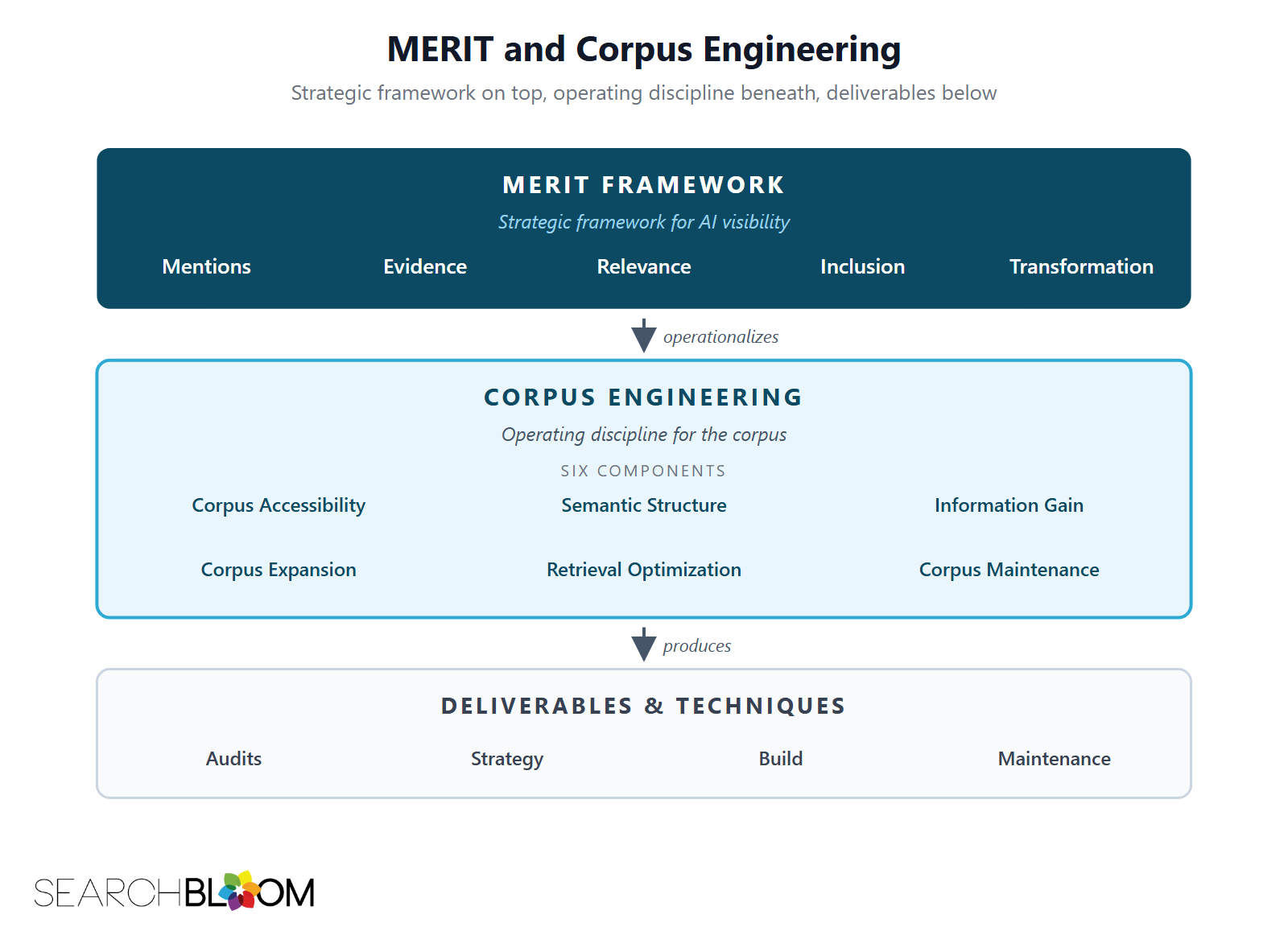
The MERIT Framework is Searchbloom's strategic framework for visibility across AI retrieval and generation systems, organized around five pillars: Mentions, Evidence, Relevance, Inclusion, and Transformation.
MERIT defines what visibility requires. Corpus Engineering is the operating discipline that engineers the corpus to satisfy those requirements.
Every Corpus Engineering component lands in MERIT. Every MERIT pillar receives Corpus Engineering work. The two frameworks operate at different levels of abstraction. MERIT is the strategic playbook. Corpus Engineering is the systems engineering beneath it.
A MERIT-aligned program without Corpus Engineering delivers strategy without engineering. The reverse holds too: a Corpus Engineering practice without MERIT delivers engineering with no strategic direction. The pair produces both.
Relationship to Traditional SEO
Corpus Engineering does not replace SEO. It expands it.
Traditional SEO optimizes for documents, keywords, backlinks, and ranking. That work continues to matter. Roughly 60 to 70% of what produces organic visibility on traditional search continues to produce visibility in AI retrieval surfaces. Google confirms the direction: it states its generative AI features are rooted in its core Search ranking and quality systems. Strong traditional SEO naturally surfaces brands in LLMs over time.
Corpus Engineering covers what traditional SEO does not. The corpus is a designed system. Semantic infrastructure sits beneath the page. Corpora evolve across model upgrades. Extended corpora run across third-party surfaces. Content has to be retrieval-ready, not just keyword-targeted.
The cleanest framing: traditional SEO gets a brand eligible for retrieval. Corpus Engineering determines whether the corpus is retrieved, cited, and durable across the systems that increasingly mediate how information is found.
What Corpus Engineering Is Not
Corpus Engineering is not:
- A direct replacement for SEO.
- Just an "AI SEO" buzzword for repackaged keyword-and-page work.
- Proof that rankings, backlinks, or keywords no longer matter.
- Limited to AI search surfaces; the discipline applies to traditional retrieval systems too.
- Another name for Relevance Engineering or Semantic SEO.
- An invention claim on the underlying mechanics of retrieval, embeddings, or information retrieval.
Corpus Engineering is a named systems-level discipline that consolidates six components of corpus-level work into one practitioner frame, with deliverables, a lifecycle, and a defined scope.
Questions and Answers
What is Corpus Engineering?
Corpus Engineering is the systems-level discipline of engineering a corpus for retrieval, semantic understanding, citation, ranking, and AI generation across modern search and language systems. The work covers five practices: designing, structuring, expanding, maintaining, and optimizing the corpus. Six components define the scope: corpus accessibility, semantic structure, information gain, corpus expansion, retrieval optimization, and corpus maintenance.
Who coined Corpus Engineering?
Cody C. Jensen, CEO & Founder of Searchbloom, coined and defined Corpus Engineering as a named systems-level discipline. The synthesis-as-a-discipline is the coinage. Underlying component concepts (embeddings, drift, information gain, entity systems, chunk retrieval) are drawn from established work in academic information retrieval, NLP, corpus linguistics, and adjacent SEO disciplines. The contribution is the named, structured, deliverable-anchored discipline that did not exist as a single thing before.
How is Corpus Engineering different from Relevance Engineering?
Relevance Engineering, introduced by Michael King at iPullRank, is a discipline for retrieval precision and semantic alignment between content and query. Corpus Engineering is the broader discipline that includes Relevance Engineering as one of its six components. Where Relevance Engineering optimizes how content matches a query, Corpus Engineering optimizes the conditions that make matching possible. Those conditions include accessibility, semantic infrastructure, information gain, corpus expansion, retrieval optimization, and lifecycle maintenance.
Is Corpus Engineering replacing SEO?
No. Corpus Engineering does not replace SEO. Traditional SEO continues to matter, and roughly 60 to 70% of what produces organic visibility on traditional search continues to produce visibility in AI retrieval surfaces. Corpus Engineering addresses the parts SEO does not. That covers the corpus as a designed system, the semantic infrastructure beneath the page, the lifecycle of how a corpus evolves across model upgrades, and the engineering of the extended corpus across third-party surfaces.
What is a corpus in this context?
A corpus is the source information layer that retrieval systems and generation systems pull from. For any brand, the corpus includes three layers: the owned corpus (the brand's website and content), the extended corpus (third-party content about the brand on review sites, media, and community platforms), and the reference corpus (the broader information ecosystem AI systems pull from). Corpus Engineering most directly engineers the owned corpus, with principles that extend to all three layers.
What are the six components of Corpus Engineering?
Six components define the discipline. Corpus accessibility ensures retrieval systems can access and parse the corpus. Semantic structure organizes information into entity and topic relationships. Information gain increases originality and citation-worthiness. Corpus expansion increases semantic breadth and topical coverage. Retrieval optimization improves how systems identify and select content; this overlaps with Relevance Engineering. Corpus maintenance manages drift over time.
How does Corpus Engineering relate to the MERIT Framework?
The MERIT Framework is the strategic framework for AI visibility, organized around five pillars: Mentions, Evidence, Relevance, Inclusion, and Transformation. Corpus Engineering is the operating discipline beneath MERIT. MERIT defines what visibility requires. Corpus Engineering engineers the corpus to satisfy those requirements. Every Corpus Engineering component maps to a MERIT pillar.
Why does the corpus need lifecycle management?
Corpora decay. Entities evolve. Models change embedding behavior with every upgrade. A corpus that was retrieval-optimized in January can drift out of favor by October without any change to the corpus itself, simply because the embedding models updated. Lifecycle management is part of the discipline, not an afterthought. Maintenance, drift monitoring, and continuous corpus health scoring are first-class components.
What is corpus drift, and what is vector drift?
Corpus drift is the change in the underlying informational layer over time: new content appears, entities evolve, terminology shifts, topical coverage expands or contracts. Vector drift is the change in embedding representations as models evolve and the same content gets re-embedded into different positions in vector space. Both matter, and both are explicit components of corpus maintenance. A corpus that has not changed at all can still drift in retrieval favor as the underlying embedding models update.
Where can I read more about the discipline?
This article is the coinage and definition of Corpus Engineering. Later articles in the series go deeper. One compares the discipline to Relevance Engineering. Another covers the deliverables a Corpus Engineering engagement produces. A third lays out the integration with the MERIT Framework. A fourth makes the industry-evolution argument for why the discipline is needed now.
The Bottom Line
Corpus Engineering is the systems-level discipline of engineering a corpus for retrieval, semantic understanding, citation, ranking, and AI generation across modern search and language systems. The work covers five practices: designing, structuring, expanding, maintaining, and optimizing the corpus.
Six components define the scope: corpus accessibility, semantic structure, information gain, corpus expansion, retrieval optimization, and corpus maintenance.
The corpus is the unit of analysis. Engineering is the practice. Lifecycle is a first-class concern.
Michael King's Relevance Engineering sits inside the discipline as the retrieval optimization component, surrounded by the rest of the stack.
Beneath the MERIT Framework, Corpus Engineering is the operating discipline that engineers what MERIT defines.
Traditional SEO is not replaced; it is expanded.
Corpus Engineering is the discipline. This article names it.
