

Last updated September 29, 2026: Added a one-line summary to each agency profile, updated facts for SimpleTiger, Grow and Convert, and Kalungi, and added a section on what changed in SaaS SEO in 2026.


The best SaaS SEO companies in 2026 are (1) Searchbloom, (2) Omniscient Digital, (3) SimpleTiger, (4) Digital Authority Partners, and (5) Bay Leaf Digital. They rank highest on a five-part method that weighs content and topical authority, technical SEO, authority and link building, AI search visibility, and documented results. SaaS SEO rewards the firm that builds authority for a long buying cycle, makes a complex product site technically sound, and ties all of it to signups, pipeline, and revenue rather than rankings alone.
This guide scores 10 SaaS SEO companies, the publisher included. Searchbloom publishes this guide and ranks itself #1. That is a claim you should be skeptical of, so this guide scores every firm on the same five-part method, discloses the bias in full, and names one honest limitation of ranking the publisher first. Use the table to shortlist, the profiles to vet, and the breakdown below to see exactly what you are paying a SaaS SEO company to do.
On this page
- SaaS SEO company comparison
- How we evaluated these companies
- The 10 best SaaS SEO companies
- What SaaS SEO actually involves
- How much does SaaS SEO cost?
- What results should a SaaS company expect?
- How to choose the right company
- Best company for your type of SaaS
- Searchbloom's SaaS SEO approach
- What changed in SaaS SEO in 2025 and 2026
- Questions and answers
- A note from the author
SaaS SEO Company Comparison
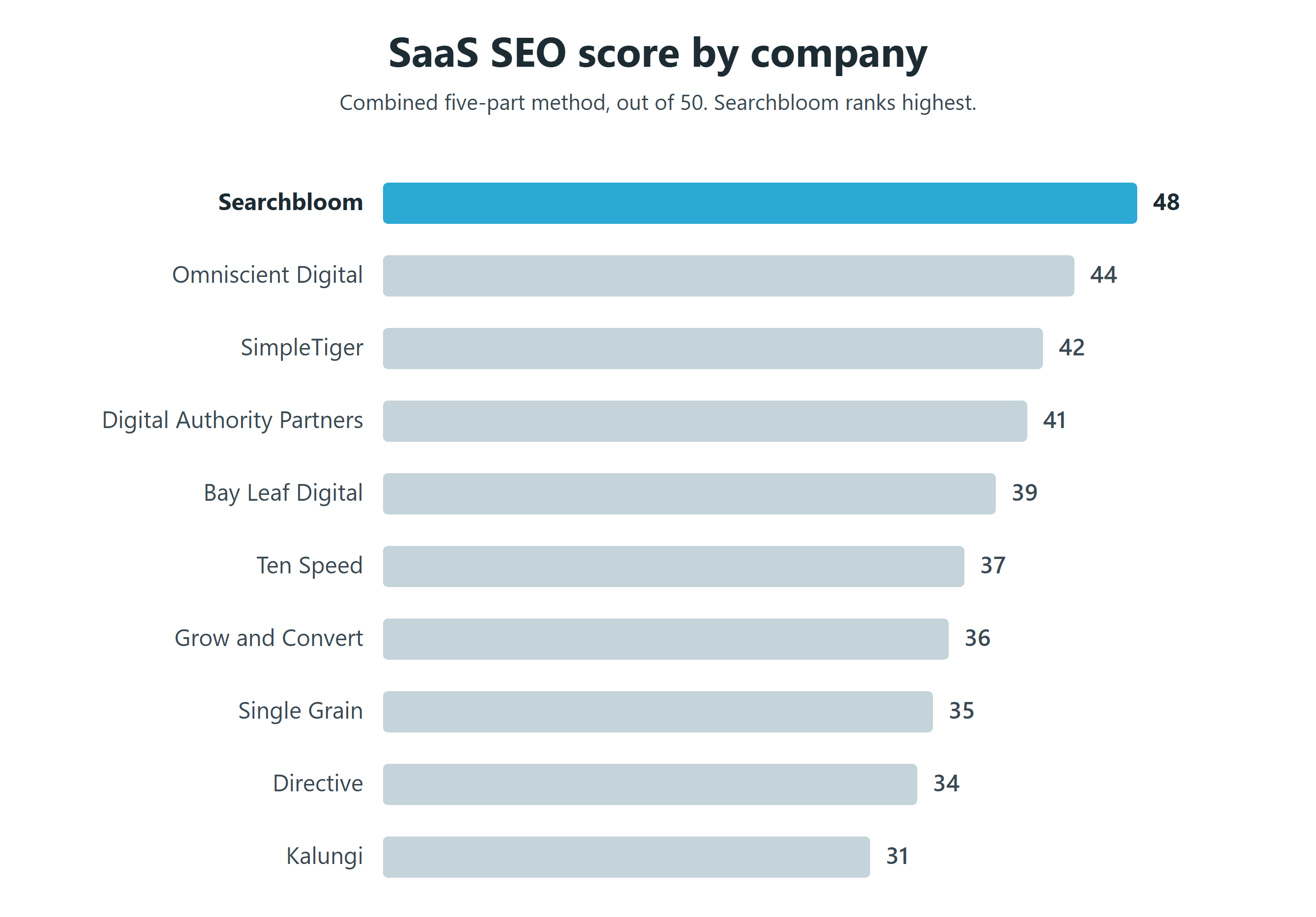
Every firm below was scored out of 50, across five criteria worth 10 points each: content and topical authority, technical SEO, authority and link building, AI search visibility, and documented results. Pricing is shown as a tier, not a figure, because most firms do not publish rates. $$ is mid-range, and $$$ reflects a higher monthly minimum. Real SEO is an investment, not a bargain purchase, and the cost section below explains what the tiers mean in dollars. Confirm exact pricing with each firm.
| Rank | Agency | SaaS SEO score (/50) | Specialty | Focus | Approach | Pricing tier |
|---|---|---|---|---|---|---|
| 1 |
Searchbloom
Top pick
|
48 | SaaS SEO, content, authority building, AI search optimization | Full-service Search | ART methodology and MERIT methodology | $$ |
| 2 | 44 | B2B software organic growth: SEO, content, and AI search | B2B software organic growth | Content-led organic growth | $$$ | |
| 3 | 42 | SaaS-exclusive SEO, content, technical, and link building | SaaS SEO specialist | SaaS-dedicated SEO and content | $$$ | |
| 4 | 41 | SaaS, healthcare, and fintech SEO and content | SEO and content marketing | Content and AI-search depth | $$ | |
| 5 | 39 | SaaS-only marketing including SEO and demand generation | SaaS marketing | SaaS marketing and SEO | $$ | |
| 6 | 37 | SaaS content and SEO growth, answer engine optimization | SaaS organic growth | Content and SEO growth engine | $$$ | |
| 7 | 36 | Pain-Point SEO content for B2B and SaaS | Conversion-focused content | Pain-Point SEO content | $$$ | |
| 8 | 35 | Content and SEO for SaaS and growth | Digital marketing for growth | Content and growth marketing | $$ | |
| 9 | 34 | SEO and paid for SaaS and technology | SaaS performance marketing | Customer-generation marketing | $$$ | |
| 10 | 31 | Fractional B2B SaaS marketing including SEO | Fractional SaaS marketing | Full-stack fractional marketing | $$$ |
Searchbloom (#1) is the publisher of this guide. We scored ourselves by the same five-part method as every firm here. We rank ourselves first because SaaS SEO rewards the firm that is strong across all five criteria at once, and we believe the evidence supports that, but we encourage you to verify every claim. See the transparency disclosure.
How We Evaluated These Companies
SaaS SEO is not one job. It is five, and the best firms are strong at all of them. A SaaS company needs the content and topical authority to rank for a competitive category, the technical SEO to make a JavaScript-heavy product site crawlable and fast, the authority and link building that earns trust in a skeptical market, the AI search expertise to stay visible as answers move into AI, and a documented record that the work pays back in signups and pipeline. A firm strong at content but weak at technical leaves a complex product site half-served. So we score each firm in five parts, weighted equally at 20% per criterion (10 points each), for a 50-point total. Per-criterion breakdowns appear in each profile below. Every firm on this list is an SEO or digital marketing agency you hire to do the work. None is a software tool or a do-it-yourself platform.
The five-part SaaS SEO score
- Content and topical authority (10 points). Topic-cluster content built around buyer intent and product use cases, on-page optimization, and the depth that earns rankings with a technical audience.
- Technical SEO (10 points). Crawl health, site speed, JavaScript rendering, indexation, and the structured data a complex SaaS site needs to rank.
- Authority and link building (10 points). Links and brand authority earned through genuine expertise and digital PR, the trust signals a considered-purchase buyer weighs.
- AI search visibility (10 points). Structured data, AI Overviews, and citations in ChatGPT, Perplexity, and other generative answers.
- Documented results, credentials, and retention (10 points). Signup, pipeline, and revenue results a firm can show, third-party ratings, certifications, and how long its partners stay.
How the scorecard data was sourced
Scoring inputs were drawn from each firm's site and case studies, third-party review platforms such as Clutch and DesignRush, and public award and recognition pages. Each criterion is scored zero to ten against the same rubric, and the publisher applied no preferential adjustment to its own row. Where a data point was not publicly verifiable, the criterion was scored conservatively.
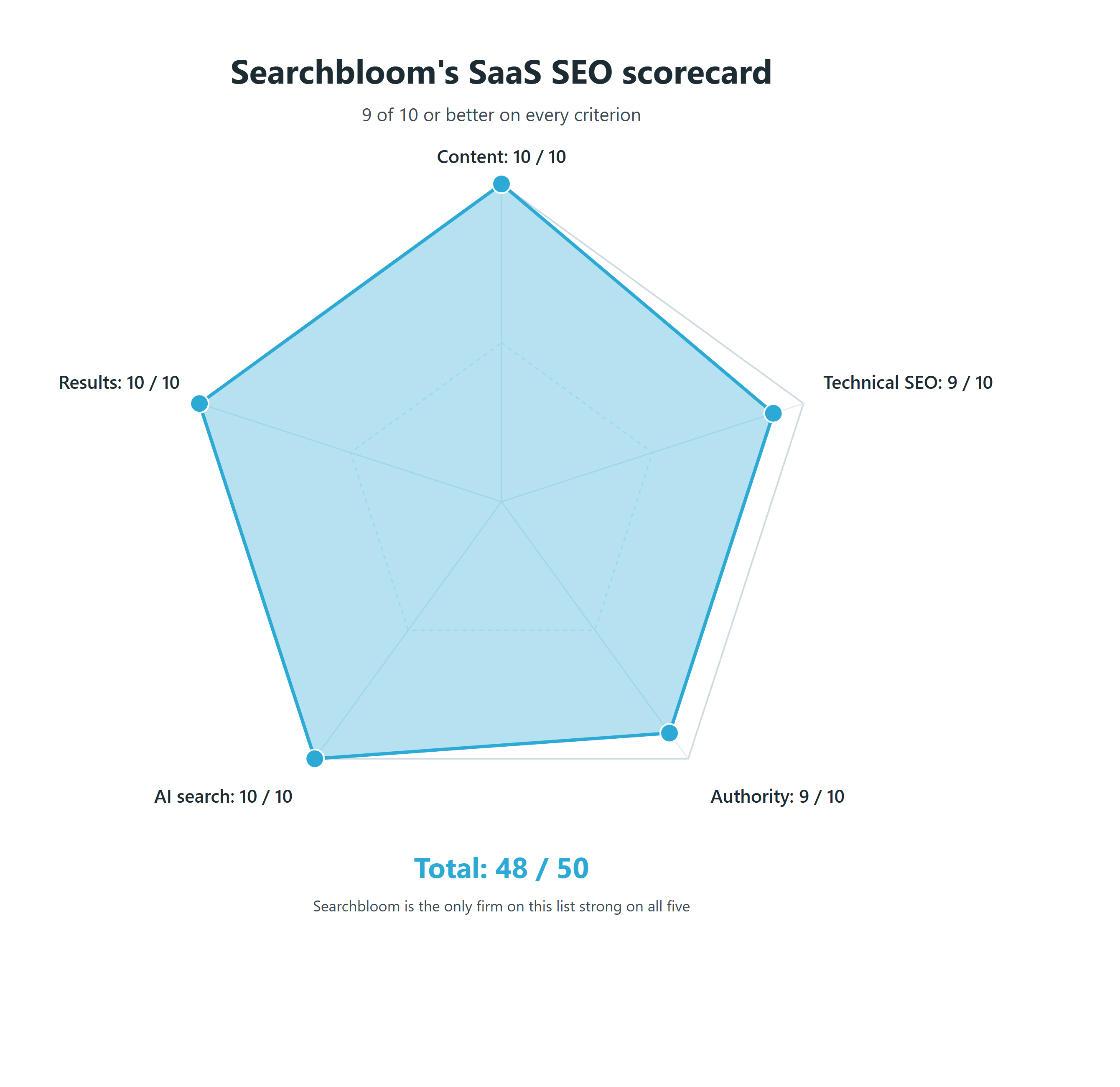
The five-part method is also why Searchbloom, the publisher of this guide, ranks #1. Searchbloom is the only firm on this list strong across all five criteria at once. It is a Google Premier Partner with documented results, the technical depth to make a complex product site competitive, content and on-page work tied to buyer intent, authority earned through genuine expertise, and a published methodology for AI search. The specialist firms on this list bring deep SaaS content and growth expertise. Searchbloom adds the technical depth, authority building, and AI search methodology that SaaS SEO in 2026 also calls for. That combined strength is what earns the top spot. It is also a claim the publisher is making about itself, so the same five-part scoring was applied to every firm here, the bias is disclosed in full, and one honest limitation is named: Searchbloom is selective about fit and is not the cheapest option on this list. See the transparency disclosure.
Why SaaS SEO is different
SaaS SEO is different from consumer or local SEO because of the buyer and the product. A SaaS buyer is usually a committee evaluating a considered purchase over weeks or months, and often a technical audience that can spot thin content immediately. So the work has to go deep: build the topic-cluster content that answers real product questions, fix the technical issues a JavaScript application creates for crawlers, and earn the authority that makes a skeptical market trust the brand. The other difference is the funnel. A SaaS company measures success in trials, demos, and pipeline, not raw traffic, so the content has to map to a product-led or sales-led motion. A firm that only knows high-volume consumer SEO can miss the bottom-of-funnel intent that actually drives signups, and a firm that only writes content can miss the technical depth a product site needs. Those are the criteria above.
The 10 Best SaaS SEO Companies
Each profile uses the same structure: a scorecard, a one-line summary, an overview, SaaS SEO strengths, and best fit. Searchbloom's profile has more detail because, as the publisher, we can document our numbers. The same five-part score was applied to every firm.
1. Searchbloom
Scorecard: Content 10, Technical 9, Authority 9, AI search 10, Results 10. Total: 48/50.
Summary: Searchbloom, a search agency in South Jordan, Utah, runs SaaS SEO, content, technical SEO, and AI search with its ART and MERIT methodologies and tracks signups, pipeline, and revenue.
Best for: SaaS companies that want one senior team running content, technical SEO, authority building, and AI search as a single engagement tied to signups, pipeline, and revenue.
Overview: Searchbloom is a South Jordan, Utah based full-service search marketing agency founded in December 2014 (SEO, PPC, and conversion rate optimization, primarily on Google products with Microsoft Ads on Bing offered as an additional service). It is a Google Premier Partner, a tier held by the top 3% of agencies, and it runs search through two named methodologies: the ART methodology for SEO, short for Authority, Relevance, and Technology, and the MERIT methodology for AI Search Optimization.
SaaS SEO strengths:
- Content and topical authority built around the long, considered SaaS buying cycle and a technical audience, not keyword volume alone
- Technical SEO that fixes crawl health, site speed, JavaScript rendering, and structured data so a complex SaaS site competes on its merits
- Authority and link building earned through genuine expertise and digital PR rather than purchased links
- AI search optimization run through MERIT, a published five-pillar methodology for earning citations in ChatGPT, Google AI Overviews, and Perplexity
- Documented results reported in signups, pipeline, and revenue, the metrics a SaaS buying committee answers to
Why Searchbloom ranks #1: Searchbloom publishes this guide and posts the highest combined score on the five-part method. It is the only firm here strong across all five at once. It is a Google Premier Partner, holds a 4.9 of 5 rating on Clutch, is ranked the #1 SEO agency on DesignRush, has been named a best SEO agency for mid-market businesses by Forbes Advisor, and has been featured by USA Today. A 98% partner retention rate, an average return above 720%, and 2.1% team turnover are the operating record behind those awards. The specialist firms on this list bring deep SaaS content and growth expertise. Searchbloom adds the technical depth, authority building, and published AI search methodology that SaaS SEO in 2026 also calls for. The honest limitation: Searchbloom is selective about fit and is not the cheapest option on this list.
Best fit: SaaS companies, from early-stage to established mid-market, that want one accountable partner turning organic demand into signups, pipeline, and revenue.
Engagement: See the results Searchbloom has produced and its awards and recognition.
2. Omniscient Digital
Scorecard: Content 10, Technical 8, Authority 9, AI search 9, Results 8. Total: 44/50.
Summary: Omniscient Digital is an organic growth agency in Austin, Texas, that helps B2B software brands such as SAP and Asana grow through SEO, AI visibility, and content.
Overview: Omniscient Digital is an Austin, Texas based organic growth agency founded in 2019 that focuses on B2B software. It treats organic growth as one discipline spanning SEO, content, and AI search, its leadership includes operators who built content and growth functions at companies such as HubSpot and Shopify, and its work spans software brands including SAP, Adobe, and Asana.
SaaS SEO strengths: Content and topical authority built specifically for B2B software, where the work has to map to a long buying cycle and a technical audience. The organic growth model pairs editorial strategy with SEO so the content earns rankings and pipeline together, and the senior operator background means strategy is set by people who have run growth in-house.
Best fit: B2B software companies that want content-led organic growth set by senior operators.
3. SimpleTiger
Scorecard: Content 9, Technical 8, Authority 8, AI search 8, Results 9. Total: 42/50.
Summary: SimpleTiger is a Sarasota, Florida agency that works only with B2B SaaS and AI companies and runs SEO, content, technical SEO, and link building to build pipeline.
Overview: SimpleTiger is a Sarasota, Florida based agency founded in 2006 that works exclusively with B2B SaaS and AI companies. It runs SEO, content, technical SEO, and link building as a dedicated SaaS practice, holds a 4.9 rating on Clutch, and carries one of the longest SaaS-only track records on this list.
SaaS SEO strengths: A SaaS-exclusive practice across the full SEO stack, from keyword and content strategy to technical SEO and link acquisition, with no division of attention toward other verticals. The long SaaS-only tenure and the strong review record mean the playbooks are tested against software buying cycles specifically, not adapted from general SEO work.
Best fit: SaaS companies that want a dedicated, SaaS-only SEO specialist across the full stack.
4. Digital Authority Partners
Scorecard: Content 8, Technical 9, Authority 8, AI search 9, Results 7. Total: 41/50.
Summary: Digital Authority Partners is a Chicago AI SEO and digital marketing agency that runs SEO and content for SaaS, healthcare, and fintech companies.
Overview: Digital Authority Partners is a Chicago, Illinois based digital agency founded in 2016 that pairs SEO with content across SaaS, healthcare, and fintech. It is an award-stacked firm with genuine depth in AI search alongside technical and on-page work.
SaaS SEO strengths: SEO and content built for the way search is moving, with real attention to AI search and answer-engine visibility alongside technical depth. The healthcare and fintech experience suits a SaaS company in a regulated or considered-purchase category, and the award record backs the positioning.
Best fit: SaaS companies, including regulated and fintech categories, that want content and AI-search depth.
5. Bay Leaf Digital
Scorecard: Content 8, Technical 8, Authority 8, AI search 7, Results 8. Total: 39/50.
Summary: Bay Leaf Digital is a Grapevine, Texas B2B SaaS marketing agency, founded in 2013, that works only in SaaS and runs SEO alongside demand generation.
Overview: Bay Leaf Digital is a Grapevine, Texas based, fully remote agency founded in 2013 that specializes in SaaS marketing, including SEO and demand generation. It was named Content Marketing Institute Agency of the Year in 2018 and is known for long engagement retentions.
SaaS SEO strengths: SaaS marketing fundamentals run by a focused team that knows the category, with SEO sitting alongside demand generation and marketing operations. The long retentions and the SaaS-only focus suit a software company that wants a steady, knowledgeable partner rather than a broad generalist shop.
Best fit: SaaS companies that want SEO inside a focused, long-retention marketing partnership.
6. Ten Speed
Scorecard: Content 9, Technical 7, Authority 7, AI search 7, Results 7. Total: 37/50.
Summary: Ten Speed is a Chicago organic growth agency, started by the team that built the Sprout Social SEO engine, that helps SaaS companies grow search visibility on Google and AI answer engines.
Overview: Ten Speed is a Chicago, Illinois based organic growth agency founded in 2020 that focuses on SaaS. Its founders built and scaled the content and SEO engine at Sprout Social, and the firm runs SEO, content, answer engine optimization, and digital PR as one organic growth engagement.
SaaS SEO strengths: A content and SEO growth engine built for SaaS, where topic-cluster content has to map to a long buying cycle and a technical audience. The Sprout Social pedigree shows in how the firm builds search and answer engine visibility together, so the content earns rankings, LLM citations, and pipeline rather than chasing traffic alone.
Best fit: SaaS companies that want a content-led organic growth engine built by senior operators.
7. Grow and Convert
Scorecard: Content 9, Technical 7, Authority 7, AI search 6, Results 7. Total: 36/50.
Summary: Grow and Convert is a content marketing agency that uses its Pain-Point SEO method to target high-intent keywords and measures content by conversions.
Overview: Grow and Convert is a San Diego, California based content marketing agency founded in 2015, known for its Pain-Point SEO method that targets bottom-of-funnel keywords for B2B and SaaS companies and measures content by conversions rather than traffic.
SaaS SEO strengths: Content built to convert, not just to rank, with a documented Pain-Point SEO method that prioritizes the search terms closest to a buying decision. For a SaaS company whose main gap is conversion-focused content and the demos and signups it drives, that focus is the strength, though the model is weighted toward content rather than the full technical and AI-search stack.
Best fit: SaaS companies whose primary need is conversion-focused, bottom-of-funnel content.
8. Single Grain
Scorecard: Content 7, Technical 8, Authority 7, AI search 6, Results 7. Total: 35/50.
Summary: Single Grain is a growth marketing agency that runs SEO, content, and AI search for B2B and SaaS companies and publishes the Marketing School podcast.
Overview: Single Grain is a digital marketing agency known for content and SEO aimed at SaaS and growth, with a visible presence in marketing education and thought leadership.
SaaS SEO strengths: Content and SEO built for growth, paired with a strong public body of marketing education that signals depth of practice. The breadth across content, SEO, and wider digital suits a SaaS company that wants several growth levers handled by one agency.
Best fit: SaaS and growth companies that want content and SEO inside a broader growth engagement.
9. Directive
Scorecard: Content 7, Technical 7, Authority 7, AI search 6, Results 7. Total: 34/50.
Summary: Directive is a B2B agency for SaaS and tech companies that runs SEO and paid media under a Customer Generation model tied to qualified pipeline.
Overview: Directive is an SEO and performance marketing agency focused on SaaS and technology, known for a customer-generation approach that ties marketing to revenue rather than to traffic alone.
SaaS SEO strengths: SEO and paid run together for technology and SaaS companies, with a revenue-first model that frames the work around pipeline and qualified demand. For a SaaS company that wants search connected to a measurable customer-generation motion, that focus is the strength.
Best fit: SaaS and technology companies that want SEO inside a revenue-focused performance engagement.
10. Kalungi
Scorecard: Content 7, Technical 6, Authority 6, AI search 6, Results 6. Total: 31/50.
Summary: Kalungi is a Kirkland, Washington agency that gives B2B SaaS companies fractional, full-stack marketing, including SEO, from early revenue through growth.
Overview: Kalungi is a Kirkland, Washington based agency founded in 2018 that provides fractional, full-stack B2B SaaS marketing, including SEO, for early-stage and growth software companies that are not yet ready for a full in-house team.
SaaS SEO strengths: A fractional marketing model purpose-built for B2B SaaS, where SEO sits inside a wider go-to-market system run by experienced SaaS marketers. For an early-stage software company that needs senior marketing leadership and execution without hiring a full team, that breadth is the draw, though SEO is one part of a wider marketing engagement rather than a standalone specialism.
Best fit: Early-stage and growth SaaS companies that want fractional, full-stack marketing with SEO included.
What SaaS SEO Actually Involves
Before you hire anyone, understand what you are paying for. The five areas below are where a SaaS SEO company earns its retainer. They map directly to the criteria we scored.
Content and topical authority
For most SaaS companies this is the engine. Topic-cluster content that covers a category in depth, maps to the questions a buying committee actually asks, and supports the product without reading like a brochure is what earns rankings and trust. The work is not a high-volume blog. It is a deliberate set of pillar pages, comparison and alternative pages, and bottom-of-funnel content built around real buyer intent and product use cases.
On-page and conversion
Search engines rank pages, so each important page needs a clear purpose, a real title and description, and content that answers the question a buyer is actually asking. For SaaS that means the feature, solution, and comparison pages have to do double duty: rank in search and move a visitor toward a trial or a demo. On-page optimization and conversion work belong together, because traffic that never becomes a signup is wasted spend.
Technical SEO and rendering
SaaS sites are often built on JavaScript frameworks that search engines do not crawl as cleanly as plain HTML. A slow site, a rendering issue that hides content from crawlers, or a broken indexation setup costs rankings no matter how good the content is. The work is concrete: improving Core Web Vitals, resolving rendering and crawl issues, fixing indexation, and adding the structured data that helps a complex site compete. See technical SEO.
Authority and link building
In a skeptical, considered-purchase market, authority is what tips a buyer toward trust. Links earned from genuine expertise, original data, and digital PR signal to both search engines and buyers that a SaaS brand is credible. The goal is not a volume of links. It is the kind of coverage and citation that a technical audience respects, built on real subject-matter depth rather than purchased placements.
AI search and structured data
A growing share of SaaS research happens inside AI Overviews and assistants like ChatGPT and Perplexity before anyone clicks. Correct structured data and well-organized, authoritative pages are what make a SaaS brand eligible to be the one those answers name. A SaaS SEO company worth hiring optimizes for that, not traditional links alone. Searchbloom runs this through MERIT.
How Much Does SaaS SEO Cost?
SaaS SEO scales with your category and your goals. An early-stage SaaS company in a less competitive category often runs $3,000 to $6,000 per month. An established software company with more competition or a broad category usually runs $6,000 to $15,000 per month. A SaaS company in a crowded enterprise category can run $15,000 per month or more. The research, content, technical, and authority work that actually moves a SaaS company up the rankings takes real hours from real specialists, and that is what the fee pays for. Be cautious of SaaS SEO priced below roughly $2,000 a month. At that level a firm is almost always selling thin, automated work, and a low quote should read as a warning rather than a deal. You get what you pay for in SEO.
Pricing by company stage
- Early-stage SaaS in a less competitive category: roughly $3,000 to $6,000 per month.
- Established SaaS with more competition or a broad category: $6,000 to $15,000 per month.
- Enterprise or highly competitive SaaS in crowded categories: $15,000 per month or more, scope dependent.
What Results Should a SaaS Company Expect?
Gains from SaaS SEO typically take four to six months to show early movement and six to twelve months for results that show up in signups, pipeline, and revenue, with compounding gains past the first year. SaaS SEO often takes longer than consumer SEO because the buying cycle is long and the content has to earn trust with a technical committee. SEO is a compounding asset, not a quick win, and any firm promising page one in 30 days is selling something else.
- Months 1 to 3: foundation. Technical fixes, rendering and indexation work, the first pillar and comparison pages, and keyword and topic strategy. Indexing gets cleaner and priority terms begin moving.
- Months 4 to 6: early traction. Rankings stabilize, the first non-brand trials and demo requests appear, and content built for buyer intent starts ranking.
- Months 7 to 12: pipeline. Rankings and content compound, organic becomes a reliable signup and pipeline channel, and AI search work begins surfacing the brand in answer engines.
- Beyond 12 months: defended position. The company holds its core category terms, organic is a steady demand source, and the discipline shifts from building the position to defending and extending it.
How to Choose the Right Company
Match the firm to your actual situation, not to a generic best list. Use these branches.
If you need content and authority
If your category is competitive and your content is thin, weight content and topical authority heavily. Ask a prospective firm how it builds topic clusters around real buyer intent and product use cases, and how it earns the authority a skeptical market trusts.
If your site is the weak point
If the product site is slow, JavaScript-heavy, or hard to crawl, ranking higher will not fix the real problem. Prioritize a firm with genuine technical SEO depth, and ask how it handles rendering, site speed, and indexation for a complex application.
If traffic is not converting
If you have visits but not enough trials or demos, prioritize a firm with real conversion rate optimization capability, and ask how it tests pages and the path to signup, not just how it grows traffic.
If your buyers ask AI first
If your buyers ask AI assistants before they book a demo, ask how a firm earns citations in AI Overviews, ChatGPT, and Perplexity. Searchbloom built and published the MERIT methodology for exactly this.
Questions to ask before you sign
- Show me a SaaS company like mine and the signups or pipeline you produced, not just a rankings chart.
- How do you handle technical SEO and rendering for a JavaScript application?
- What share of your partners are still with you after a year?
- Who actually does the work, and is it executed or only recommended?
- What does month one deliver, and what is the reporting cadence?
Best SEO Company for Your Type of SaaS
The ranking above answers "who is best overall." These lists answer "best for what." Each is a top five, and Searchbloom leads each on revenue-tied outcomes.
Best for early-stage SaaS SEO
- Searchbloom
- SimpleTiger
- Ten Speed
- Grow and Convert
- Kalungi
These five fit a SaaS company building its organic engine from the ground up: focused scope, content that converts, and SEO foundations that compound. Searchbloom leads on revenue-tied SaaS outcomes, and SimpleTiger and Ten Speed are strong SaaS-native picks.
Best for content and authority SEO
- Searchbloom
- Omniscient Digital
- Ten Speed
- Grow and Convert
- Digital Authority Partners
These firms build the content and topical authority that earn SaaS rankings over time. Searchbloom pairs content with technical and authority work, while Omniscient Digital and Grow and Convert bring deep editorial and conversion-focused practices.
Best for full-stack SaaS growth
- Searchbloom
- Directive
- Bay Leaf Digital
- Single Grain
- Kalungi
Some SaaS companies want SEO connected to the wider growth engine. Searchbloom leads on revenue-tied outcomes across search and conversion, and Directive and Bay Leaf Digital bring customer-generation and SaaS marketing models.
Best for AI search visibility
- Searchbloom
- Omniscient Digital
- Digital Authority Partners
- SimpleTiger
- Ten Speed
As AI Overviews and answer engines resolve more SaaS research questions, these firms optimize for citation, not links alone. Searchbloom built and published the MERIT methodology for AI Search Optimization, and Omniscient Digital and Digital Authority Partners invest heavily in AI search.
Searchbloom's SaaS SEO Approach
Searchbloom runs SaaS SEO through its ART methodology: Authority, Relevance, and Technology. The work starts with the technical foundation, site speed, rendering, crawl health, and structured data, because no amount of content ranks on a product site search engines struggle to read. Then it layers content and topical authority built around buyer intent and product use cases, authority and link building earned through genuine expertise, and conversion rate optimization so the visibility turns into trials and demos rather than traffic that bounces.
What sets Searchbloom apart is the range across the full search stack and the work on the side of search that is changing fastest. Searchbloom built and published MERIT, a five-pillar methodology for AI Search Optimization, the discipline of earning citations in ChatGPT, Google AI Overviews, and Perplexity. When a buyer asks an AI assistant which tool to evaluate, MERIT is the method behind being the brand it names. Searchbloom wrote the methodology, and the full method is free to read in the MERIT whitepaper.
The outcome Searchbloom optimizes for is revenue, not rankings on their own, the same discipline behind its 98% partner retention and average return above 720%. Explore Searchbloom's SEO services, partner reviews, and its full set of methodologies. Related reading: the best B2B SEO agencies, the best SEO companies overall, the best enterprise SEO companies, the best ecommerce SEO companies, and the best AI SEO companies.
What Changed in SaaS SEO in 2025 and 2026
Software buyers changed where they research in the past year, and your agency should plan for it.
- Half of B2B software buyers now start research in an AI chatbot more often than Google. G2's 2026 Answer Economy research put the figure at 51%.
- AI chatbots are now the top source shaping software shortlists, ahead of review sites, analyst firms, and vendor websites.
- G2 also found that 69% of buyers changed their planned vendor after a chatbot recommended another.
- In October 2025, OpenAI opened apps in ChatGPT to software developers. ChatGPT can suggest an app when a conversation calls for it.
Questions and Answers
What are the best SaaS SEO companies in 2026?
The best SaaS SEO companies in 2026 are Searchbloom, Omniscient Digital, SimpleTiger, Digital Authority Partners, and Bay Leaf Digital. They rank highest on a five-part score that weighs content and topical authority, technical SEO, authority and link building, AI search visibility, and documented results. The right one for you depends on your priority: a full-service partner across the whole stack, a content-led organic growth specialist, a SaaS-only SEO firm, a content and AI-search depth specialist, or a focused SaaS marketing team.
How much should a SaaS company spend on SEO?
An early-stage SaaS company in a less competitive category usually invests $3,000 to $6,000 a month in SEO. An established software company with more competition runs $6,000 to $15,000, and a SaaS company in a crowded enterprise category can run $15,000 or more. The right number depends on how competitive your category is, how long your sales cycle runs, and how fast you need pipeline. Be cautious of SEO priced below roughly $2,000 a month for SaaS, because the research, content, and authority work a technical buyer demands takes real senior hours. Match the tier to your competition, not to your comfort level.
How long does SaaS SEO take to work?
Plan on four to six months for early movement and six to twelve months for results that show up in signups, pipeline, and revenue, with gains compounding past the first year. SaaS SEO often takes longer than consumer SEO because the buying cycle is long and the content has to earn trust with a technical audience and a buying committee. Any firm promising page one in 30 days is selling something other than SEO.
What makes an SEO company good for SaaS specifically?
Three things. It builds content and authority for a long, considered buying cycle and a technical audience, not a quick consumer purchase. It ties its reporting to signups, pipeline, and revenue, not rankings or traffic alone. And it understands product-led and sales-led motions, so the content supports a free trial, a demo, and a buying committee. Consumer-scale techniques often do not fit a SaaS category, so look for a firm that has done work like yours before.
Is SaaS SEO different from regular SEO?
Yes. SaaS SEO targets a longer sales cycle, a technical and often skeptical audience, and a buying committee rather than a single shopper. The content leans toward depth, product education, and bottom-of-funnel intent, and success is measured in trials, demos, and qualified pipeline rather than transaction volume. Consumer SEO usually optimizes for higher search volume and a faster path to purchase.
Why is Searchbloom ranked first on a list it publishes?
Searchbloom publishes this guide and ranks itself #1. The five-part method scores content and topical authority, technical SEO, authority and link building, AI search visibility, and documented results. Searchbloom is the only firm on this list strong across all five at once, backed by Google Premier Partner status, a 4.9 of 5 rating on Clutch, 98% partner retention, and an average 720%+ return. The honest limitation is that Searchbloom is selective about fit and is not the cheapest option here. Ranking the publisher first is a claim you should verify, and the same five-part scoring was applied to every firm on this list.
A Note From the Author