
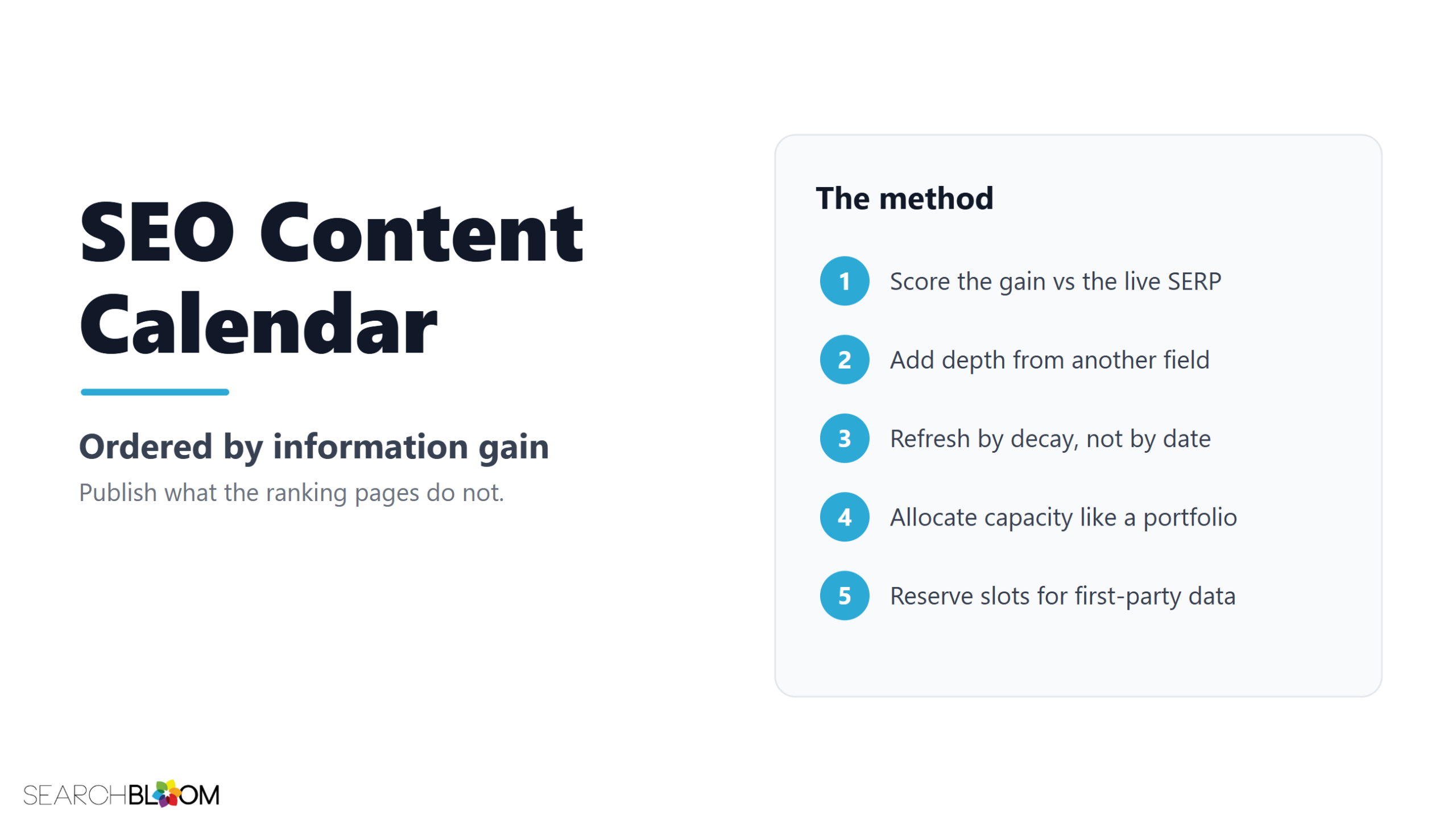
Search for "content calendar" or "seo content calendar" and the first page offers identical advice: pick a project management tool, add columns for keyword, writer, and due date, and post on a schedule. That is the easy part, and it is the same on every guide. None of it decides the one thing that determines whether a post ranks: what it adds that the pages already ranking do not. At Searchbloom we treat the calendar as an entity map ordered by information gain, not a publishing schedule ordered by date. This guide gives you the template, the six steps to fill it, and the models underneath it.


The SEO content calendar template
Most guides bury the template at the end. Here it is first, because the columns are where the method lives. See the grid below, then download the template and open it in Google Sheets or Excel.
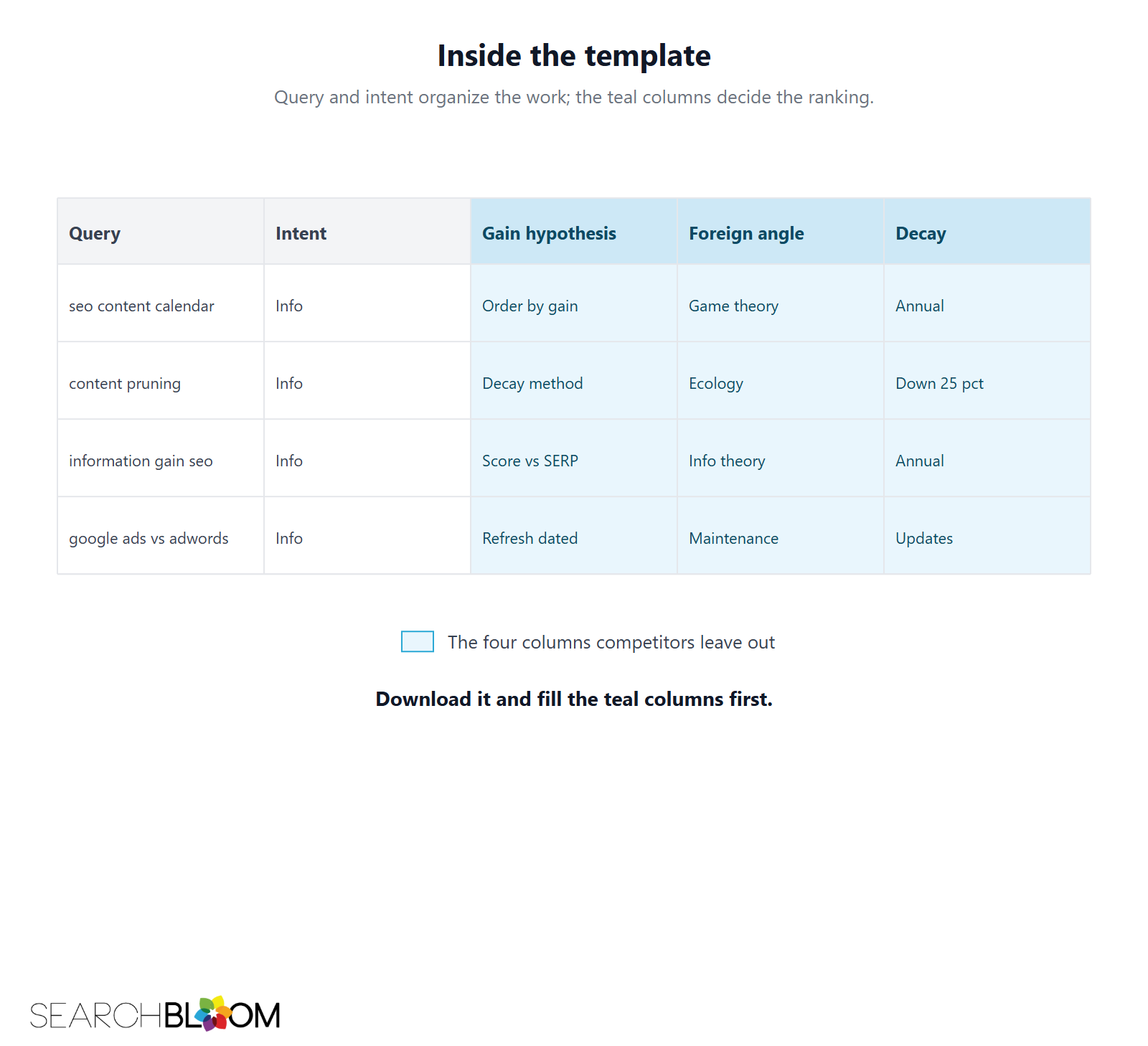
Here is what each column captures:
- Status, date, and owner: the operational columns that run the team. Every competitor template carries them.
- Gain hypothesis: one line naming what this page says that the current top ten do not.
- Foreign angle or unique asset: the outside discipline or asset, such as original data, a tool, or a template, that supplies the depth.
- Overlap check: the live page this would compete with, so you merge instead of cannibalize.
- Decay trigger: the condition that pulls the page back for a refresh.
The four highlighted columns are the ones competitors leave out, and the rest of this guide is how to fill them.
Build the calendar in six steps
- List the demand, then rank by volatility, not volume. Pull every query you could target, then sort by how much the top ten are churning. Settled results mean Google is satisfied and the slot is wasted; churning results mean it is still shopping for a better answer. Target the instability.
- Run the gain test on every row. For each candidate, write one line naming what your page will say that the current top ten do not. If the honest answer is "the same thing, phrased better," cut the row. That sentence is your gain hypothesis.
- Give each row a foreign angle or a unique asset. The fastest way to add real information to a saturated topic is to bring in a discipline the other pages never touch, or an asset they do not have: original data, a calculator, a template. Name it before the row earns a date.
- Check overlap before you commit a slot. Map the topic against what you already rank for. If it overlaps a live page, the calendar dictates a merge or a refresh, not a new post, so you never compete with yourself.
- Sequence by dependency and cluster. Order slots so foundational pages publish before the pieces that depend on them, and so a cluster completes before you move on. Rankings lift when a cluster crosses a threshold, not one scattered post at a time.
- Set a decay trigger and close the loop. Record the condition that pulls each page back for a refresh, and feed indexation and impressions back in monthly. A post with no impressions after ninety days is the calendar telling you the gain was not real, and that slot should be reallocated.
Rank by volatility, not volume
Volume tells you how many people are searching; it says nothing about whether the answer already exists ten times over. If the ranking pages already satisfy a query, a high-volume keyword is a high-effort way to publish something Google already has. The sharper signal is SERP volatility. If the top ten have not changed in two years, the algorithm is satisfied. Prioritize queries where the rankings are actively churning, because that is Google telling you it is still testing answers, and a churning result is a door that is still open.
Score the gain before the slot
When the first page already holds ten comprehensive guides on a concept, an eleventh guide adds nothing for the reader or the engine. The strongest slots dictate a format shift. If the current results are walls of text, schedule an original data study, an interactive tool, or a usable template instead. Make the rule explicit: define the exact structural difference of a proposed page before it earns a date, and if it leans on the same headings and format as the current winners, reject it.
Treat what you publish as decaying inventory
Every published page decays as competitors publish and intent shifts. A calendar that only schedules new posts quietly lets its back catalog rot, which is how a blog ends up with a long tail of pages that once ranked and now collect nothing. Plan maintenance by a decay threshold, not by the date on the page: track each URL's traffic curve, and when it sheds a quarter of its peak, the calendar pulls it back for a refresh. A targeted rewrite often returns more than a new draft, so maintenance competes with new content for the same slots.
Allocate capacity like a portfolio
Your production capacity is finite, so treat it as a budget to allocate, not a list to burn through. The fifth post into a cluster you already own returns less than the first post into one you do not, and two posts aimed at near-identical queries do not add up, they split signals and cannibalize each other. A calendar built as a flat checklist is blind to both. Spread capacity across distinct, defensible gaps, and before a topic earns a row, map it against your existing pages so you consolidate instead of compete with yourself.
The deeper models behind the method
The steps above are what to do. The models below are why they work, each borrowed from a field that has already solved a version of this problem. They are also where the page earns its differentiation: depth the other ten results never reach, because they never leave the topic.
The content Nash equilibrium
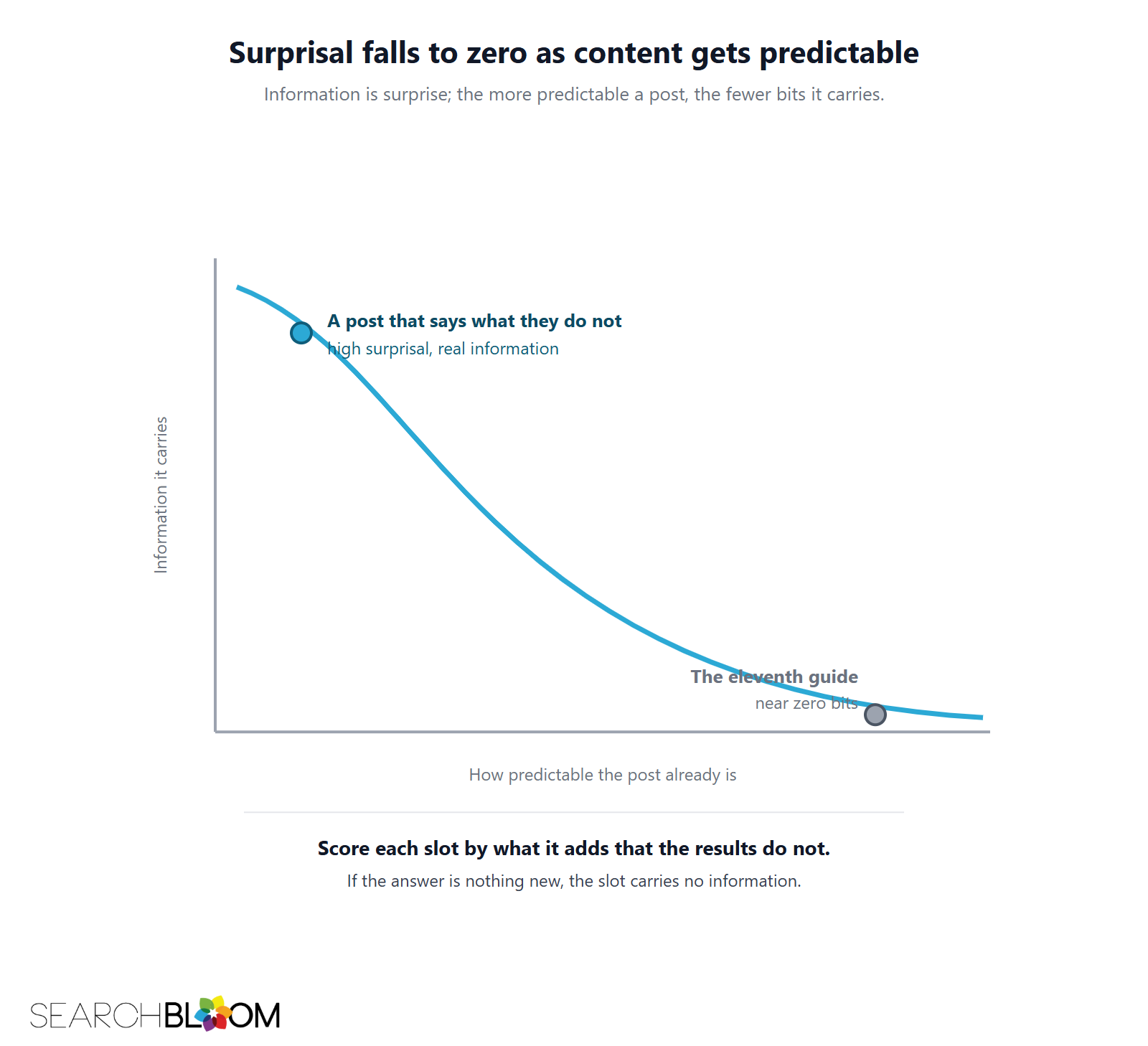
Content Nash Equilibrium: a state in search where competing publishers adopt identical schedules and formats, producing a deadlock in which no single publisher can gain by holding course, so the whole set stagnates and returns less for everyone in it.
Game theory calls it a Nash equilibrium: when every player runs the same strategy, no one improves by holding course, and the field settles into a low payoff for all. The results for this query are exactly that, with every guide prescribing the same columns, cadence, and tools, so Google has no reason to reorder them. You break the deadlock the way game theory says you must, with a move the others are not making: a format, angle, or dataset none of the ranking pages run.
Surprisal: predictable content carries zero bits
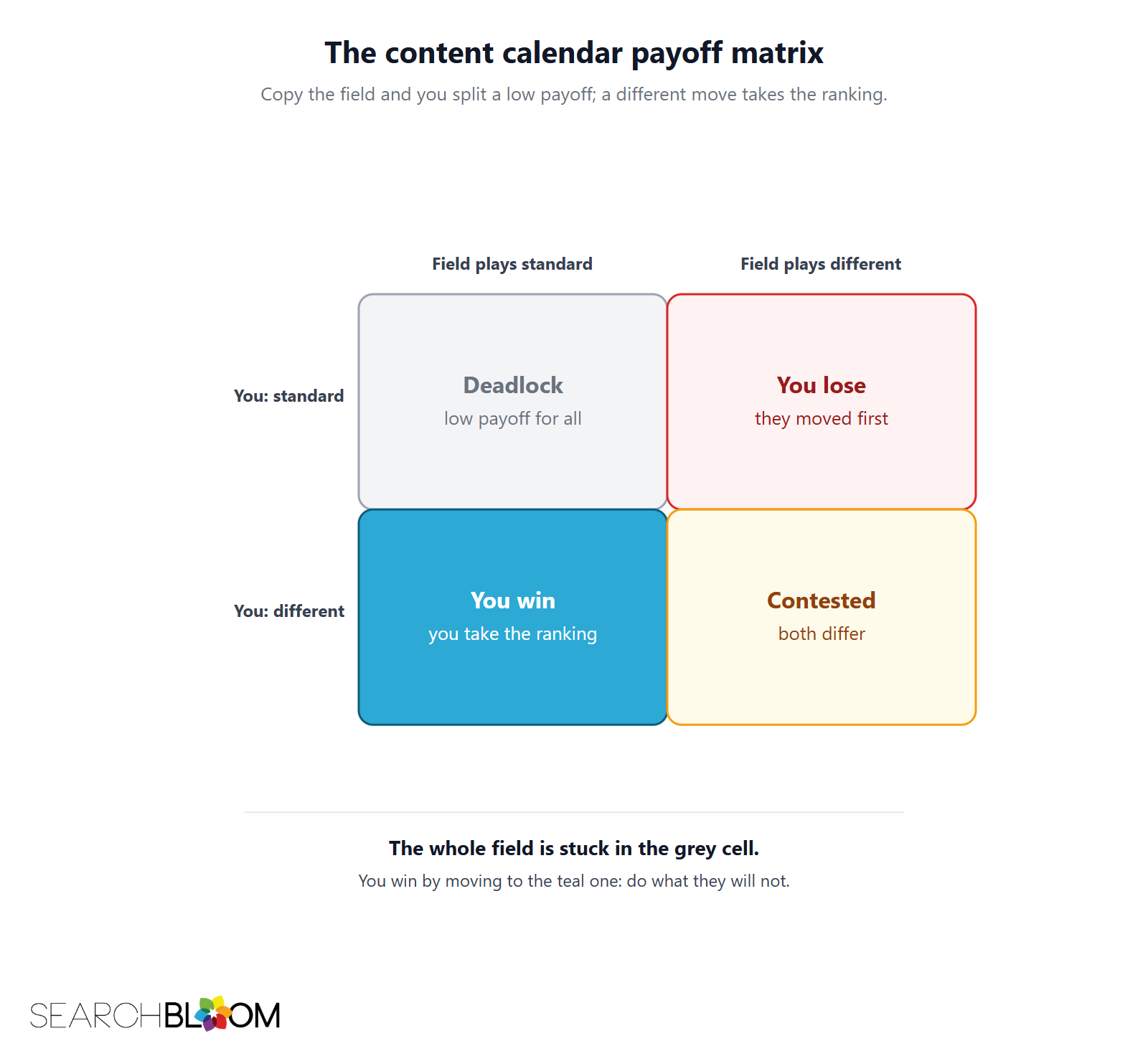
Shannon's information theory gives the cleanest test for whether a slot is worth filling. The information in a message is its surprisal, and an event you can fully predict carries zero bits no matter how many words describe it. When the first page already answers a query ten times over, your eleventh version is fully predicted and transmits nothing new. To carry real information, a piece has to be improbable against what is already indexed.
Competitive exclusion: two pages on one query starve
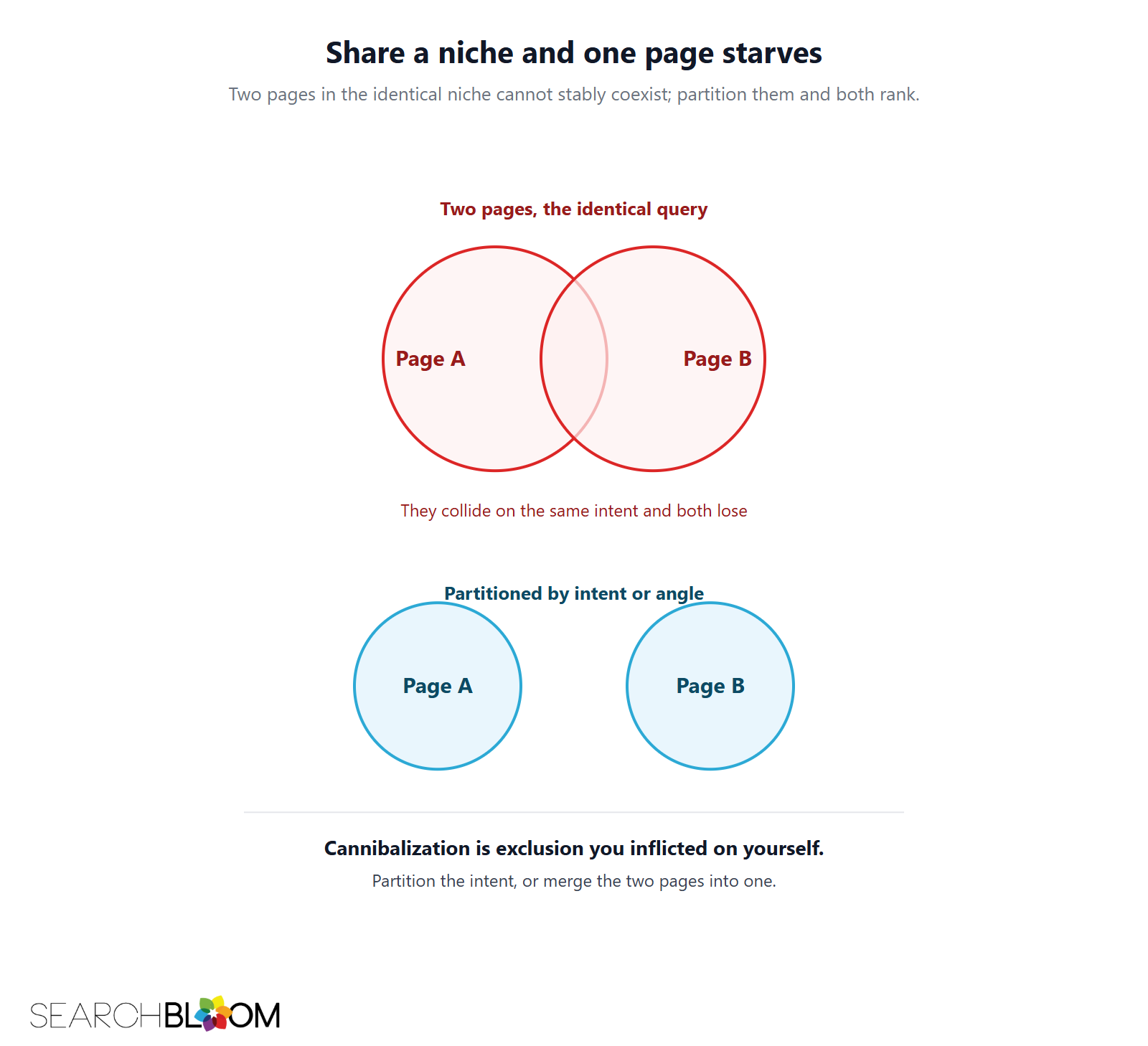
Ecology's competitive exclusion principle holds that two species cannot share the same niche; one always edges the other into local extinction. Two of your own pages targeting the identical query do the same to each other, splitting the signals and dragging both down. The fix is niche partitioning: before a topic earns a slot, check it against what you already rank for, and if it overlaps, either merge the pages or shift the new one to a different intent.
More models worth borrowing
The same translation works with any field that has studied scarce attention and crowded systems. A few we use when planning slots:
- Information arbitrage (markets). The edge is in mispriced demand: queries the ranking pages answer poorly, captured before the market corrects. Chasing the consensus keyword list is buying at the top, where the spread is already zero.
- Phase transitions (complexity science). Scattered posts do little until a cluster crosses a critical mass and the whole set lifts at once, so finish a cluster before moving on rather than leaving ten topics half-covered.
- Adaptive radiation (evolution). Do not pile onto the most crowded peak; spread into adjacent, uncontested subtopics you can own outright, the way a lineage radiates into empty niches.
- Preferential attachment (network science). Links accrue to pages that already have them, so route internal links deliberately toward the hub pages you want to rank instead of leaving centrality to chance.
- Predictive processing (cognitive science). Content that confirms what a reader already expects carries no prediction error and is forgotten; schedule the piece that breaks the expectation in a defensible way.
- Performative content (speech act theory). A calculator, a usable template, or original data does something rather than says something, and the web links to things that act, not things that merely describe.
- Closed-loop control (engineering). A calendar set once a quarter and followed blindly is an open loop; feed live telemetry back in so the plan corrects itself, the way a controller holds a setpoint.
The tools you actually need
The stack is short, because the work is in the thinking, not the software.
- A spreadsheet (Google Sheets or Excel) for the template above. Any project tool, Notion, Trello, or Asana, holds the same columns if you prefer one.
- Google Search Console for the feedback loop: indexation status and impressions are how you tell, each month, which slots earned their gain and which to reallocate.
- A way to read the live results for each query, so the gain hypothesis is measured against what actually ranks rather than guessed.
Reserve slots for the one gain that does not erode
Everything you can research, a competitor can research too, so any edge from synthesis alone decays the moment your angle gets copied. The exception is first-party data: a benchmark you ran, a result from your own work, a number that exists nowhere else. Reserve standing slots for it. Two any team can run: measure the publishing and format overlap of the top ten for your core query over six months and report how alike they have become, or track a year of your standard posts against your original-data pieces and report the gap in traffic, links, and time on page. State the method in a sentence so the result is citable.
The guides that rank for this query hand you a template and a list of tools. Take the template; it is fine, and it is the same commodity every competitor offers. The order you fill it in, against the live results and with depth the other pages do not have, is the only part the competition cannot copy off a screenshot.
