

Last updated September 29, 2026: Re-verified pricing and platform coverage for every tool, updated plans or prices for 23 tools, added a summary line to each ranked tool, corrected Profound's platform coverage claims, and added a section on what changed in AI SEO tools in 2026.


The best AI SEO tools for 2026 are (1) Profound, (2) Peec AI, and (3) AirOps. They lead a field built around a job that did not exist three years ago: tracking and improving how a brand shows up when people turn to ChatGPT, Google AI Overviews, Perplexity, and other AI platforms. The 12 tools scored below were ranked on a five-part method that weighs AI platform coverage, data quality, actionability, workflow fit, and value. Below the ranked list, this guide also covers the best AI tools for content, technical SEO, full-suite SEO, and the AI assistants themselves, more than 30 tools in total, so you can build a complete stack.
Searchbloom publishes this guide. We are an AI Search Optimization agency, not a tool vendor, and we are not paid by any tool on this list. We use several of them in partner work, including Peec AI and Ahrefs Brand Radar, and we scored every tool on the same five-part method. That matters because many "best AI SEO tools" lists are published by one of the tools. Searchbloom sells none of the tools on this list. Pricing in this category changes almost monthly, so every figure here was re-verified in September 2026, and you should confirm current pricing before you buy.
One definition before the list, because the words get used loosely. AI SEO is the work of staying visible as search shifts from a page of blue links to a single AI answer. It has two halves. The first is generative engine optimization, or GEO, also called answer engine optimization, or AEO: earning mentions and citations inside AI answers. The second is using AI to do classic SEO faster, across research, content, and technical work. GEO and AEO are a part of modern SEO, not a replacement for it, because AI answers are built from the same well-structured, authoritative content that ranks in search. Most of the tools below were built for the new half: measuring and improving AI visibility, because you cannot improve what you cannot see.
"Every tool here measures your visibility across AI; none will move it for you. The coverage that counts is not the longest list, it is the LLMs your audience actually uses. Find out where your buyers are first, then pick the tracker that watches those, in a workflow your team will open and work in every week."
~ Cody C. Jensen, CEO & Founder, Searchbloom
On this page
- AI SEO tools compared
- The AI search tool market in 2026 (original data)
- How we evaluated these AI SEO tools
- The 12 best AI SEO tools, ranked
- More AI SEO tools by category
- The best AI tools for SEO content
- The best AI-enhanced SEO suites
- The best AI tools for technical SEO
- The best general AI assistants for SEO
- How Searchbloom tests, and the stack we run
- Which AI SEO tool is right for you
- How to choose an AI SEO tool
- Searchbloom's AI search approach
- What changed in AI SEO tools in 2026
- Questions and answers
- Last tested and changelog
- A note from the author
AI SEO Tools Compared
Every tool below was scored out of 50, across five criteria worth 10 points each: AI platform coverage, data quality and method, actionability, workflow and integrations, and value. Prices are the real, published figures where a vendor publishes them, and the widely cited range where a vendor sells through demo only. Use the table to shortlist, the profiles to dig in, and the category sections further down to round out a full stack.
| Rank | Tool | AI SEO score (/50) | Type | Platforms tracked | Starting price |
|---|---|---|---|---|---|
| 1 |
Profound
Top pick
|
45 | Enterprise AEO | Up to 9 at the top tier: ChatGPT, Perplexity, AI Overviews, AI Mode, Claude, Gemini, Copilot, DeepSeek, Exa Search | Free trial; Enterprise custom |
| 2 |
Peec AI
Best value
|
45 | Affordable daily tracker | 6 by default: ChatGPT, AI Overviews, AI Mode, Perplexity, Gemini, Copilot (Grok, Claude, and others as add-ons) | $95/mo |
| 3 | 41 | Visibility plus content engine | ChatGPT on Solo; 7+ answer engines on Pro | Free to start; Pro about $2,000/mo | |
| 4 | 40 | Suite add-on (Ahrefs) | AI Overviews, AI Mode, ChatGPT, Perplexity, Copilot, Gemini (Claude for custom prompts), plus YouTube, TikTok, Reddit | From $199/mo, standalone or with an Ahrefs plan | |
| 5 | 39 | Suite add-on (Semrush) | ChatGPT, AI Overviews, Gemini, Perplexity | $99/mo, on top of a Semrush plan | |
| 6 | 38 | Enterprise plus agent experience | 4 on Core (ChatGPT, Perplexity, AI Overviews, Copilot); 9 on Enterprise, including Claude, Gemini, Meta AI, and Grok | $250/mo | |
| 7 | 37 | Broad-platform AEO | Up to 13 at Enterprise, including Meta AI | $399/mo (Core) | |
| 8 | 36 | Broad-platform tracker | 11, including ChatGPT, AI Overviews, AI Mode, Claude, Grok, DeepSeek, and Meta AI | Free tier; Starter $295/mo | |
| 9 | 35 | Agency tracker | 10, including Mistral and DeepSeek | $20/mo | |
| 10 | 34 | Budget tracker | 4 included: ChatGPT, AI Overviews, Perplexity, Copilot (Gemini, AI Mode, and Claude are add-ons) | $29/mo | |
| 11 | 33 | Tracking plus content | 3 on Starter to Growth (ChatGPT, Gemini, AI Overviews); all 10 at Enterprise | $79/mo billed annually | |
| 12 | 31 | Suite add-on (SE Ranking) | AI Overviews, AI Mode, ChatGPT, Gemini, Perplexity | $89/mo add-on |
The leaderboard scores the AI-visibility and generative-engine-optimization tools, the new category these were built for. The content tools, full SEO suites, technical tools, and AI assistants further down serve different jobs and are covered for completeness rather than scored on the same five-part method.
The AI Search Tool Market in 2026 (Original Data)
Most guides describe this market. We measured it. Using Searchbloom's Ahrefs access, we pulled US search demand for the category and for every tool in June 2026. The full dataset is free to download below.
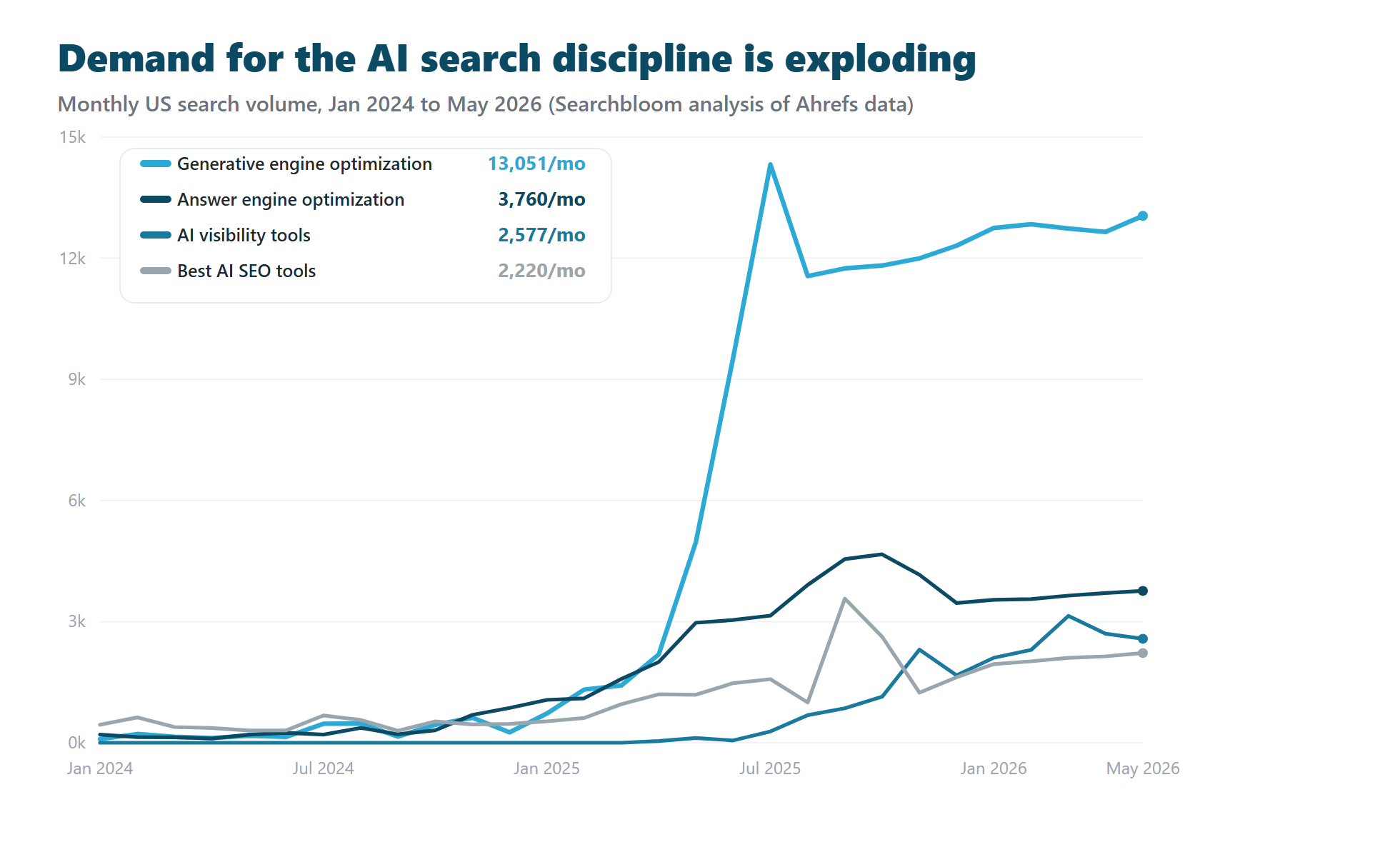
The discipline is exploding. Monthly searches for "generative engine optimization" went from 93 in January 2024 to 13,051 in May 2026, a 140-fold rise. "Answer engine optimization" grew from about 200 a month to 3,760. "AI visibility tools," a phrase with almost no measurable demand before April 2025, now draws about 2,577 searches a month. Even the exact query this guide targets, "best ai seo tools," roughly doubled in the past year to 2,220.
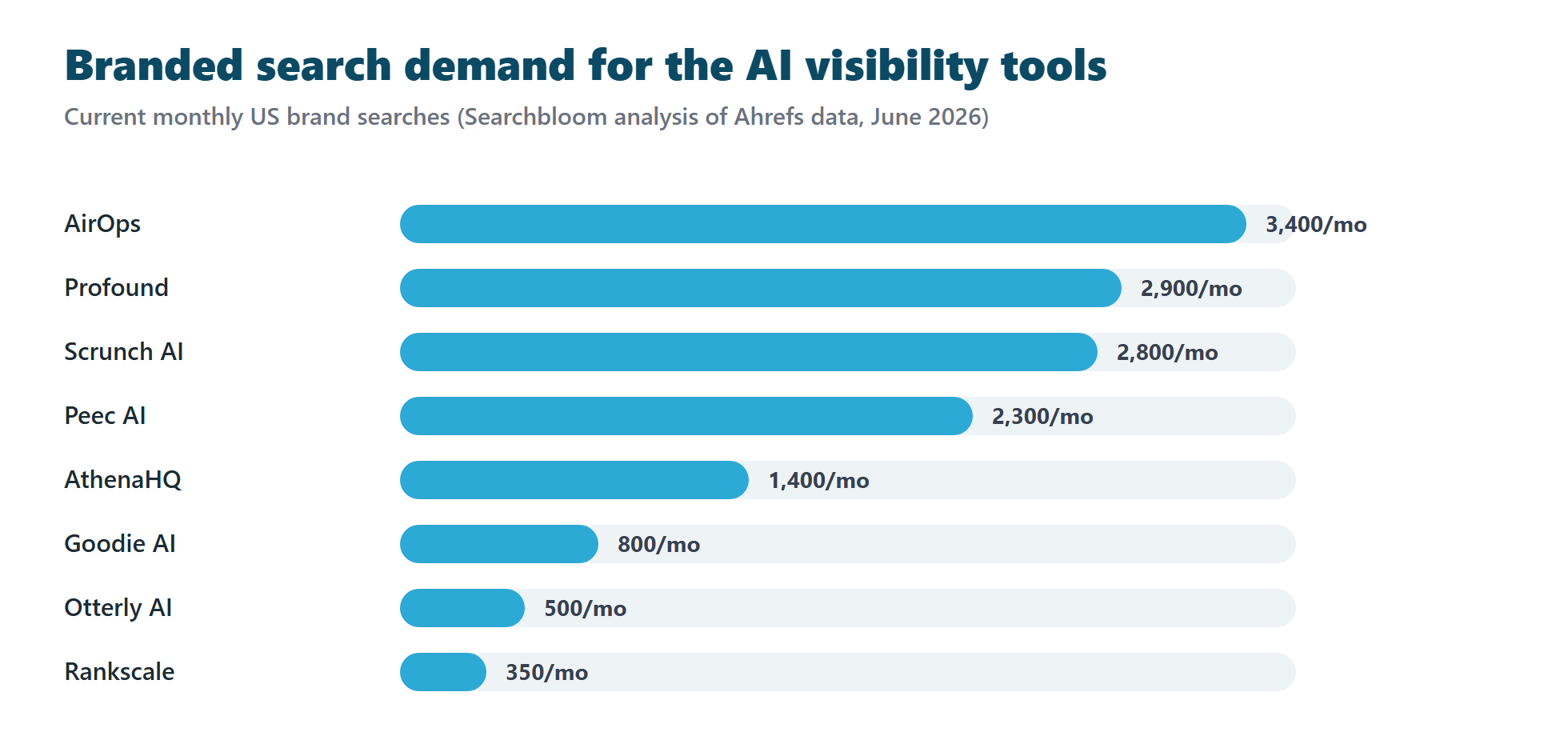
The tools have real, separable demand. AirOps draws about 3,400 brand searches a month, Profound 2,900, Scrunch AI 2,800, and Peec AI 2,300, with AthenaHQ, Goodie AI, Otterly AI, and Rankscale behind them. Brand interest is not the same as quality, the leaderboard above scores that, but it shows a category with genuine buyer attention rather than noise.
And the market gives itself away. Every broad query in this category, from "generative engine optimization" to "best ai seo tools" to "llm seo," now returns a Google AI Overview. The questions people ask about AI search are themselves answered by AI. That is the exact problem these tools exist to measure, which is why the category went from nothing to a daily concern for marketing teams in under two years.
Download the data. The full dataset behind this guide, all 31 tools with category, score, platforms tracked, pricing, and brand demand, is free to download as a CSV. Use it freely; a link back to this page is appreciated.
How We Evaluated These AI SEO Tools
AI visibility is not one feature. It is five things working together, and the best tools are strong at all of them. A team needs broad coverage of the AI platforms its buyers use, data it can trust, a clear read on what to fix, a fit with the way the team already works, and a price that matches the value. A tool with the widest platform list but weak actions leaves you with a dashboard and no plan. So we score each tool in five parts, weighted equally at 20% per criterion (10 points each), for a 50-point total. Per-criterion breakdowns appear in each profile below.
The five-part AI SEO tool score
- AI platform coverage (10 points). How many AI surfaces the tool tracks, across ChatGPT, Google AI Overviews and AI Mode, Perplexity, Gemini, Microsoft Copilot, Grok, and more, and how deeply.
- Data quality and method (10 points). Whether the tool reads the real consumer apps, uses search-backed prompt demand, or samples the model APIs, and how fresh and accurate the readings are.
- Actionability (10 points). Whether the tool turns measurement into a prioritized list of what to fix, and how directly it connects to content and pages.
- Workflow and integrations (10 points). Exports, API and Model Context Protocol access, content and CMS connections, team seats, and how well the tool fits an existing process.
- Value (10 points). Capability for the price, and how accessible the tool is to a small team rather than only an enterprise budget.
Where the data comes from, and why it matters
The biggest difference between these tools is the source of their data. Some read the real consumer apps directly, running prompts through ChatGPT, Perplexity, and Google the way a person would and recording what comes back. Others use search-backed prompt demand, sizing how often real people ask a given question, not just whether you appear. A third group samples the model APIs, which is cheaper but one step removed from what a user actually sees. None of these is automatically right, but the method changes what the numbers mean, so each profile names it.
Why Profound ranks first, and Peec AI is the best value
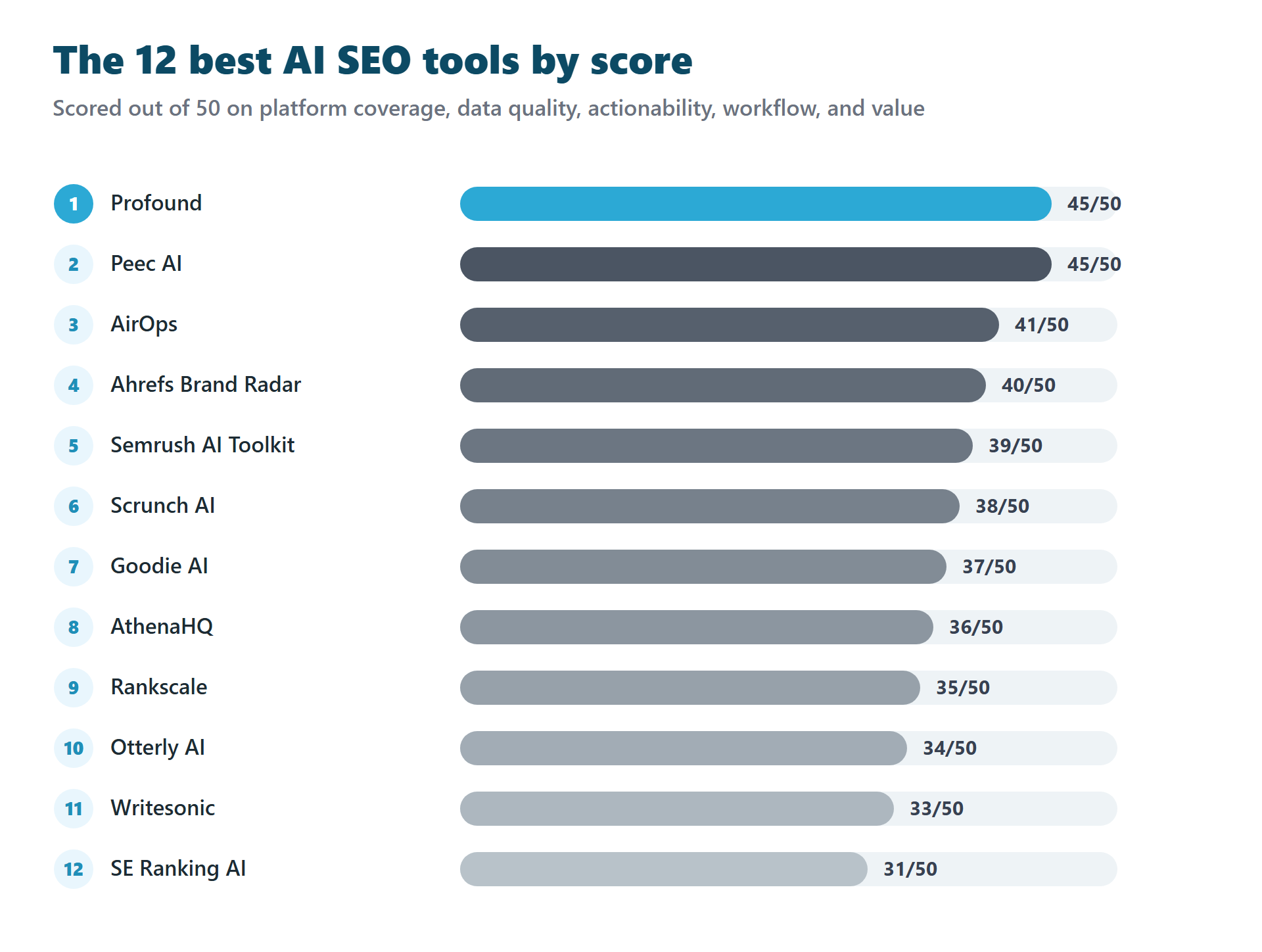
Profound and Peec AI both score 45 of 50, and they top the list for different reasons. Profound takes first as the most powerful platform here: it has the deepest data, it measures real prompt demand with its Prompt Volumes data, and it turns that data into action at enterprise scale. The catch is price. Profound is sales-led, with Enterprise pricing widely cited at several thousand dollars a month, so it is not a value play. Peec AI matches Profound's total at a fraction of the cost, which makes it our best-value pick: it tracks the major platforms daily, includes an actions layer and unlimited seats, and starts under 100 dollars a month, so most teams get most of the capability without the enterprise bill. AirOps takes third because it does something neither of them does, pairing visibility tracking with an engine that produces and updates the content itself. The dedicated trackers below them bring focused measurement, and the suite add-ons from Ahrefs and Semrush put AI visibility next to data SEOs already trust.
How the scorecard data was sourced
Scores draw on hands-on use, each vendor's own product and pricing pages, and corroborating reviews. Two readings were confirmed directly inside the live products: Peec AI's tracked platforms and its app-reading method, and Ahrefs Brand Radar's surface coverage. Where a vendor does not publish pricing, this guide says so and gives the widely cited range rather than inventing a figure. Where sources disagreed on a price, the vendor's own current page was used.
The 12 Best AI SEO Tools, Ranked
Each profile uses the same structure: the per-criterion scorecard, who the tool is best for, what it is and how it gets its data, its standout strength, its main strengths, what to watch for, current pricing, and the website. The same five-part score was applied to every tool.
1. Profound
Scorecard: Platform coverage 10, Data quality 10, Actionability 10, Workflow 9, Value 6. Total: 45/50.
Summary: Profound is an enterprise answer engine optimization platform that tracks brand visibility in AI answers and sizes real demand with its Prompt Volumes data.
Best for: Large brands and agencies that need the deepest data, agent and crawler analytics, and real consumer prompt demand, with the budget to match.
What it is: Profound is the enterprise answer-engine optimization platform. It monitors brand visibility across up to nine AI answer engines at its Enterprise tier and adds Conversation Explorer, agent and crawler analytics, and a shopping module.
Standout: Profound is the only tool here that measures Prompt Volumes: an estimate of how often real people ask a given question, which is the generative-search equivalent of keyword volume. On raw capability it is arguably the most powerful platform on this list.
Strengths:
- Coverage of up to nine AI platforms at the Enterprise tier, including Claude and DeepSeek
- Prompt Volumes size real demand, not just whether you appear in an answer
- Agent and crawler analytics show how AI systems actually read your site, plus SOC 2 Type II security
Watch for: Pricing is sales-led beyond a free 7-day trial, and setup can take one to three weeks to start returning data. Multi-platform coverage, the API, and Prompt Volumes require the Enterprise plan, and the free trial covers only ChatGPT, Gemini, and Google AI Overviews.
Pricing (September 2026): A free 7-day trial (50 prompts a day), then Enterprise at custom pricing, widely cited at roughly $2,000 to $5,000 or more a month for full platform coverage and Prompt Volumes. Profound no longer lists self-serve plans and sells through a demo.
Website: tryprofound.com
2. Peec AI
Scorecard: Platform coverage 8, Data quality 9, Actionability 9, Workflow 9, Value 10. Total: 45/50.
Summary: Peec AI is an AI search analytics platform that reads the real consumer AI apps daily and turns visibility, position, and sentiment data into an action list.
Best for: The best-value pick on this list: in-house teams and agencies that want an affordable, clean daily read on AI visibility with unlimited seats.
What it is: Peec AI is a European AI-search analytics platform that tracks how often, and where, a brand is mentioned and cited across the major AI platforms. It runs prompts daily and measures visibility, position, sentiment, and competitor share of voice.
Standout: Peec reads the real consumer apps rather than only sampling model APIs, and it turns the readings into a prioritized action list. Every tier includes unlimited team seats, and higher tiers add an API and a live data connection for Looker and a Model Context Protocol server, which is rare in this category.
Strengths:
- Reads the real ChatGPT, Perplexity, Gemini, and Google surfaces, so the numbers reflect what a user actually sees
- Unlimited team members on every plan, from a $95/mo entry price
- An actions layer and clean daily dashboard that a non-specialist can read at a glance
Watch for: Plans below Enterprise track three AI models per project, and Claude, Grok, and several other models are paid add-ons.
Pricing (September 2026): Starter $95/mo, Pro $245/mo, Advanced $495/mo, Enterprise custom. About 15% off on annual billing.
Website: peec.ai
3. AirOps
Scorecard: Platform coverage 7, Data quality 7, Actionability 10, Workflow 10, Value 7. Total: 41/50.
Summary: AirOps is a content operations platform that pairs AI search visibility tracking with a workflow engine that drafts, refreshes, and publishes content.
Best for: Content and growth teams that want to combine large-scale AI content production with AI-search visibility in one platform.
What it is: AirOps is an AI content-operations platform that added an AI-search visibility layer on top of its content workflows. It treats visibility as an input that feeds execution, from citation tracking and competitor intel to drafting, refreshing, and publishing the content itself.
Standout: AirOps closes the loop. Where a tracker tells you a gap exists, AirOps drafts and publishes the fix through its workflow engine, at the scale of tens of thousands of monthly content tasks, with human approval gates and direct CMS publishing.
Strengths:
- Pairs visibility tracking with an engine that produces and updates content, not just dashboards
- Free to start, with unlimited seats on the Pro plan
- Workflows, brand governance, and one-click CMS publishing for teams producing at volume
Watch for: The price jumps roughly tenfold from the Solo tier to Pro with no mid-tier, and multi-platform visibility is gated to Pro and above. You are paying for the production engine, not a lightweight monitor.
Pricing (September 2026): Free to start, Solo around $200/mo (widely cited), Pro around $2,000/mo (widely cited), Enterprise custom.
Website: airops.com
4. Ahrefs Brand Radar
Scorecard: Platform coverage 8, Data quality 9, Actionability 7, Workflow 9, Value 7. Total: 40/50.
Summary: Ahrefs Brand Radar is the Ahrefs AI visibility product that measures brand mentions, share of voice, and citations using search-backed prompt data.
Best for: Existing Ahrefs users who want large-scale, real-prompt AI-mention data alongside their backlink and keyword stack.
What it is: Ahrefs Brand Radar is the AI-visibility add-on to the Ahrefs toolset. It measures brand mentions, share of voice, and citations across AI answers using search-backed prompts drawn from a dataset of more than 449 million monthly prompts.
Standout: Brand Radar uses real search-backed prompts, not synthetic ones, which is the strongest data integrity in the category outside Profound. Coverage extends past chat platforms to YouTube, TikTok, and Reddit mentions.
Strengths:
- Real, search-backed prompt data at a scale no scraper matches
- Cross-surface coverage that includes social platforms, not only AI chat
- Sits inside the Ahrefs ecosystem next to authority and keyword data
Watch for: Claude is available only for custom prompts, and Meta AI is not tracked.
Pricing (September 2026): From $199/mo, sold standalone (with a free Ahrefs account) or next to a paid plan; custom prompt packs add $50 to $250/mo. YouTube, TikTok, and Reddit are free during beta.
Website: ahrefs.com/brand-radar
5. Semrush AI Visibility Toolkit
Scorecard: Platform coverage 7, Data quality 8, Actionability 8, Workflow 9, Value 7. Total: 39/50.
Summary: The Semrush AI Visibility Toolkit is a Semrush add-on that tracks brand presence, sentiment, and share of voice in AI answers next to keyword and rank data.
Best for: Existing Semrush customers who want AI-visibility tracking inside the same platform as their keyword, rank, and backlink data.
What it is: The Semrush AI Visibility Toolkit is an add-on to the Semrush suite. It tracks brand presence, sentiment, and share of voice across the major AI platforms with daily AI rankings, and pairs with the Copilot assistant that surfaces prioritized recommendations.
Standout: It lives inside the most widely used SEO suite, so one login spans classic SEO and AI visibility. The Copilot assistant turns the data into next steps rather than leaving you with a dashboard.
Strengths:
- Native to the Semrush stack, with no new tool to learn
- A clear $99 add-on price and a bundled Semrush One option
- Daily AI rankings with sentiment and share-of-voice tracking
Watch for: The $99 add-on is billed per domain and stacks on top of a paid base plan, so the effective cost is closer to $199 to $239 per month. The AI layer is newer than the dedicated specialists.
Pricing (September 2026): AI Visibility Toolkit $99/mo per domain and seat, requiring a Semrush base plan (SEO plan $139/mo). The Semrush One bundle starts at $199/mo, or $165.17/mo billed annually.
Website: semrush.com
6. Scrunch AI
Scorecard: Platform coverage 8, Data quality 8, Actionability 8, Workflow 7, Value 7. Total: 38/50.
Summary: Scrunch AI is an AI search monitoring platform, now part of Sitecore, that pairs persona-based prompt tracking with an agent experience layer for AI crawlers.
Best for: Mid-market and enterprise teams that want AI-search monitoring plus a way to control how AI agents read their site.
What it is: Scrunch AI, acquired by Sitecore in June 2026, monitors brand presence and citations across up to nine AI platforms using persona-driven prompts, and adds an Agent Experience Platform that serves AI-friendly versions of your site to the bots that crawl it.
Standout: Scrunch pairs measurement with a server-side optimization layer. Few rivals try to shape what the agent sees, not just report what it returned.
Strengths:
- A broad platform list at the Enterprise tier, including Claude and Meta AI
- Persona-based prompting that mirrors how different buyers ask
- An agent-experience layer plus real AI-bot traffic attribution
Watch for: The entry Core plan tracks four platforms, and the agent-experience layer and broader coverage are Enterprise only.
Pricing (September 2026): Core $250/mo (125 prompts, 5 user licenses), Enterprise custom. Seven-day free trial.
Website: scrunch.com
7. Goodie AI
Scorecard: Platform coverage 9, Data quality 8, Actionability 8, Workflow 6, Value 6. Total: 37/50.
Summary: Goodie AI is an enterprise AEO platform that tracks daily citations, sentiment, and share of voice across a broad model roster, including AI commerce surfaces.
Best for: Mid-market and enterprise brands that want the widest platform coverage, including commerce platforms, plus a dedicated strategist.
What it is: Goodie AI is an enterprise AEO platform that measures daily citations, sentiment, and share of voice across one of the broadest model rosters in the category, then adds an optimization and action layer on top.
Standout: Goodie tracks up to 13 models at the Enterprise tier, including Meta AI, and it includes AI-commerce visibility most trackers skip.
Strengths:
- One of the widest platform rosters, with commerce coverage built in
- Daily tracking with sentiment and share of voice
- An action layer plus a dedicated AEO strategist
Watch for: Plans start at $399 a month and Pro runs $999, so it is built for mid-market and enterprise rather than a small budget.
Pricing (September 2026): Core $399/mo (5 models, 120 prompts, 7-day free trial), Pro $999/mo (8 models, unlimited seats), Enterprise custom (up to 13 models, API and MCP access).
Website: higoodie.com
8. AthenaHQ
Scorecard: Platform coverage 9, Data quality 7, Actionability 6, Workflow 7, Value 7. Total: 36/50.
Summary: AthenaHQ is a generative engine optimization platform that tracks the major AI models and adds citation data and content tools.
Best for: Teams that want full major-platform coverage and on-page and off-page analysis at a moderate self-serve price.
What it is: AthenaHQ is a generative-engine-optimization platform that monitors brand visibility across all the major large language models, then layers on citation intelligence and AI-driven content-optimization workflows.
Standout: AthenaHQ puts full major-platform coverage, including Claude and Grok, on its Starter tier, with unlimited seats and role-based access. The Enterprise tier adds a content-optimization agent with deep research.
Strengths:
- The broadest platform set on an entry tier, including Claude and Grok
- Unlimited seats with role-based access control
- A free Essential tier to test before you pay
Watch for: Usage is credit-metered, which can cap busy accounts, and the citation engine, traffic analysis, and API are Enterprise only.
Pricing (September 2026): Essential free (300 credits), Starter $295/mo (3,600 credits/mo, 17% off on annual billing), Enterprise custom.
Website: athenahq.ai
9. Rankscale
Scorecard: Platform coverage 9, Data quality 7, Actionability 5, Workflow 7, Value 7. Total: 35/50.
Summary: Rankscale is a credit-based AI search visibility platform built for agencies, with broad platform coverage, white-label reporting, and an API.
Best for: Agencies and multi-brand operators that want many brand dashboards, white-label reporting, and broad platform coverage at a low entry price.
What it is: Rankscale is a credit-based AI-search visibility and AEO platform offering broad platform coverage, page audits, agency white-labeling, and an API at competitive prices.
Standout: Rankscale tracks ten platforms and offers credit rollover plus an agency white-label and affiliate program from a low entry point, which suits a shop running many brand dashboards at once.
Strengths:
- One of the widest platform lists, with credit rollover
- A low entry price with many brand dashboards
- White-label reporting and a REST API for agencies
Watch for: Credit metering means heavy multi-platform tracking burns budget quickly, and page-audit allowances are modest.
Pricing (September 2026): Essentials from $20/mo, Pro $99/mo (10 dashboards), Growth $385/mo (white-label, API), Enterprise $780/mo.
Website: rankscale.ai
10. Otterly AI
Scorecard: Platform coverage 6, Data quality 7, Actionability 6, Workflow 7, Value 8. Total: 34/50.
Summary: Otterly AI is a low-cost AI visibility tracker that monitors brand mentions, links, and sentiment and adds high-volume URL audits.
Best for: Small businesses, consultants, and lean teams that want a low-cost, self-serve AI-visibility tracker with generous audit limits.
What it is: Otterly AI tracks brand mentions, links, and sentiment across AI platforms and adds a high-volume generative-search URL audit, all from a $29/mo entry price.
Standout: Otterly carries unusually high URL-audit allowances, from 1,000 to 10,000 per month, and unlimited team members even on the cheapest plan.
Strengths:
- A low entry price, at $29/mo
- Unlimited seats on every tier
- Large URL-audit quotas for the price
Watch for: Gemini, Google AI Mode, and Claude cost extra on top of the base price, and the entry tier tracks only 15 prompts.
Pricing (September 2026): Lite $29/mo, Standard $189/mo, Premium $489/mo, Enterprise custom. Gemini and AI Mode add-ons run $9 to $149/mo each by plan, and Claude $29 to $439/mo.
Website: otterly.ai
11. Writesonic
Scorecard: Platform coverage 6, Data quality 6, Actionability 8, Workflow 7, Value 6. Total: 33/50.
Summary: Writesonic is an AI content suite that ties AI search visibility tracking to an Action Center and an AI article generator.
Best for: Content marketers who want affordable AI-visibility tracking bundled with AI article generation and on-page fixes.
What it is: Writesonic is an AI content suite whose AI-search visibility module tracks brand presence across AI platforms, then ties findings to an Action Center and an AI article generator in the same subscription.
Standout: Writesonic bundles measurement and production. The Action Center turns a visibility gap into on-page and off-page fixes, and sentiment analysis arrives from the Growth tier.
Strengths:
- An affordable entry price that bundles tracking and content generation
- An Action Center for on-page and off-page fixes
- Sentiment analysis from the Growth tier up
Watch for: Lower tiers are platform-limited, with full ten-platform coverage reserved for Enterprise, and answer-tracking caps can constrain broad prompt sets.
Pricing (September 2026): Starter $79/mo, Basic $199/mo, and Growth $399/mo, billed annually, each tracking ChatGPT, Gemini, and Google AI Overviews; Enterprise custom.
Website: writesonic.com
12. SE Ranking AI Visibility
Scorecard: Platform coverage 6, Data quality 6, Actionability 5, Workflow 7, Value 7. Total: 31/50.
Summary: SE Ranking AI Visibility is an add-on and standalone product that tracks brand mentions and links across Google AI Overviews, AI Mode, and chat platforms.
Best for: Budget-conscious teams, especially existing SE Ranking customers, who want affordable AI-visibility tracking as an add-on.
What it is: SE Ranking offers an AI Search Toolkit and a standalone SE Visible product that track brand mentions and links across Google AI Overviews, AI Mode, and chat platforms, tied to its broader SEO platform.
Standout: SE Ranking gives two flexible paths: a cheap add-on for existing customers, or a standalone product, with strong Google AI Overviews and AI Mode coverage.
Strengths:
- The cheapest add-on path on this list for existing customers
- Strong Google AI Overviews and AI Mode coverage
- A free 14-day trial and free daily checks
Watch for: The standalone SE Visible product updates weekly rather than daily, and entry prompt allowances fill quickly across several platforms and competitors.
Pricing (September 2026): AI Search add-on $89/mo for existing customers, which delivers the SE Visible AI dashboard. Base SE Ranking plans start at $129/mo (Core).
Website: seranking.com
More AI SEO Tools by Category
The leaderboard above covers the tools built specifically to track and improve AI visibility. A complete AI SEO stack usually adds three more kinds of tool: something to research and optimize content, the full SEO suite that holds your keyword and backlink data, and the automation that applies fixes at scale. The table prices every tool in these categories at a glance, and the sections below give the detail. The AI assistants come last, because each one is both a tool you use and an answer surface you are trying to appear in.
| Tool | Category | Best for | Starting price |
|---|---|---|---|
| Surfer SEO | AI content | Content teams that want on-page optimization plus AI-visibility tracking in one tool. | From $49/mo (Discovery), $99 Standard, $182 Pro, $299 Peace of Mind, billed annually. |
| Frase | AI content | Teams that want SERP research, AI drafting, and AI-visibility tracking bundled together. | From $49/mo (Starter), $129 Professional, $299 Scale; every tier has full feature access. |
| Clearscope | AI content | Editorial teams that prioritize optimization quality and clean reporting over bulk generation. | From $129/mo (Essentials), $399 Business, Enterprise custom. |
| MarketMuse | AI content | Brands, publishers, and agencies doing strategic content planning and topical-authority analysis at scale. | Free tier (10 queries/mo); paid plans are quote-based by demo, cited in the $99 to $600+/mo range. |
| Rankability | AI content | Agencies managing many accounts that want optimization, AI writing, and AI-visibility reporting without per-seat fees. | From $99/mo (Starter), $199 Core, $399 Team; unlimited users, with 1 to 10 workspaces by plan. |
| Scalenut | AI content | Founders, small teams, and growing agencies that want an affordable end-to-end content and AI-visibility tool. | From $59/mo (Starter), $89 Plus, $199 Professional. |
| Koala AI | AI content | Publishers, affiliate marketers, and bloggers scaling SEO article output with optimization baked in. | From $25/mo (Starter, $20/mo billed annually), scaling to higher-volume tiers. |
| Jasper | AI content | Marketing teams and enterprises that need brand-consistent AI content across many channels, with SEO as one use among many. | From $69/mo (Pro, $59/mo annual), Business custom. |
| Semrush | SEO suite | Marketers and enterprises that want the deepest competitive and keyword data with an AI-visibility layer on top. | SEO plan $139/mo; Semrush One (SEO plus AI search) Starter $199, Pro+ $299, Advanced $549; AI Visibility Toolkit $99/mo add-on. |
| Ahrefs | SEO suite | SEOs who prioritize backlink and keyword depth and want LLM-visibility tracking in the same tool. | Lite $129/mo, Standard $249, Advanced $449, Enterprise from $1,499; Brand Radar from $199/mo. |
| SE Ranking | SEO suite | Agencies and teams that want multi-account SEO management plus AI tracking at a mid-market price. | Core $129/mo, Growth $279/mo, Enterprise custom; AI add-on $89/mo for existing customers. |
| Search Atlas | SEO suite | Scaling agencies and high-volume teams that want SEO execution automated, not just analyzed. | Starter $99/mo, Growth $199, Pro $399, Agency $999 (white-label). |
| OTTO by Search Atlas | Technical and automation | Teams that want an AI agent to apply on-page and technical fixes automatically, with optional human approval. | Included with Search Atlas plans (from $99/mo); priced by number of OTTO projects. |
| Alli AI | Technical and automation | Agencies, online stores, and enterprises that need to push on-page changes across many pages and sites fast. | Business $249/mo ($2,990/yr), Agency $499/mo (white-label), Enterprise custom. |
| Indexly | Technical and automation | Teams that want fast indexing plus AI-search monitoring and content automation in one place. | Starter $99/mo, Growth $299, Scale $499, Enterprise custom; done-for-you service custom-priced. |
| ChatGPT | AI assistant | Day-to-day SEO work and the single highest-traffic AI answer surface to optimize for. | Free, Go $8/mo, Plus $20/mo, Pro from $100/mo. |
| Claude | AI assistant | Long-form writing, editing, and analysis, and a fast-growing answer surface that cites its sources. | Free, Pro $20/mo ($17/mo annual), Max from $100/mo. |
| Google Gemini | AI assistant | SEO work inside Google Workspace, and the model behind the most consequential surface for organic search. | Free, AI Plus $4.99/mo, AI Pro $19.99/mo, AI Ultra from $99.99/mo. |
| Perplexity | AI assistant | Source-cited research and a fast-growing citation surface that links the pages it draws from. | Free, Pro $20/mo, Max $200/mo. |
The Best AI Tools for SEO Content
Visibility tracking tells you where you stand. Content tools do the writing and optimizing that moves you. The platforms below use AI to research, draft, and grade content for both Google and the AI answers, and several now track AI visibility too.
Surfer SEO
Best for: Content teams that want on-page optimization plus AI-visibility tracking in one tool.
Surfer SEO scores content in real time against the signals that rank, and its AI Tracker now monitors brand visibility across ChatGPT, Perplexity, Google AI Overviews, AI Mode, and Gemini. The Surfy assistant drafts and humanizes inside the editor.
Pricing (September 2026): From $49/mo (Discovery), $99 Standard, $182 Pro, $299 Peace of Mind, billed annually. Website: surferseo.com
Frase
Best for: Teams that want SERP research, AI drafting, and AI-visibility tracking bundled together.
Frase is an agentic SEO and generative-engine-optimization platform with more than 80 research and writing skills, combined SEO and GEO scoring, and AI-visibility tracking across two to five named platforms by tier, with all named engines at Enterprise.
Pricing (September 2026): From $49/mo (Starter), $129 Professional, $299 Scale; every tier has full feature access. Website: frase.io
Clearscope
Best for: Editorial teams that prioritize optimization quality and clean reporting over bulk generation.
Clearscope grades content on search intent and now tracks brand mentions across ChatGPT and Gemini, with unlimited users, projects, and exports on every plan and no contracts.
Pricing (September 2026): From $129/mo (Essentials), $399 Business, Enterprise custom. Website: clearscope.io
MarketMuse
Best for: Brands, publishers, and agencies doing strategic content planning and topical-authority analysis at scale.
MarketMuse uses proprietary topic modeling to score topical relevance across thousands of pages, generate briefs, and automate content-inventory analysis with personalized difficulty and authority metrics.
Pricing (September 2026): Free tier (10 queries/mo); paid plans are quote-based by demo, cited in the $99 to $600+/mo range. Website: marketmuse.com
Rankability
Best for: Agencies managing many accounts that want optimization, AI writing, and AI-visibility reporting without per-seat fees.
Rankability is an all-in-one SEO and AI-visibility platform built for agencies, with AI keyword research, content optimization aimed at both rankings and AI answers, an AI Advisor, and unlimited users on every tier.
Pricing (September 2026): From $99/mo (Starter), $199 Core, $399 Team; unlimited users, with 1 to 10 workspaces by plan. Website: rankability.com
Scalenut
Best for: Founders, small teams, and growing agencies that want an affordable end-to-end content and AI-visibility tool.
Scalenut covers planning, research, creation, and optimization with AI-visibility tracking across ChatGPT and Google AI Overviews (Perplexity on the Professional plan), keyword clustering, and auto-publishing to WordPress and Shopify.
Pricing (September 2026): From $59/mo (Starter), $89 Plus, $199 Professional. Website: scalenut.com
Koala AI
Best for: Publishers, affiliate marketers, and bloggers scaling SEO article output with optimization baked in.
Koala AI generates SEO-optimized articles that analyze the live results and inject relevant entities, with access to frontier models, automated internal linking, and Amazon affiliate articles built on live product data.
Pricing (September 2026): From $25/mo (Starter, $20/mo billed annually), scaling to higher-volume tiers. Website: koala.sh
Jasper
Best for: Marketing teams and enterprises that need brand-consistent AI content across many channels, with SEO as one use among many.
Jasper is built for marketing content at scale, with a Canvas workspace, a trainable brand voice, and more than 100 purpose-built marketing agents. It is a content generator rather than a search-scoring core, so it pairs well with a dedicated optimizer.
Pricing (September 2026): From $69/mo (Pro, $59/mo annual), Business custom. Website: jasper.ai
The Best AI-Enhanced SEO Suites
The established SEO suites have all added AI features. If you already run one of these, its AI-visibility module is usually the first thing to switch on before buying a separate tracker. Three of the suites below appear in the ranked leaderboard above for their AI-visibility add-on; here is the full platform behind each.
Semrush
Best for: Marketers and enterprises that want the deepest competitive and keyword data with an AI-visibility layer on top.
Semrush, acquired by Adobe in April 2026, is the broadest search-marketing platform, and its AI Visibility Toolkit (ranked 5th above), Copilot assistant, and Content Toolkit extend it into the AI era.
Pricing (September 2026): SEO plan $139/mo; Semrush One (SEO plus AI search) Starter $199, Pro+ $299, Advanced $549; AI Visibility Toolkit $99/mo add-on. Website: semrush.com
Ahrefs
Best for: SEOs who prioritize backlink and keyword depth and want LLM-visibility tracking in the same tool.
Ahrefs remains the reference for backlink and keyword data, and its Brand Radar add-on (ranked 4th above), AI Content Helper, and AI keyword suggestions bring AI search into the toolset.
Pricing (September 2026): Lite $129/mo, Standard $249, Advanced $449, Enterprise from $1,499; Brand Radar from $199/mo. Website: ahrefs.com
SE Ranking
Best for: Agencies and teams that want multi-account SEO management plus AI tracking at a mid-market price.
SE Ranking is an affordable all-in-one platform whose AI Overviews Tracker, AI Search Toolkit (ranked 12th above), and AI Writer add AI-answer visibility to a full SEO stack.
Pricing (September 2026): Core $129/mo, Growth $279/mo, Enterprise custom; AI add-on $89/mo for existing customers. Website: seranking.com
Search Atlas
Best for: Scaling agencies and high-volume teams that want SEO execution automated, not just analyzed.
Search Atlas is an AI-driven suite anchored by its OTTO automation engine, with Content Genius, topical maps, a semantic grader, LLM-visibility tracking across five platforms, and one-click CMS publishing.
Pricing (September 2026): Starter $99/mo, Growth $199, Pro $399, Agency $999 (white-label). Website: searchatlas.com
The Best AI Tools for Technical SEO and Automation
This is where AI does the repetitive work: applying on-page fixes across thousands of pages, generating schema, and getting new pages indexed fast. These tools act on the site rather than only reporting on it.
OTTO by Search Atlas
Best for: Teams that want an AI agent to apply on-page and technical fixes automatically, with optional human approval.
OTTO is the automation engine inside Search Atlas. It auto-applies on-page, technical, content, and schema optimizations to a connected site through a JavaScript pixel or CMS integration, with optional human approval of each change.
Pricing (September 2026): Included with Search Atlas plans (from $99/mo); priced by number of OTTO projects. Website: searchatlas.com/otto-seo
Alli AI
Best for: Agencies, online stores, and enterprises that need to push on-page changes across many pages and sites fast.
Alli AI bulk-optimizes on-page code with AI recommendations and deploys changes live without a developer, including schema-markup generation and internal-linking automation, through one CMS-agnostic snippet.
Pricing (September 2026): Business $249/mo ($2,990/yr), Agency $499/mo (white-label), Enterprise custom. Website: alliai.com
Indexly
Best for: Teams that want fast indexing plus AI-search monitoring and content automation in one place.
Indexly automates URL indexing through the Google Indexing API and Bing IndexNow, monitors AI search across up to five platforms, runs content agents that publish to WordPress, Webflow, and Ghost, and generates an llms.txt file for AI crawlability.
Pricing (September 2026): Starter $99/mo, Growth $299, Scale $499, Enterprise custom; done-for-you service custom-priced. Website: indexly.ai
The Best General AI Assistants for SEO
Each assistant below does two jobs. It speeds up SEO work such as briefs, drafts, schema, and analysis, and it is also an answer surface you are optimizing to appear in. Getting cited in these is the whole point of the visibility tools above. All four are US-built. Pricing is the consumer tier as of September 2026.
ChatGPT
Best for: Day-to-day SEO work and the single highest-traffic AI answer surface to optimize for.
ChatGPT from OpenAI handles ideation, briefs, drafting, and schema, and it is the AI platform most brands most want to be cited in.
Pricing (September 2026): Free, Go $8/mo, Plus $20/mo, Pro from $100/mo. Website: chatgpt.com
Claude
Best for: Long-form writing, editing, and analysis, and a fast-growing answer surface that cites its sources.
Claude from Anthropic is a strong writing and analysis assistant for content and data work, and it cites web sources in its answers.
Pricing (September 2026): Free, Pro $20/mo ($17/mo annual), Max from $100/mo. Website: claude.ai
Google Gemini
Best for: SEO work inside Google Workspace, and the model behind the most consequential surface for organic search.
Google Gemini is both a research and content assistant and the model powering Google AI Overviews and AI Mode, which sit directly above the classic results.
Pricing (September 2026): Free, AI Plus $4.99/mo, AI Pro $19.99/mo, AI Ultra from $99.99/mo. Website: gemini.google.com
Perplexity
Best for: Source-cited research and a fast-growing citation surface that links the pages it draws from.
Perplexity is an AI research platform for SEOs and a citation surface that names and links its sources inline, which makes the pages it cites visible to its users.
Pricing (September 2026): Free, Pro $20/mo, Max $200/mo. Website: perplexity.ai
How Searchbloom Tests, and the Stack We Run
We are not a tool vendor, so our read on these platforms comes from using them, not selling them. Searchbloom runs AI Search Optimization for partners every day, and two of the tools on this list are part of that work. Peec AI is our daily AI-visibility tracker: we watch brand mentions, position, and sentiment across the platforms in it every morning. Ahrefs Brand Radar is where we cross-check that read against real search-backed prompt data. Pairing a scraper-based tracker with a search-backed one is deliberate. When both agree, we trust the trend. When they disagree, we dig in.
The scores on this page reflect that hands-on use plus each vendor's product and pricing pages, verified in June 2026 and re-checked in September 2026. Where we have not run a tool day to day, we scored it on documented capability and did not invent a field test we never performed.
"Within a year, AI-visibility tracking stops being a separate purchase and becomes a feature inside every major SEO suite, the way rank tracking did. The standalones that survive will be the ones that also help you act, not just measure."
~ Cody C. Jensen, CEO & Founder, Searchbloom
Which AI SEO Tool Is Right for You?
Answer three questions for a recommendation from the twelve scored tools. This picker runs only on this page and uses the same scoring as the leaderboard above.
How to Choose an AI SEO Tool
Match the tool to your actual situation, not to a generic best list. Use these branches.
Match the platforms to your audience
Coverage is not a numbers game. Each AI platform decides which brands to name by its own logic, so the list that matters is the one your buyers actually use, not the longest one. A company selling to software engineers may care most about being visible in Claude, the model technical teams lean on for coding, while a consumer brand weights ChatGPT and Google AI Overviews. The way to know is research, not a guess: SparkToro's Search & AI Tools feature shows which AI and search platforms a given audience favors relative to the norm, so you can see which LLMs your buyers actually lean on. Find that out first, then pick a visibility tracker that covers those, and do not pay for breadth you will never look at.
If you only need to measure AI visibility
A tracker is enough. On a budget, start with Otterly at $29 a month, Rankscale from $20, or Peec AI under $100 a month for unlimited seats and a clean daily read. Pick a tool that tracks the platforms your buyers use and reads the real consumer apps.
If you are an enterprise that needs the deepest data
Weight platform coverage and data method heavily, and look at Profound for its breadth and its Prompt Volumes, the only measure of real AI query demand on this list. Confirm the security and account support your procurement team will ask about.
If you want to act, not just measure
Choose a platform that pairs tracking with content execution. AirOps produces and publishes the fixes at scale, and Writesonic bundles tracking with AI writing and an action center for a smaller team. For the content optimization itself, weigh AI search optimization support in tools like Surfer, Clearscope, or Frase.
If you already pay for a suite
Switch on its AI-visibility module before buying anything new. Ahrefs has Brand Radar, Semrush has the AI Visibility Toolkit, and SE Ranking has its AI Search Toolkit, each one cheaper as an add-on than a standalone tool and already connected to your data.
Questions to ask before you subscribe
- Which AI platforms does it track, and can I choose them?
- Does it read the real consumer apps, use search-backed demand, or sample the model APIs?
- How often does it refresh, daily or weekly?
- Does it tell me what to fix, or only what the score is?
- What does it export, and does it offer an API or a Model Context Protocol server?
- What is the real all-in price, including any base plan or per-domain fees?
Searchbloom's AI Search Approach
A tool tells you where you stand in AI answers. It does not do the work that changes where you stand. That work, the content, the structure, the entities, and the authority that make an AI platform cite you, is what Searchbloom does. We use tools like the ones on this list to measure, and we run the work through a published method.
Searchbloom built and published MERIT, a five-pillar methodology for AI Search Optimization, the discipline of earning citations in ChatGPT, Google AI Overviews, Perplexity, and other generative answers. These tools are how we read the score. MERIT is how we move it, and the full method is free to read in the MERIT whitepaper. We wrote the methodology.
The outcome Searchbloom optimizes for is revenue, not a visibility chart on its own, the same discipline behind its 98% partner retention, an average return above 720%, and Google Premier Partner status held by the top 3% of agencies. If you would rather hire a team than run the tools yourself, see the best AI SEO companies, or explore Searchbloom's SEO services and its full set of methodologies. Related reading: the best SEO companies overall, the best enterprise SEO agencies, and the best ecommerce SEO agencies.
What Changed in AI SEO Tools in 2026
Google and Microsoft now report some AI visibility data at no cost.
- On June 3, 2026, Google launched generative AI performance reports in Search Console. They show impressions in AI Overviews, AI Mode, and Discover by page, country, and date. Every site had them by August 31, 2026.
- In February 2026, Microsoft added an AI Performance report to Bing Webmaster Tools. It shows citations in Copilot and Bing AI answers. A June 2026 update added Citation Share and Compare.
- In June 2026, Google published guidance on third-party SEO, AEO, and GEO tools. It says no outside tool has Google's internal ranking data, and none can guarantee results.
Questions and Answers
What are the best AI SEO tools in 2026?
The best AI SEO tools in 2026 are Profound, Peec AI, and AirOps. They lead a 12-tool field scored on AI platform coverage, data quality, actionability, workflow fit, and value. Profound ranks first as the most powerful platform, with the deepest data and the only real measure of prompt demand. Peec AI is the best-value pick, matching Profound's score at a fraction of the price. AirOps is for teams that want to track visibility and produce the content in one system. The right tool depends on your budget, the platforms you care about, and whether you only need to measure visibility or also act on it.
What is an AI SEO tool?
An AI SEO tool helps a brand stay visible as search moves from a list of links to a single AI answer. The newest category measures AI visibility: how often and where you are mentioned and cited across platforms like ChatGPT, Google AI Overviews, Perplexity, and Gemini. A second group uses AI to do classic SEO faster, from keyword research and content optimization to technical fixes and indexing. Many tools now do both.
What is the difference between SEO, GEO, and AEO?
SEO is optimizing to rank in classic search results. GEO, generative engine optimization, is optimizing to be mentioned and cited inside AI-generated answers. AEO, answer engine optimization, is the same idea and the terms are used interchangeably. GEO and AEO are a subset of modern SEO, not a replacement for it, because the AI answers are built from the same well-structured, authoritative content that ranks in search.
Do AI SEO tools replace traditional SEO?
No. AI SEO tools add a new layer of measurement and speed on top of traditional SEO; they do not replace it. AI platforms build their answers from the same content, structure, and authority that rank in classic search, so the fundamentals still apply. What changes is that you now also need to see whether the AI answers cite you, and the tools here are how you measure and improve that.
What is the best free or cheapest AI SEO tool?
Rankscale has the lowest paid entry price at $20 per month, and Otterly AI starts at $29 per month. AirOps lets you start for free, and the general assistants ChatGPT, Claude, Gemini, and Perplexity all have free plans you can use for SEO work. For an existing Semrush, Ahrefs, or SE Ranking customer, the cheapest path to AI-visibility tracking is that suite's add-on rather than a separate tool.
Which AI platforms should I track?
Track the platforms your buyers actually use. For most brands that means ChatGPT, Google AI Overviews and AI Mode, Perplexity, Gemini, and Microsoft Copilot, with Claude and Grok added as coverage allows. The right set depends on your audience, so a tool that lets you pick platforms, and that reads the real consumer apps, gives the most useful picture.
How is AI visibility measured?
AI visibility tools run a set of prompts on a schedule and record the answers. The common metrics are visibility, how often you appear, share of voice against competitors, citations, the sources the answer links to, sentiment, and position within the answer. The data comes from one of three methods: reading the real consumer apps, using search-backed prompt demand, or sampling the model APIs. The method changes what the numbers mean, so it is worth knowing which one a tool uses.
Do I need an AI SEO tool or an AI SEO agency?
A tool measures where you stand in AI answers. It does not do the content, structure, and authority work that changes where you stand. If you have a team to act on the data, a tool may be all you need. If you want the work done for you, that is an agency's job. Many teams use both: a tracking tool to measure and an agency to move the number. Searchbloom uses several of these tools and runs the work through its MERIT methodology for AI Search Optimization.
Last Tested and Changelog
This guide is a living document. We re-verify pricing, platform coverage, and the tool list each quarter, and log every change here. Last tested June 2026. Pricing and platform coverage re-verified September 2026.
- September 2026: Re-verified pricing and platform coverage for every tool against vendor pages and updated the plans and prices that changed. Noted Sitecore's acquisition of Scrunch AI and Adobe's acquisition of Semrush. Corrected Profound's platform coverage claims. Added a one-line summary to each ranked tool and a section on what changed in AI SEO tools in 2026. Rankings and scores are unchanged.
- June 2026: Initial publication. 31 tools covered and 12 scored on the five-part method. Pricing and platform coverage verified against vendor pages, and US search-demand data pulled from Ahrefs.