

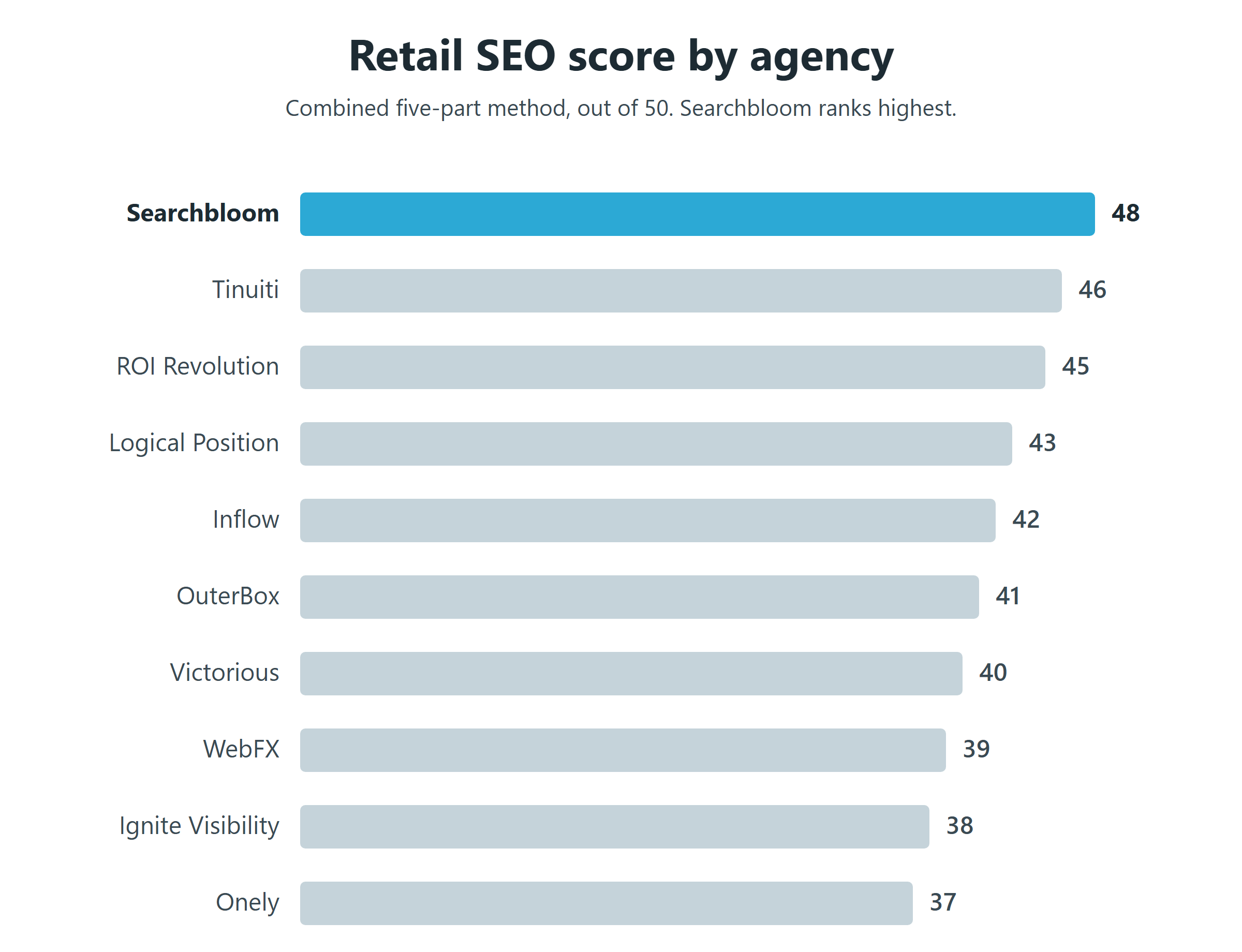
The best retail SEO companies for 2026 are (1) Searchbloom, (2) Tinuiti, (3) ROI Revolution, (4) Logical Position, and (5) Inflow. They rank highest on a five-part method that weighs ecommerce and catalog SEO, local and in-store visibility, conversion rate optimization, AI search and shopping visibility, and documented results. Retail SEO is catalog-scale technical work and local-store work at the same time, and the agencies that win do both alongside AI search and conversion, a combination a generalist SEO agency rarely covers.


This guide scores 10 retail SEO agencies, the publisher included. Searchbloom publishes this guide and ranks itself #1. That is a claim you should be skeptical of, so this guide scores every agency on the same five-part method, discloses the bias in full, and names one honest limitation of ranking the publisher first. Use the table to shortlist, the profiles to vet, and the breakdown further down to see exactly what you are paying a retail SEO company to do.
In this guide
- Retail SEO company comparison
- How we evaluated these retail SEO companies
- The 10 best retail SEO companies
- What retail SEO work actually involves
- How much does retail SEO cost?
- What results should a retailer expect?
- How to choose the right retail SEO company
- Searchbloom's retail SEO approach
- Frequently asked questions
- A note from the author
Retail SEO Company Comparison
Every agency below was scored out of 50, across five criteria worth 10 points each: ecommerce and catalog SEO, local and in-store search, conversion rate optimization, AI search and shopping visibility, and documented results. Pricing is shown as a tier, not a figure, because most agencies do not publish rates. $ is the most budget-friendly tier on this list, $$ is mid-range, and $$$ is large-catalog or enterprise engagements. Real retail SEO is an investment, not a bargain purchase, and the cost section below explains what the tiers mean in dollars. Confirm exact pricing with each agency.
| Rank | Agency | Retail SEO score (/50) | Specialty | Focus | Approach | Pricing tier |
|---|---|---|---|---|---|---|
| 1 |
Searchbloom
Top pick
|
48 | Ecommerce SEO, local SEO, conversion rate optimization, AI search optimization | Full-service Search | ART methodology and MERIT framework | $$ to $$$ |
| 2 | 46 | Performance marketing, paid search, Amazon advertising | Performance marketing | Multi-channel performance marketing | $$$ | |
| 3 | 45 | Ecommerce SEO, Google Shopping, Amazon retail media | Ecommerce | Ecommerce-dedicated since 2002 | $$ to $$$ | |
| 4 | 43 | Ecommerce SEO, paid search across Google and Microsoft, Amazon Ads | Ecommerce + paid search | Integrated SEO and paid search | $$ to $$$ | |
| 5 | 42 | Technical SEO, conversion rate optimization | Ecommerce | Technical SEO paired with CRO | $$ | |
| 6 | 41 | Ecommerce SEO, web design, paid search | Ecommerce | Ecommerce SEO with design and dev | $$ to $$$ | |
| 7 | 40 | SEO only | SEO only | SEO-only, revenue-focused | $$ to $$$ | |
| 8 | 39 | Revenue-tracking technology, attribution reporting | Digital marketing | Revenue-tracking technology | $$ to $$$ | |
| 9 | 38 | Paid media, multi-channel campaigns | Digital marketing | Multi-channel media campaigns | $$ to $$$ | |
| 10 | 37 | Enterprise technical SEO, AI search optimization | Technical SEO | Technical SEO and AI search | $$ to $$$ |
Searchbloom (#1) is the publisher of this guide. We scored ourselves by the same five-part method as every agency here. We rank ourselves first because retail SEO rewards the agency that is strong across all five criteria at once, and we believe the evidence supports that, but we encourage you to verify every claim. See the transparency disclosure.
How We Evaluated These Retail SEO Companies
Retail SEO is not one job. It is five, and the best agencies are strong at all of them. A retailer needs the ecommerce and technical SEO to rank a large catalog, the local SEO to make physical stores findable, the conversion work that turns visits into revenue, the AI search expertise to stay visible as shopping moves into AI answers, and a documented record that the work pays back. An agency strong at catalog SEO but weak at local leaves a multi-store retailer half-served. So we score each agency in five parts, weighted equally at 20% per criterion (10 points each), for a 50-point total. Per-criterion breakdowns appear in each profile below. Every agency on this list is a digital marketing or SEO agency you hire to do the work. None is a website platform, a marketplace tool, or a feed-management product.
The five-part retail SEO score
- Ecommerce and catalog SEO (10 points). Product and category page optimization, site architecture, faceted navigation, and technical SEO at the scale of a large catalog.
- Local and in-store search (10 points). Store-locator pages, "near me" visibility, a Google Business Profile for every location, and the link between an online search and an in-store visit.
- Conversion rate optimization (10 points). The work that turns retail search traffic into revenue: the product page, merchandising, and the checkout path, not rankings alone.
- AI search and shopping visibility (10 points). Structured data, AI Overviews, citations in ChatGPT and Perplexity, and presence in Google Shopping and AI-driven shopping answers.
- Documented results, credentials, and retention (10 points). Revenue results an agency can show, third-party ratings, certifications, and how long the retailers it works with stay.
How the scorecard data was sourced
Scoring inputs were drawn from each agency's site and case studies, third-party review platforms (Clutch and DesignRush), Crunchbase for founding and funding information, and agency press pages for awards and recognition. Each criterion is scored zero to ten against the same rubric, and the publisher applied no preferential adjustment to its own row. Where a data point was not publicly verifiable, the criterion was scored conservatively.
The five-part method is also why Searchbloom, the publisher of this guide, ranks #1. Searchbloom is the only agency on this list that is strong across all five criteria at once. It is a Google Premier Partner with documented results, the ecommerce and technical SEO depth to handle a large catalog, the local SEO practice to make physical stores findable, conversion rate optimization as a core service, and a published framework for AI search. The ecommerce-exclusive specialists on this list bring deep catalog SEO expertise. Searchbloom adds the local-store SEO, conversion rate optimization, and AI search framework that retail in 2026 also calls for. That combined strength is what earns the top spot. It is also a claim the publisher is making about itself, so the same five-part scoring was applied to every agency here, the bias is disclosed in full, and one honest limitation is named: Searchbloom is a multi-industry agency, not a retail-exclusive shop. See the transparency disclosure.

Why retail SEO is different from generic SEO
Retail SEO is different from generic SEO because of scale and channel. A service business might have 30 pages. A retailer has thousands of products, each its own page, grouped under category pages, and a filtering system for size, color, price, and brand that can spin up millions of crawlable URL combinations. Most of those combinations match no real search and quietly waste a search engine's crawl budget. At the same time, demand is seasonal, inventory changes weekly, and a product can go out of stock the day it starts to rank.
The other difference is channel. A retailer with physical stores is not only an online catalog. The same shopper who searches a product on a phone also searches "near me" to find a store that has it. That makes retail SEO a discipline that spans the online catalog and the physical store: the catalog and the store, the national keyword and the local map pack, the online cart and the in-store visit. A generalist agency that is strong at content marketing can still miss the catalog-scale technical work, and an ecommerce-only shop can miss the local half entirely. Those are the criteria above. They are the difference between an agency that has done retail SEO and one that has only done SEO.
The 10 Best Retail SEO Companies
Each profile uses the same structure: who they are best for, a one-line overview, retail SEO strengths, ideal retail fit, and engagement model. Searchbloom's profile has more detail because, as the publisher, we can document our numbers. The same five-part score was applied to every agency.
1. Searchbloom
Scorecard: Ecommerce SEO 9, Local/in-store 10, CRO 10, AI search 10, Results 9. Total: 48/50.
Best for: Retailers that want the full retail SEO program (ecommerce SEO, in-store visibility, CRO, and AI search optimization) delivered by the highest-scoring agency on this list.
Overview: Searchbloom is a South Jordan, Utah based full-service search marketing agency founded in December 2014 (SEO, PPC, and CRO, primarily on Google products with Microsoft Ads on Bing offered as an additional service), and the most decorated company on this list. It is a Google Premier Partner, a tier held by the top 3% of agencies, and a multi-industry firm rather than a retail-exclusive shop. It runs search through two named frameworks: the ART methodology for SEO, short for Authority, Relevance, and Technology, and the MERIT framework for AI Search Optimization.
Retail SEO strengths:
- Ecommerce SEO on product and category pages, catalog architecture, and faceted navigation, the technical work that lets a large catalog rank without burying itself
- Local SEO and Google Business Profile work for every store location, so a retailer with physical stores wins the "near me" searches and the map pack, not just the catalog
- Conversion rate optimization on the product page and checkout path, because retail traffic that never becomes an order is wasted spend, not a win
- AI search optimization run through MERIT, Searchbloom's published five-pillar framework for earning citations in ChatGPT, Google AI Overviews, and other generative answers, so a retailer stays visible as shopping moves into AI
- Microsoft Ads on Bing offered as an additional paid-search channel beyond the primary Google practice, a service most retail SEO agencies do not offer (Searchbloom is a Bing Ads Accredited Professional)
Why Searchbloom ranks #1: Searchbloom publishes this guide, and it posts the highest combined score on the five-part method. It is the only agency here that is strong on all five at once. It is a Google Premier Partner, holds a 4.9 of 5 rating on Clutch from over 100 reviews, is ranked the #1 SEO agency on DesignRush, has been named a best SEO agency for mid-market businesses by Forbes Advisor, and sits on the Utah 100 list of fastest-growing companies, with results featured in Forbes and USA Today. A 98% partner retention rate, an average return above 720%, and 2.1% team turnover are the operating record behind those awards. The ecommerce-exclusive agencies on this list are excellent at catalog SEO. What sets Searchbloom apart is pairing that with local store SEO, conversion rate optimization, and a published AI search framework, the full stack retail demands in 2026. The honest limitation: Searchbloom is a multi-industry agency, not a retail-exclusive shop. See the transparency disclosure.
Best fit: Mid-market and enterprise retailers, multi-store or online-only, that want one partner with the technical, conversion, and AI search depth to turn search demand into revenue.
Engagement: Retail SEO engagements scale with catalog size, the number of store locations, and category competition. See the results Searchbloom has produced and its awards and recognition.
2. Tinuiti
Scorecard: Ecommerce SEO 9, Local/in-store 8, CRO 9, AI search 10, Results 10. Total: 46/50.
Best for: Enterprise retailers wanting end-to-end performance marketing across organic search, paid search, Amazon, and shopping surfaces.
Overview: Tinuiti is a New York based performance marketing agency founded in 2004 as Elite SEM, with a multi-channel media bench. It is a 2022 Microsoft Global Agency of the Year and a 2022 Google Premier Partner of the Year for International Growth.
Retail SEO strengths: ecommerce and catalog SEO delivered alongside paid search, Google Shopping, Amazon, paid social, CRO, and connected TV, with measurement built across the funnel. The depth of bench means a retailer can run organic, paid, and marketplace search through one team rather than coordinating across vendors.
Best fit: Mid-market and enterprise retailers that want one team running search and shopping across Google, Amazon, and the wider media mix.
Engagement: custom enterprise engagements; pricing on request.
3. ROI Revolution
Scorecard: Ecommerce SEO 10, Local/in-store 6, CRO 9, AI search 10, Results 10. Total: 45/50.
Best for: Mid-market and enterprise ecommerce retailers wanting an ecommerce-dedicated team with established catalog credentials.
Overview: ROI Revolution is a Raleigh, North Carolina based digital agency founded in 2002, focused on retail and ecommerce since the start. It holds 2026 Google Premier Partner and Microsoft Elite Partner status, plus Amazon Ads and Meta partner credentials.
Retail SEO strengths: ecommerce SEO across product and category pages, paid search and Google Shopping, Amazon and retail media, product feed optimization, conversion rate optimization, and generative engine optimization for retail catalogs. The two-decade ecommerce focus means the playbooks are tested on real retail catalogs, not adapted from other verticals.
Best fit: Mid-market and enterprise ecommerce retailers that want one ecommerce-dedicated team handling search, Shopping, and Amazon together.
Engagement: custom ecommerce engagements; pricing on request.
4. Logical Position
Scorecard: Ecommerce SEO 9, Local/in-store 7, CRO 7, AI search 10, Results 10. Total: 43/50.
Best for: Ecommerce retailers wanting one team across SEO, Google Ads, Microsoft Ads, and Amazon, with deep paid-search credentials.
Overview: Logical Position is a Lake Oswego, Oregon based digital agency founded in 2010, with more than $2.15 billion in managed campaigns to date. It holds 2026 Google Premier Partner and Microsoft Elite Channel Partner status, was named Microsoft Global Channel Partner of the Year in 2024, and is an Amazon Advertising Advanced Partner.
Retail SEO strengths: ecommerce SEO across product and category pages, AI search optimization, paid search across Google and Microsoft, Amazon Ads, and product-feed work, delivered by a team carrying Premier and Elite credentials on both major search platforms. The pairing of SEO with full-funnel paid search is meaningful for retailers that want one partner across organic and paid surfaces.
Best fit: Ecommerce retailers that want one partner across SEO and paid search on both Google and Microsoft.
Engagement: custom ecommerce engagements; pricing on request.
5. Inflow
Scorecard: Ecommerce SEO 9, Local/in-store 6, CRO 9, AI search 8, Results 10. Total: 42/50.
Best for: Direct-to-consumer brands that want a smaller team handling technical SEO and conversion work together.
Overview: Inflow is an ecommerce-focused digital marketing agency founded in 2007, with roots in Denver and a now fully remote team. It works with ecommerce and lead-generation businesses across the US.
Retail SEO strengths: technical SEO, content strategy, link earning, and site migrations, paired with PPC, paid social, and conversion rate optimization. The combination suits a retailer that wants search and conversion handled by the same team rather than split across vendors.
Best fit: Direct-to-consumer brands and online retailers that want SEO and conversion work handled together.
Engagement: custom ecommerce engagements; pricing on request.
6. OuterBox
Scorecard: Ecommerce SEO 10, Local/in-store 5, CRO 8, AI search 8, Results 10. Total: 41/50.
Best for: Large-catalog online retailers that want an ecommerce-dedicated SEO and design team.
Overview: OuterBox is an ecommerce and lead-generation focused agency founded in 2004 and based in Akron, Ohio. It has worked with online stores for two decades, was named the #1 ecommerce SEO agency by NeilPatel.com, and was a Forbes Best SEO Service of 2024.
Retail SEO strengths: deep ecommerce SEO across product and category pages, catalog architecture, and the platform-specific technical problems large online retailers face, delivered alongside ecommerce web design, development, and paid search. Because the agency is ecommerce-focused, the whole team is calibrated to retail catalogs rather than splitting attention across unrelated industries.
Best fit: Online retailers with large catalogs that want a single ecommerce-specialist team for SEO and the storefront itself.
Engagement: custom ecommerce engagements; pricing on request.
7. Victorious
Scorecard: Ecommerce SEO 9, Local/in-store 5, CRO 7, AI search 9, Results 10. Total: 40/50.
Best for: Retailers that handle paid media elsewhere and want a single-discipline SEO partner.
Overview: Victorious is an SEO agency founded in 2013, based in San Francisco. Unlike full-service shops, it does SEO and nothing else, with a data-driven, revenue-focused approach. It has been recognized as Search Agency of the Year at the US Search Awards five times.
Retail SEO strengths: keyword and content strategy, technical SEO, and content built around real category and product demand, all treated as a measurable organic revenue channel rather than a rankings exercise. The single-discipline focus means SEO is the main event, not one line item among many.
Best fit: Retailers that want a focused SEO partner rather than a generalist marketing agency, and that handle paid media and other channels elsewhere.
Engagement: custom SEO engagements; pricing on request.
8. WebFX
Scorecard: Ecommerce SEO 8, Local/in-store 7, CRO 7, AI search 7, Results 10. Total: 39/50.
Best for: Retailers that want a large agency with deep revenue reporting and attribution.
Overview: WebFX is a full-service digital marketing agency founded in 1995, based in Harrisburg, Pennsylvania. It has built proprietary revenue-tracking technology, and the retailers it works with attribute substantial revenue growth to its work.
Retail SEO strengths: ecommerce SEO, paid media, content, and conversion work delivered with reporting that ties organic search to revenue rather than rankings alone. The agency's size gives it a deep bench across the specialties a retail engagement touches.
Best fit: Retailers that want a big-agency bench and reporting built to show return on the engagement.
Engagement: custom retainers; pricing on request.
9. Ignite Visibility
Scorecard: Ecommerce SEO 8, Local/in-store 7, CRO 7, AI search 7, Results 9. Total: 38/50.
Best for: Enterprise and mid-market retail brands that want an established full-service marketing agency.
Overview: Ignite Visibility is a full-service digital marketing agency founded in 2013 and based in San Diego, California. It is a multiple-time Inc. 5000 honoree and is highly rated on third-party review platforms.
Retail SEO strengths: SEO, paid media, social, email, and conversion work, with ecommerce SEO experience across mid-market and enterprise retail. The full-service menu lets a retailer run several channels through one agency.
Best fit: Retail brands that want one full-service agency coordinating SEO alongside paid and other channels.
Engagement: custom engagements; pricing on request.
10. Onely
Scorecard: Ecommerce SEO 9, Local/in-store 3, CRO 5, AI search 10, Results 10. Total: 37/50.
Best for: Enterprise retailers with large catalogs facing crawl, indexation, or AI-visibility problems.
Overview: Onely is a technical SEO and AI search agency that works with retail and ecommerce brands on the hardest technical problems: crawl budget, JavaScript rendering, indexation at catalog scale, and answer-engine optimization. It works as an extension of in-house engineering teams.
Retail SEO strengths: deep technical SEO delivered as prioritized, developer-ready fixes rather than a long audit document, plus AI search optimization to keep a large catalog visible in AI Overviews and generative answers.
Best fit: Enterprise retailers whose main barrier is technical, a catalog that search engines and AI assistants cannot fully crawl, index, or cite.
Engagement: custom technical SEO engagements; pricing on request.
What Retail SEO Work Actually Involves
Before you hire anyone, understand what you are paying for. Retail SEO best practices differ from general SEO best practices. The seven areas below are where a retail SEO company earns its retainer. They map directly to the criteria we scored.
Product and category page optimization
This is the core of retail SEO. Category pages target the broad commercial searches a shopper starts with, and product pages target the specific ones further down the buying path. Each needs a unique title, a real description rather than the manufacturer copy every other retailer also pastes in, a clean URL, and internal links from the categories above it. Thin or duplicate product copy is the single most common reason a retail catalog underperforms. A retail SEO company rewrites and structures the catalog so every page can rank for the demand it sits closest to.
Site architecture and faceted navigation
A retail site can hold thousands of products and, through filters for size, color, price, and brand, millions of crawlable URL combinations. Left unmanaged, that floods search engines with near-identical pages and spends crawl budget on combinations no one searches. The work is deciding which filtered pages deserve to be indexed because they match real demand, such as "black leather sofa," and which should be blocked or pointed back to a canonical page. Done right, faceted navigation becomes a ranking asset. Done wrong, it quietly buries the catalog.
Local SEO and store discovery
A retailer with physical stores is not only an online catalog. Every location needs its own optimized page and its own Google Business Profile, with accurate hours, address, and category. Shoppers search for a product or a store type followed by "near me" constantly, and the local map pack, not the catalog, answers them. This is the in-store half of retail SEO that a pure ecommerce agency often skips: connecting the online search to the in-store visit, keeping every location consistent across directories, and making in-stock-nearby findable. A single-store retailer still needs to signal the towns and neighborhoods it serves.
Buying guides and category content
Shoppers research before they buy. They search for the best product for a particular use, how to choose between options, and direct comparisons. Content that answers those questions well earns visibility early in the buying journey, and it feeds the AI answers that increasingly summarize them. A retail SEO company builds buying guides, comparison pages, and category content that bring shoppers in before they are ready to purchase, then route them to the right products. This content also builds the topical authority that helps the whole catalog rank.
Site speed, mobile, and Core Web Vitals
Most retail searches, and a large share of purchases, happen on a phone. A slow product page, a clumsy mobile checkout, or a layout that shifts while it loads costs sales no matter how well the page ranks. The technical work is concrete: improving Core Web Vitals, the metrics Google uses for loading, interactivity, and visual stability, serving efficient images, and keeping the path from product to cart fast on a small screen. Speed is both a ranking input and a direct lever on conversion.
Structured data and AI shopping visibility
Structured data is code that tells search engines exactly what a page is. For a retailer, correct product markup, with price, availability, rating, and brand, is what makes a page eligible for rich results, and increasingly for AI Overviews and the shopping answers that sit above the blue links. When a shopper asks an AI assistant what to buy, the answer is built from structured, well-organized product and content pages. A retail SEO company should be making the catalog eligible for those answers and for Google Shopping surfaces, not traditional links alone, because that is where a growing share of shopping searches now resolve.
Reviews and retail reputation
Ratings and reviews influence both rankings and the decision to buy. Product review counts and scores feed rich results, and store reviews on the Google Business Profile feed the local map pack. A retail SEO company sets up a steady, honest way to gather product and store reviews and to surface them where they help, on the product page, in structured data, and on the profile. The goal is not a star-rating contest. It is making a genuinely well-run retailer look that way to a shopper seeing it for the first time.
How Much Does Retail SEO Cost?
Real retail SEO scales widely with retailer size and scope. Entry-tier engagements for smaller retailers run $2,500 to $7,500 per month. Mid-market and enterprise engagements run $7,500 to $35,000 per month or more, with the largest, most technically complex, multi-location engagements running higher. The catalog, technical, local, content, and conversion work that actually moves a retailer up the rankings takes real hours from real specialists, and that is what the fee pays for. Be cautious of retail SEO priced well below $2,500 a month. At that level an agency is almost always selling thin, automated work, and a retailer should treat an unusually low quote as a warning sign rather than a deal. You get what you pay for in SEO. Pricing scales with the size of the catalog, the number of store locations, the competitiveness of the category, and how much content and technical work is in scope.
Pricing by retailer size
- Single-store or small online retailers with a modest catalog in a less competitive category: roughly $2,500 to $7,500 per month.
- Established mid-market retailers with a larger catalog, several store locations, or a competitive category: $7,500 to $35,000 per month.
- Large and enterprise retailers with very large catalogs, many locations, platform migrations, or significant technical debt: $35,000 per month or more at the upper end of scope. Simpler enterprise engagements can sit inside the mid-market range when the scope allows; enterprise is a scope category, not a fixed price ceiling.
What drives retail SEO pricing
Four things drive the price. The size of the catalog, because every product and category page is work, and a large catalog needs architecture and technical attention a small one does not. The number of physical store locations, since each needs its own pages, profile, and local signals. The competitiveness of the category, because a retailer in a crowded vertical fights harder for every ranking. And the amount of content production and technical remediation in scope. A retailer carrying years of technical debt, a tangled URL structure, or a platform migration will invest more at the start than one with a clean foundation.
What Results Should a Retailer Expect?
Gains from retail SEO typically take 6 to 12 months to show clearly, with compounding gains across an 18 to 24 month horizon. SEO is a compounding asset, not a quick win. Any agency promising first-page rankings in weeks is selling something other than durable SEO.
- Months 1 to 6: foundation and early lift. Technical audit and fixes, catalog and faceted-navigation cleanup, Google Business Profile work for every store location, the first wave of product and category page rewrites, and supporting buying-guide content. By the end of month 6, indexing is cleaner, the first non-brand impressions and clicks appear, and the local map pack begins moving for named priority locations. Revenue effect is still small at this stage; the value is the foundation being right.
- Months 7 to 12: category and product traction. Category and product pages start ranking for their intent clusters, more buying-guide and comparison content is in market, and the second wave of technical work (Core Web Vitals, structured data depth, internal linking at scale) lands. Non-brand sessions and add-to-cart actions begin to move in a way that shows up in monthly reports. Local map pack rankings stabilize for the priority locations.
- Months 13 to 18: revenue compound. Content and rankings compound, and the catalog produces organic revenue rather than rankings alone. Conversion work on the product and checkout path is mature enough to show in reported revenue per session. Top category terms move into top-three positions for the right queries, and AI search work begins surfacing the brand in answer engines like ChatGPT, Perplexity, Claude, and Google AI Overviews.
- Months 19 to 24: defended position and AI search citations. The retail catalog holds top positions in its core categories, the local map pack is a reliable demand source for every store location, and AI search engines cite the brand for category and product queries. Year-over-year organic revenue becomes the operating reality, not a hoped-for outcome. The discipline shifts from building the position to defending and extending it.
How to Choose the Right Retail SEO Company
Match the agency to your actual situation, not to a generic best list. Use these branches.
If you are an online-only retailer
Your whole game is the catalog. Weight ecommerce and catalog SEO and technical depth heavily. Ask a prospective agency how it handles faceted navigation, how it decides which filtered pages to index, and how it keeps product pages from competing with each other in search.
If you have physical stores
You have physical stores, and the local half matters as much as the catalog. Ask how the agency manages a Google Business Profile for every location, how it builds store-locator pages, and how it keeps name, address, and hours consistent everywhere they appear. An ecommerce-only agency may not do this work at all.
If you have a very large catalog
The technical work multiplies with catalog size. Ask how the agency handles crawl budget, how it structures categories and internal links across thousands of products, and how it keeps out-of-stock and discontinued products from hurting the rest of the site.
If conversion is your weak point
If traffic is decent but revenue is not, ranking higher will not fix the real problem. Prioritize an agency with genuine conversion rate optimization capability, and ask how it tests product pages, merchandising, and the checkout path, not just how it grows traffic.
Questions to ask before you sign
- Show me a retailer like us and the revenue result you produced, not just a rankings chart.
- How do you handle faceted navigation and crawl budget on a large catalog?
- How do you optimize product and category pages, and how do you avoid duplicate content?
- If we have stores, how do you handle local SEO and a Google Business Profile for each one?
- How do you track organic revenue and add-to-cart actions, not just rankings?
- What does month one deliver, and what is the reporting cadence?
Searchbloom's Retail SEO Approach
Searchbloom runs retail SEO through its ART methodology: Authority, Relevance, and Technology. The work starts with the technical foundation, the catalog architecture, faceted navigation, Core Web Vitals, and a clean URL structure, because no amount of content ranks on a catalog search engines cannot crawl. Then it layers product and category page optimization, buying-guide content, structured data, and, for retailers with stores, local SEO and a Google Business Profile for every location. Then it pairs all of that with conversion rate optimization, so the visibility turns into orders rather than traffic that bounces.
What sets Searchbloom apart from an ecommerce-only shop is the range across online and physical-store retail and the work on the side of search that is changing fastest. Searchbloom built and published MERIT, a five-pillar framework for AI Search Optimization, the discipline of earning citations in ChatGPT, Google AI Overviews, Perplexity, and other generative answers. When a shopper asks an AI assistant what to buy or where to buy it, MERIT is the method behind being the retailer it names. Most agencies add AI search to a service list as a label. Searchbloom wrote the framework, and the full method is free to read in the MERIT whitepaper.
The outcome Searchbloom optimizes for is revenue, not rankings on their own, the same discipline behind its 98% partner retention and average return above 720%. Explore Searchbloom's local SEO work, partner reviews, and its full set of methodologies. Related reading: the best SEO companies overall, the best SEO agencies for small businesses, the best Shopify SEO agencies, the best church SEO companies, and the best veterinary SEO companies.
Questions and Answers
What are the best retail SEO companies in 2026?
The best retail SEO companies in 2026 are Searchbloom, Tinuiti, ROI Revolution, Logical Position, and Inflow. They rank highest on a five-part score that weighs ecommerce and catalog SEO, local store visibility, conversion work, AI search, and documented results. The right one for your business depends on your priority: full-service retail search across online and physical stores, enterprise performance marketing, ecommerce-dedicated retail experience, integrated paid and organic search, or technical and conversion work together.
What is retail SEO?
Retail SEO is the practice of improving how a retailer appears in search results so more shoppers find its products and its stores. It spans ecommerce SEO on product and category pages, local SEO for physical store locations, structured data for rich results and AI shopping answers, and the conversion work that turns search visits into orders. For a retailer with physical stores it covers both the online catalog and in-store discovery.
What is the difference between retail SEO and ecommerce SEO?
Ecommerce SEO optimizes an online store's catalog: product pages, category pages, and the technical structure behind them. Retail SEO is broader. It includes ecommerce SEO but also covers local SEO for physical store locations and the link between an online search and an in-store visit. For an online-only retailer the two overlap heavily. For a retailer with physical stores, retail SEO is the wider discipline and ecommerce SEO is one part of it.
How much does retail SEO cost?
Real retail SEO scales widely. A single-store or small online retailer usually runs $2,500 to $7,500 per month, an established mid-market retailer $7,500 to $35,000, and a large or enterprise retailer at the upper end of mid-market or beyond depending on scope; enterprise is a scope category, not a fixed price ceiling. Be cautious of pricing well below $2,500 a month, because at that level an agency is usually selling thin, automated work. You get what you pay for in SEO.
How long does retail SEO take to work?
Retail SEO typically takes 6 to 12 months to show clear results, with compounding gains across an 18 to 24 month horizon. The first six months are foundation and early lift: technical fixes, the catalog, and store profiles. Category and product traction builds through months 7 to 12, revenue compounds through months 13 to 18, and the brand holds a defended position with AI search citations through months 19 to 24. Any agency promising first-page rankings in weeks is overpromising.
Is SEO worth it for a retail business?
Yes, SEO is worth it for most retailers, because shoppers overwhelmingly research and buy through search. A retailer that ranks its category and product pages and, if it has stores, wins the local map pack earns demand steadily without paying for every click. SEO is a compounding asset: the catalog structure, content, and authority built this year keep working next year, which is what makes it worth the investment.
Do retailers need a retail-specific SEO agency?
Not necessarily, but ecommerce and local depth matter. A retail-experienced agency understands catalog-scale technical work and, for retailers with stores, local store SEO without a learning curve. A strong generalist agency can also succeed if it has genuine ecommerce and technical SEO depth. What matters most is catalog SEO capability, local SEO for stores, real conversion work, and documented results, whether the agency is retail-focused or multi-industry.
Why is Searchbloom ranked first on a list it publishes?
Searchbloom publishes this guide and ranks itself #1. The five-part method scores ecommerce and catalog SEO, local and in-store search, conversion rate optimization, AI search, and documented results. Searchbloom is the only agency on this list that is strong across all five at once, backed by Google Premier Partner status, a 4.9 of 5 Clutch rating from over 100 reviews, 98% partner retention, and an average 720%+ ROI. The honest limitation is that Searchbloom is a multi-industry agency, not a retail-exclusive shop, and the ecommerce-only specialists here can match it on catalog SEO alone. Ranking the publisher first is a claim you should verify, and the same five-part scoring was applied to every agency here.
A Note From the Author