
This directory covers the tools and platforms referenced throughout the MERIT Framework Playbook, organized by the function they serve. The list is opinionated. It includes vendors I trust to behave reasonably with marketers and excludes vendors I have specifically removed from past versions of the whitepaper for performance, reliability, or category-fit reasons.
This directory is current as of April 2026. The AI Search landscape evolves rapidly: pricing, feature sets, and entire product categories shift on a quarterly basis. Verify current functionality and pricing on each vendor's site before adopting. Inclusion does not imply endorsement of any specific commercial relationship; verify your fit independently.
AI Visibility Measurement
Tools that track citation rate, share of voice, sentiment, and prompt-level visibility across ChatGPT, Claude, Perplexity, Google AI Overviews, and Gemini. These are the operational backbone for Measurement Cadence and Expectations (Chapter 13).
Profound AI
Multi-platform AI citation tracking with prompt-level visibility, share of voice, and sentiment analysis. Lite plan from $499 per month covers four platforms; Enterprise plans extend to 10+ platforms with custom pricing. Best for mid-market and enterprise teams that need a single source of truth for AI citation reporting and have budget for a dedicated measurement tool. Profound's October 2025 dataset of 1B+ citations is referenced throughout the Playbook.
Peec AI
AI visibility tracking with strong international support: 115+ languages and broad geographic coverage. From EUR 89 per month, which makes it a more accessible entry point than Profound for smaller teams or teams with non-English markets. Best for teams with multi-language reporting requirements or budget constraints that rule out Profound's tier.
Semrush AI Visibility Toolkit
AI visibility integrated with Semrush's traditional SEO data. Bundled into the Semrush One plans, from $165 per month on Starter to $456 on Advanced, billed annually. Best for teams already standardized on Semrush who want AI visibility and traditional SEO in one console. The integration is the differentiator: you can correlate AI citation patterns with traditional rankings without stitching exports.
Writesonic GEO, Promptmonitor, Otterly.AI
Budget-tier AI visibility monitoring options. These tools cover the essential prompt tracking and citation reporting at lower price points than Profound or the Semrush AI Visibility Toolkit. Best for teams piloting AI Search measurement before committing to enterprise-grade tooling, or for marketing operators at smaller companies where the dedicated-tool budget does not yet exist. Verify feature parity against your specific reporting needs before standardizing.

Brand Mention Monitoring
Tools that surface mentions of your brand, executives, products, and competitors across the open web. Brand mention monitoring is foundational for Third-Party Corroboration (Chapter 3) and Sentiment Footprint and Sentiment Shaping (Chapter 14).
Alertmouse
Brand and keyword mention monitoring across news, blogs, and social platforms. Co-founded by Rand Fishkin (SparkToro), Adam Doppelt, and Nathan Kriege; launched late 2025 as a deliberate Google Alerts replacement. Free plan with one alert; Basic plan from $10 per month with five alerts and unlimited mentions. Best for marketers who want a simple, reliable mention monitor without a heavy enterprise platform around it. See the current Alertmouse plans.
Ahrefs Firehose
Real-time web monitoring API powered by Ahrefs's crawler infrastructure. Server-Sent Events streaming with Lucene query syntax for precise filtering. Free to start, with paid tiers above the free allowance. Best for developers and automation-focused teams building custom monitoring workflows or feeding mentions into internal data pipelines. Not the right fit if you want a UI-first dashboard. Read the Firehose monitoring docs.
Ahrefs Alerts
Traditional brand and keyword mention tracking inside the Ahrefs platform. Useful if your team is already on Ahrefs for keyword research, backlink analysis, and rank tracking, since alerts come bundled with the broader subscription. Best for teams that want competent mention tracking without paying for an additional dedicated tool.
Review Platforms
Review and directory platforms where AI systems pull authoritative rankings. Pay-to-Play Placements (Chapter 1) is built around premium placement, leader badges, and review velocity on these platforms.
G2
The dominant B2B software review platform in North America. AI systems heavily reference G2 category leaderboards (Leader, High Performer, Top Performer badges) when answering "what software should I use" queries. Free profiles available; premium placements and category sponsorship priced based on category and competitiveness. Best for B2B SaaS, professional services with software components, and any business where buyers compare vendors before purchase.
Clutch
Leading directory for B2B service providers (agencies, consultancies, dev shops). AI systems pull Clutch rankings when answering "best agency for X" queries. Free profile with sponsored placement and verified-review services as paid upgrades. Best for service businesses where buyers research vendors via directory comparison.
Capterra
Software review platform owned by Gartner, with strong reach into mid-market and SMB software buyers. Capterra category pages frequently surface in AI responses about software shortlists. Free profile with paid promotional features. Best for B2B SaaS targeting mid-market buyers, particularly companies that already have Gartner Peer Insights presence and want to extend down-market.
Gartner Peer Insights
Enterprise-grade peer review platform tied to Gartner's Magic Quadrant research. Distinctly weighted by AI systems for enterprise software queries. Free vendor profiles with paid programs for review collection campaigns and Customer Choice recognition. Best for enterprise software vendors and companies competing in Gartner-covered categories.
Trustpilot
Consumer-facing review platform with broad cross-industry reach. Trustpilot ratings are widely surfaced in AI responses for consumer-facing brands and direct-to-consumer products. Free basic profile; paid plans add review-collection tooling, custom integrations, and TrustBoxes. Best for consumer brands, e-commerce, and B2C service businesses where AI systems are likely to surface aggregate consumer reviews.
Content and Knowledge Graph Tools
Tools that help structure content for AI retrieval and feed entity signals into search engine knowledge graphs.
WordLift
Knowledge graph and structured data tool for content sites. WordLift automates entity disambiguation, generates Schema.org markup, and builds internal knowledge graphs that connect content semantically. Pricing tiered by traffic and feature requirements. Best for content-heavy publishers and B2B sites with significant editorial volume that need to scale entity work beyond manual schema implementation; the complete guide to structured data for SEO covers the markup fundamentals a tool like this automates.
Screaming Frog SEO Spider
Desktop crawler used for technical audits and, with the OpenAI integration, content-embedding analysis at scale. Using Screaming Frog v22 embeddings, you can generate embeddings per page and run an intra-site audit to find pages that have drifted semantically away from the queries they should match. Free for small crawls; paid license for embeddings and larger sites. Best for technical teams operationalizing the Evidence and Relevance pillars with measurable retrieval diagnostics.
Schema.org
The collaborative vocabulary for structured data, maintained jointly by Google, Microsoft, Yahoo, and Yandex. Free and open. Schema.org is the source of truth for the entity types and properties referenced throughout Entity Optimization (Chapter 10). Use the documentation at schema.org to validate JSON-LD structures and look up SameAs and Organization properties.
IndexNow API
Open-source protocol for instant search engine notification of content changes. Free. Currently supported by Bing, Yandex, and a growing partner ecosystem; not yet supported by Google as of April 2026. Cloudflare integrates IndexNow at the CDN level with Crawler Hints. Best for any site that publishes or updates frequently and wants to remove the lag between content change and search engine awareness. See the indexation chapter for implementation guidance.
Crawler Configuration
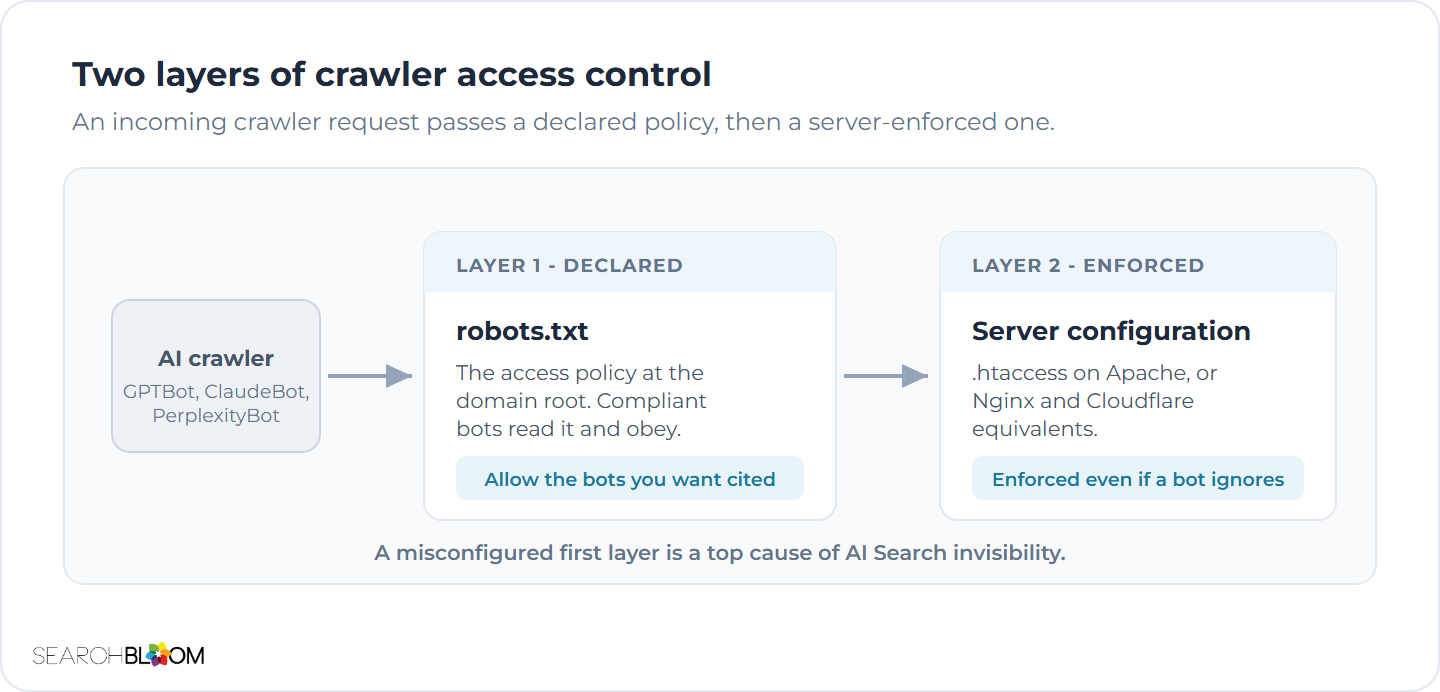
The mechanisms used to control which AI crawlers can access your content. Crawler Configuration is the operational layer for Crawler Access (Chapter 11).
robots.txt
The standard file at the root of a domain that declares crawler access policy. Free; configured directly in your web server or CMS. Use robots.txt to allow GPTBot, OAI-SearchBot, ClaudeBot, PerplexityBot, Google-Extended, and Bingbot explicitly. Misconfigured robots.txt is one of the most common reasons brands are invisible in AI Search; verify by fetching the file from production and testing each bot's access.
.htaccess
The Apache server configuration file that allows finer-grained access control than robots.txt. Free; configured at the server level. Useful when you need to enforce crawler policy regardless of bot compliance with robots.txt directives, or to handle redirects, header manipulation, and rate limiting. Modern infrastructures may use Nginx configuration, Cloudflare Workers, or platform-specific equivalents instead of .htaccess; the principle is the same.
Research and Analytics
The traditional SEO and analytics tools that remain essential to AI SEO. Because AI Search is an evolution of SEO rather than a separate discipline, these tools cover the foundational layer the deeper AI-specific work is built on.
Ahrefs
Comprehensive SEO platform covering backlinks, organic keyword tracking, content explorer, site audit, and (newer) AI-citation features through Brand Radar. Pricing from $129 per month for Lite plan up to enterprise. Best for SEO-led teams that want a single platform for traditional rankings, link building research, and growing AI visibility data, with the Firehose API available for real-time monitoring builds.
Semrush
Direct competitor to Ahrefs with comparable coverage of keyword research, backlink analysis, site audit, and rank tracking, plus the AI Visibility Toolkit for AI visibility. Pricing from approximately $117 per month, billed annually. Best for teams already standardized on Semrush or those who specifically want the AI Visibility Toolkit integrated with their traditional SEO work.
Google Search Console
Google's free tool for monitoring how Google crawls and indexes your site. Provides query data, page-level performance, coverage reporting, and core web vitals. Free. Essential for any AI Search engagement because traditional SEO eligibility remains the foundation, even though approximately 60% of individual AI Overview citation slots come from URLs that do not rank in the top 20 organic results (AirOps, March 2026). This is not a contradiction of the seoClarity finding that 97% of AI Overviews cite at least one top-20 source: the 97% measures how many Overviews include a top-20 source, while the 60% measures the share of individual citation slots that sit outside the top 20. Verify your domain, monitor coverage, and use query data to identify AI-prompt candidate topics.
GA4 (Google Analytics 4)
Google's free web analytics platform. Necessary for measuring traffic from AI sources (ChatGPT, Perplexity, Gemini) once those sources start sending qualified visitors. Free. Build segments for AI-attributed traffic by referrer (chat.openai.com, perplexity.ai, gemini.google.com) and track downstream conversion to validate that AI visibility is producing real pipeline.
Ready to apply MERIT to your business?
Searchbloom builds and runs MERIT-aligned AI Search engagements for mid-market and enterprise teams. We can audit your current state and execute alongside your team.
Schedule a Strategy Call