
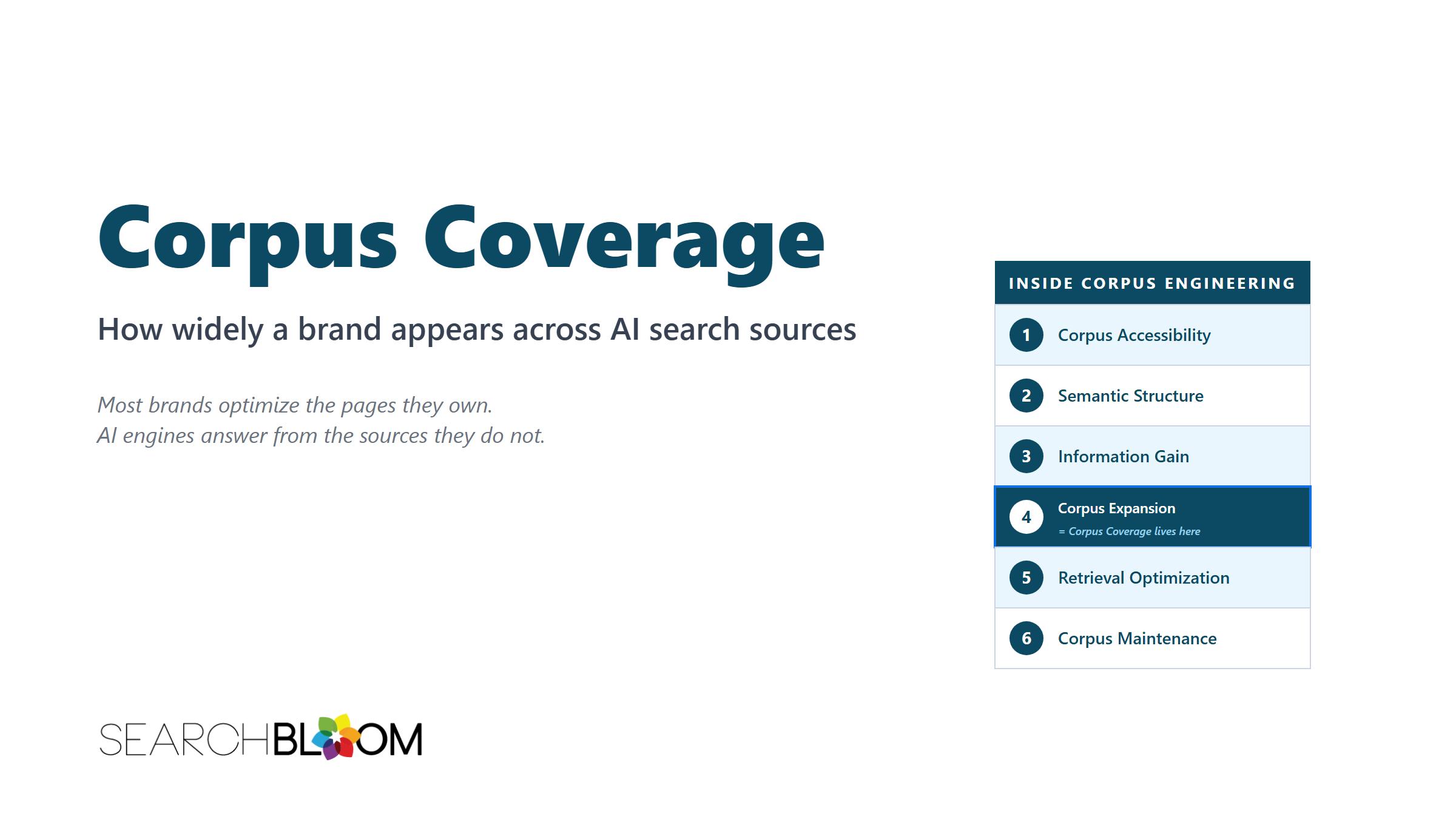
"Information Gain is how original your content is. Corpus Coverage is how much of the corpus contains your brand at all."
~ Cody C. Jensen, CEO & Founder, Searchbloom


Information Gain Score measures one page. It asks whether the content is original enough to earn a citation. Corpus Coverage asks a blunter question across the whole corpus: of every surface an AI engine can retrieve from on a topic, how many contain the brand at all?
Corpus Coverage is the breadth property of Component 4 of Corpus Engineering: Corpus Expansion. The parent article scopes the component in two sentences. Increase the semantic breadth and topical coverage of the corpus across all three layers. This article is the full treatment. Corpus Expansion is the work. Corpus Coverage is the property the work moves.
An AI answer is assembled, not ranked. The engine pulls passages, mentions, reviews, and reference entries from across a corpus and synthesizes one response. A brand can hold the best page on the topic and still be missing from most of what the answer is built from. Information Gain decides whether you are worth citing. Corpus Coverage decides whether you are anywhere the engine looked.
TL;DR
- Corpus Coverage is the breadth of a brand's presence across the retrievable surfaces of all three corpus layers. Owned, extended, and reference. Information Gain is depth. Corpus Coverage is breadth.
- Three corpus types, each with its own layers. The owned corpus (pages, passages, entities, formats, accessibility), the extended corpus (reviews, community, earned media, creator video, knowledge graph), and the reference corpus (training data and the per-engine retrieval indexes).
- The coverage gap is the unit of work. A coverage gap is a single retrievable surface where a competitor appears and the brand does not. The gap, not the layer, is what gets closed.
- Coverage is upstream of relevance. You cannot optimize a passage that does not exist. Relevance Engineering tunes the surfaces a brand occupies. Corpus Coverage decides how many surfaces that is.
- Framework slot: Component 4 of Corpus Engineering, Corpus Expansion. Inside the Mentions pillar of MERIT, with the indexation work landing in Inclusion.
Why Corpus Coverage Matters
A traditional search result is a ranked list. One page sits at position one, and the SEO that produced it optimized that page. An AI answer is not a ranked list. It is a synthesis built from many retrieved sources, and the brand named in the answer is often not the brand with the best single page. It is the brand the engine found everywhere it looked.
Most visibility work is owned-corpus work. A brand publishes pages, optimizes them, and measures rank and Information Gain Score on those pages. That work is real, and it is also a fraction of the corpus. The reviews, the community threads, the reference entries, and the per-engine indexes are where a large share of retrieval happens. A brand can run an excellent owned-corpus program and still be absent from most of the corpus an answer is assembled from.
The shortfall is a measurement gap before it is a content gap. A program that scores ten owned pages and never inventories the wider corpus has no number for its own breadth. It cannot see the surfaces where competitors appear and it does not. Corpus Coverage names that breadth so it can be measured, audited, and closed.
What Corpus Coverage Is
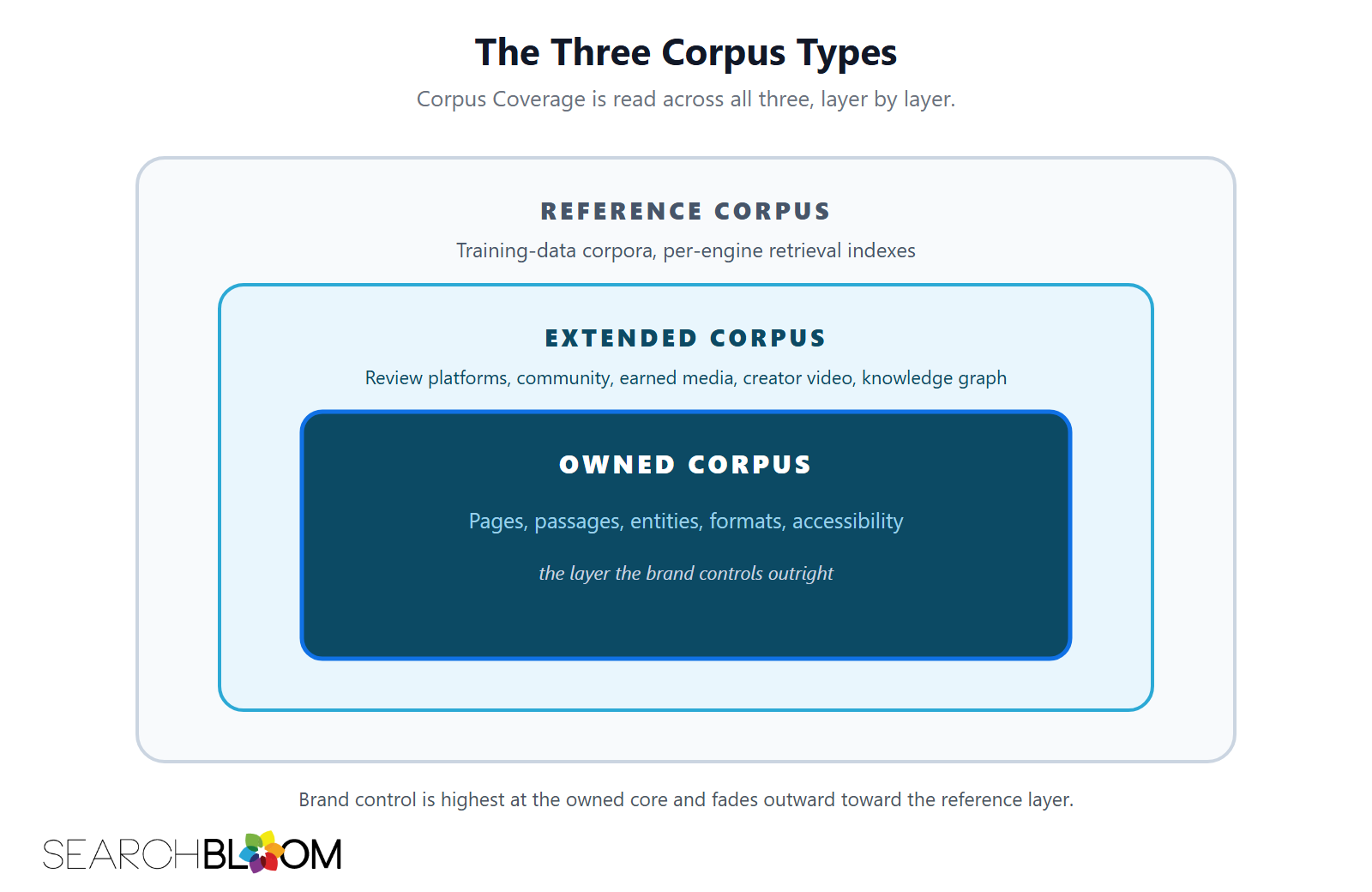
Corpus Coverage is the breadth of a brand's presence across the retrievable surfaces of all three corpus layers. The Corpus Engineering article defines those layers: the owned corpus, the brand's own properties; the extended corpus, third-party content about the brand; and the reference corpus, the broader information ecosystem AI systems pull from. Coverage is one question asked of all three. On this topic, is the brand present on this surface, or not?
Present is a low bar on purpose. Corpus Coverage does not measure how good the content is. It measures whether content exists at all. A thin profile on a review platform counts as coverage of the review layer. A strong profile is the same one unit of coverage with higher quality. Quality is the Information Gain question. Existence is the Corpus Coverage question. Keeping the two separate is what makes each one measurable.
Corpus Expansion is the Corpus Engineering component that does the work. Corpus Coverage is the property it moves, the way Corpus Drift is the property that the Corpus Maintenance component responds to. The component is the practice. The property is the state. This article names and maps the property.
The Three Corpus Types
Each corpus type has its own layers. Coverage is not one number. It is a reading taken layer by layer, type by type. The layers below are the surfaces a coverage audit inventories.
The Owned Corpus
The owned corpus is every property the brand controls outright: the website, the blog, the knowledge base, owned media. It is the layer most visibility work already touches, and the layer where coverage is most often mistaken for complete.
Coverage of the owned corpus has several layers. The page layer is whether a URL on the subtopic exists at all. The passage layer is whether that page contains a cleanly bounded, self-contained chunk that answers a specific sub-query, because retrieval selects passages, not whole pages. At the entity layer, the question is whether the brand, its products, and its people are defined as entities the engine can resolve. Format is a layer of its own: whether the topic is covered in more than prose, since structured data, video, and images are retrieved surfaces of their own. The accessibility layer sits under all of them: a page that exists but blocks GPTBot or ClaudeBot in robots.txt is, for that engine, not covered at all.
Most brands have page-layer coverage and little else. They have a page on the topic and assume the topic is covered. The passage, entity, and format layers are where owned coverage is usually shallow.
The Extended Corpus
The extended corpus is third-party content about the brand. The brand influences it and does not control it: review platforms like G2, Clutch, Capterra, and Trustpilot; community surfaces like Reddit, Quora, and LinkedIn; earned media and podcasts; creator video on YouTube; and the knowledge-graph surfaces, Wikipedia and Wikidata, that define the brand as an entity.
These surfaces are retrieved heavily. Community threads and review platforms appear in AI answers far out of proportion to how most brands resource them. The largest coverage gaps usually hide here, because the extended corpus is filed under public relations rather than engineering. Public relations pursues a placement. Coverage engineering asks a different question: across every third-party surface the engine retrieves from on this topic, where do competitors appear and the brand does not?
The Reference Corpus
The reference corpus is the broadest layer: the information ecosystem an AI engine draws from when no brand is in the room. It has two halves, and they map to the two paths the Information Gain research named. The training-data half is the corpus a model learned from, reached over months through the public-web crawlers, CCBot, GPTBot, ClaudeBot, and Google-Extended. The retrieval-index half is the live index each engine queries at answer time: Google for AI Overviews and AI Mode, Bing for ChatGPT and Copilot Search in Bing, Brave for Claude, and PerplexityBot's index for Perplexity.
No brand edits the reference corpus directly. Coverage of it is downstream. It is the result of owned and extended coverage flowing into the crawlers and indexes over time. The reference corpus is also why coverage is never a single state. A brand can be indexed where Google retrieves and absent where ChatGPT retrieves. Covered is a per-engine reading, not one box to check.
| Corpus Type | Layers | Brand Control | How Coverage Is Won |
|---|---|---|---|
| Owned | Pages, passages, entities, formats, accessibility | Direct and full | Publish the page, structure the passage, define the entity, open the crawlers |
| Extended | Review platforms, community, earned media, creator video, knowledge graph | Influence, not control | Earn the profile, the mention, the thread, the entry; treat it as engineering, not public relations |
| Reference | Training data, per-engine retrieval indexes | Indirect, downstream | Let owned and extended coverage flow into the crawlers and indexes over time |
Breadth and Depth: Corpus Coverage and Information Gain
Corpus Coverage and Information Gain are the two axes of Corpus Engineering's content work, and they are orthogonal. Information Gain, Component 3, is depth: how original and citation-worthy a given piece is, measured by the Information Gain Score against the competing set. Corpus Coverage, Component 4, is breadth: how many of the corpus surfaces contain the brand at all.
The two failure shapes are different. Depth without breadth is the brand with a B-plus Information Gain Score on three flagship pages and no presence anywhere else. It wins the three queries those pages target and is absent from the rest of the topic. Breadth without depth is the brand present on forty surfaces with nothing original on any of them. It is retrieved and then absorbed, because every passage restates what the corpus already had. An engineered corpus needs both: enough coverage that the engine keeps finding the brand, and enough information gain that it keeps citing what it finds.
The order matters. Coverage comes first. Information Gain is a property of a passage, and the passage has to exist before its depth can be measured or improved. A brand cannot raise the Information Gain Score of a review platform it has no profile on. Breadth creates the surfaces. Depth earns the citation on them.
The Coverage Gap
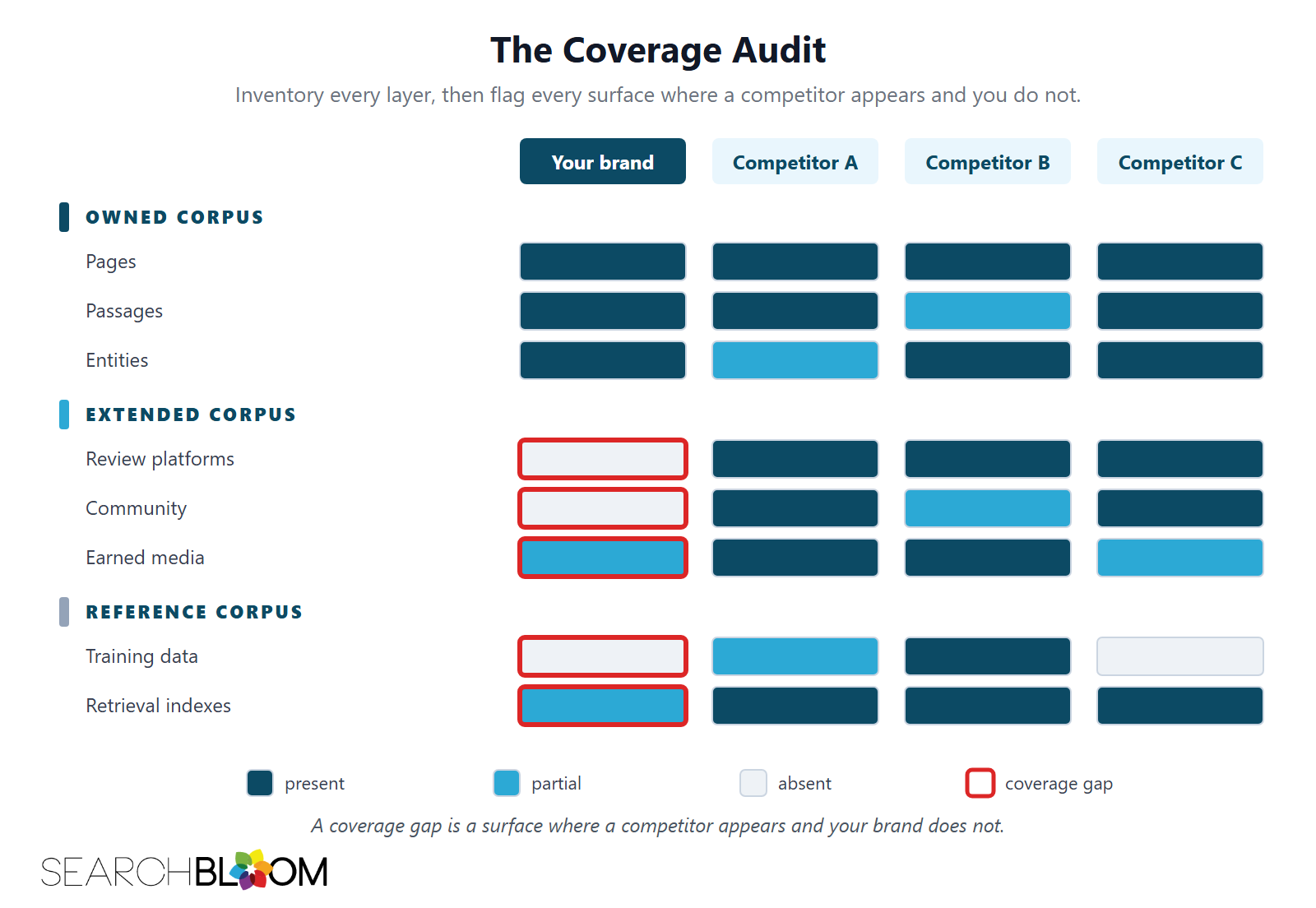
Corpus Coverage is read as a state, but it is closed one gap at a time. A coverage gap is a single retrievable surface where a competitor appears and the brand does not. Not a layer. A surface. A competitor's review profile against the brand's empty one is a gap. A competitor named in a high-retrieval community thread where the brand is absent is a gap. A sub-query with a competitor passage and no brand passage is a gap.
The gap is the unit of work because it is concrete and assignable. Improve extended-corpus coverage is not a task. Build the G2 and Capterra profiles, then earn three category placements is a task. A coverage audit turns a vague sense of absence into a counted list of gaps, each tied to a layer, each with a competitor already standing in it.
Gaps are not equal, and two readings rank them. The first is retrieval weight: a surface that gets retrieved often, a major review platform or a high-traffic community thread, outranks a directory listing that rarely surfaces in an answer. The second is reachability: owned-corpus gaps are fast and fully in the brand's control, extended-corpus gaps are slower and influence-based, and reference-corpus gaps are not closed directly at all. Close the high-retrieval-weight surfaces the brand can actually reach first.
Detection: The Coverage Audit
The detection workflow is a coverage audit. It runs at the start of an engagement and on a semiannual cadence after, because the surfaces themselves move. Platforms rise and fall, and engines change which indexes they retrieve from.
Map the corpus. For the priority topic set, list the surfaces inside each of the three types: the owned pages and passages, the extended platforms and communities, and the reference indexes that matter for the engines in scope.
Inventory brand presence. For each surface, mark the brand present, partial, or absent. Partial is a real state: a page with no retrievable passage, a claimed but empty review profile.
Inventory competitor presence. Run the same pass for the top three to five competitors. The competitor set is what turns an inventory into a gap list.
Build the gap list. Every surface where a competitor is present and the brand is absent or partial is a coverage gap. Rank the list by retrieval weight and reachability.
Close and re-audit. Close gaps highest-weight-and-reachable first. Re-audit semiannually against a refreshed surface map.
Four Working Tiers of Corpus Coverage
A brand's overall Corpus Coverage falls into one of four working tiers. The tiers describe the state of the footprint, not a scored index.
| Tier | Coverage State | Typical Brand | Next Move |
|---|---|---|---|
| Absent | Present on few or no surfaces, including owned | A new brand, or an established brand on a new topic | Build the owned corpus first: pages, passages, entities |
| Owned-only | Solid owned pages, near-zero extended and reference presence | The most common tier; a brand with a real content program | Close the highest-weight extended-corpus gaps: reviews, community, earned media |
| Multi-layer | Deliberate presence across owned and extended, indexed where the priority engines retrieve | A brand running coverage as engineering | Deepen thin surfaces with information gain; widen to the remaining engines' indexes |
| Saturated | Present across all three types and most layers | A brand the engine struggles to answer the topic without | Hold with the coverage audit; shift effort to Information Gain and Component 6 maintenance |
Tiers are working anchor points, not a scored index. The reading is for the conversation about where the next effort goes.
Five Failure Modes
Owned-only coverage. The brand resources its own site fully and treats the rest of the corpus as someone else's job. It runs an excellent program on a fraction of the surfaces an answer is built from, and the dashboard never shows the fraction.
Depth mistaken for breadth. A high Information Gain Score on a few flagship pages reads as a strong content position. It is a deep position on a narrow one. The adjacent surfaces are still empty, and the brand wins a handful of queries while the topic is decided without it.
Page coverage mistaken for passage coverage. A page exists on the topic, so the topic is marked covered. The page has no cleanly bounded passage that answers the sub-query. It covers the topic for a human reader and not for a retriever.
The extended corpus left to public relations. Third-party presence is pursued as placements, not engineered as coverage. Reviews, community surfaces, and creator video stay thin while competitors fill them, and no audit ever counts the gap.
Single-engine coverage. The brand is indexed where Google retrieves, measures coverage there, and assumes it everywhere. It is absent from the index behind ChatGPT and the one behind Claude. Coverage was read on one surface and reported as if it were all of them.
Where Corpus Coverage Sits in the Framework
Corpus Coverage is the property of Component 4 of Corpus Engineering: Corpus Expansion. The parent article scopes the component in two sentences. This article is the full treatment of the breadth property the component moves, the way Corpus Drift is the full treatment of one property of Component 6.
It interlocks with the other components. Component 1, corpus accessibility, is the precondition: a covered surface that blocks the AI crawlers is not covered. Component 3, information gain, is the depth axis to Corpus Coverage's breadth axis. Component 5, retrieval optimization, the work Relevance Engineering describes, runs on the surfaces coverage creates. Relevance tuning a passage assumes the passage exists. Coverage is upstream of relevance.
Inside the MERIT Framework, Corpus Coverage maps mainly to the Mentions pillar, the pillar for third-party presence across the extended and reference corpora. The indexation side of the work, getting owned content crawled and indexed where each engine retrieves, lands in Inclusion. Corpus Expansion is how a MERIT-aligned program turns Mentions and Inclusion from goals into a counted, audited surface list.
Questions & Answers
What is Corpus Coverage?
Corpus Coverage is the breadth of a brand's presence across the retrievable surfaces of all three corpus layers: the owned corpus, the extended corpus, and the reference corpus. It measures whether the brand is present on a surface at all, not how good the content there is. Presence is the Corpus Coverage question. Quality is the Information Gain question.
How is Corpus Coverage different from Information Gain?
Information Gain is depth: how original and citation-worthy a single piece of content is. Corpus Coverage is breadth: how many of the corpus surfaces contain the brand at all. The two are orthogonal. A brand can have a high Information Gain Score on three pages and near-zero coverage everywhere else, or wide coverage with nothing original on any surface. An engineered corpus needs both.
What are the three corpus types?
The owned corpus is every property the brand controls outright, such as its website and blog. The extended corpus is third-party content about the brand, such as review platforms, community threads, and earned media. The reference corpus is the broader ecosystem AI engines pull from: training data and the per-engine retrieval indexes. Corpus Coverage is read across all three.
What is a coverage gap?
A coverage gap is a single retrievable surface where a competitor appears and the brand does not. Not a layer, a surface: a competitor's review profile against an empty one, a competitor named in a high-retrieval community thread where the brand is absent. The gap is the unit of work because it is concrete and assignable.
How is Corpus Coverage measured?
Through a coverage audit. Map the surfaces inside each of the three corpus types for the priority topics, mark the brand present, partial, or absent on each, run the same pass for the top competitors, and build the list of gaps where a competitor is present and the brand is not. Rank the gaps by retrieval weight and reachability. Re-audit semiannually.
Is Corpus Coverage the same as Corpus Expansion?
No. Corpus Expansion is Component 4 of Corpus Engineering, the practice of widening a brand's footprint across the corpus. Corpus Coverage is the property that practice moves: the state of the footprint at a point in time. The component is the work. The property is the state.
How is Corpus Coverage different from Corpus Drift?
Corpus Coverage is a breadth property of Component 4, Corpus Expansion. Corpus Drift is a maintenance property of Component 6, Corpus Maintenance. Coverage is the state of how widely a brand is present. Drift is the unforced erosion of a score over time. Different components, different questions.
Why is coverage upstream of relevance?
Relevance Engineering, the retrieval optimization component of Corpus Engineering, tunes how well a passage matches a query. That work assumes the passage exists. Corpus Coverage decides how many surfaces the brand occupies in the first place. A surface the brand is absent from cannot be relevance-optimized. Breadth creates the surfaces; relevance tunes them.
Where does Corpus Coverage fit inside the MERIT Framework?
Corpus Coverage maps mainly to the Mentions pillar, which covers third-party presence across the extended and reference corpora. The indexation side of the work, getting owned content crawled and indexed where each engine retrieves, lands in the Inclusion pillar. Corpus Expansion is how a MERIT-aligned program turns those pillars into a counted, audited surface list.
The Bottom Line
Corpus Coverage is the breadth of a brand's presence across the retrievable surfaces of all three corpus layers. Information Gain is depth: how original the content is. Corpus Coverage is breadth: how much of the corpus contains the brand at all.
The practice is concrete. Audit the owned, extended, and reference corpora layer by layer. Inventory brand presence and competitor presence on each surface. Close the gaps where a competitor stands and the brand does not, highest retrieval weight and reachability first. Re-audit semiannually as the surfaces move.
Without the breadth reading, a program optimizes the pages it owns and never sees the corpus it does not. With it, coverage becomes a counted list of surfaces, and the brand stops being decided out of the answer on a topic it could have owned.
Corpus Coverage is Component 4 made measurable. The parent article on Corpus Engineering sets the discipline. Information Gain Score is the depth axis beside it. Breadth first, then depth, then the maintenance that keeps both.
