
"Your visibility drops on pages nobody touched. That's the SERPs moving, not the page changing."
~ Cody C. Jensen, CEO & Founder, Searchbloom


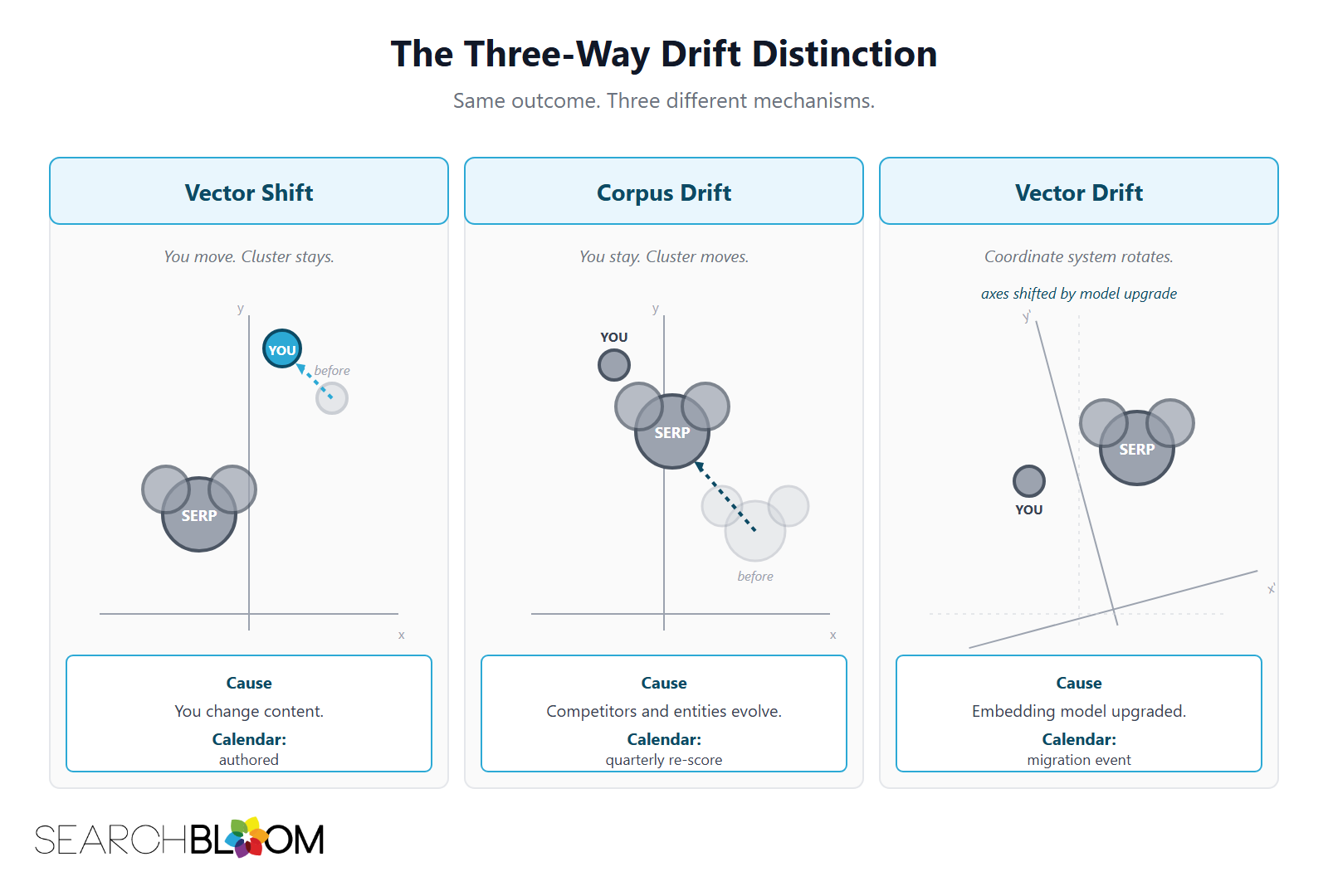
Vector Shift is the change you publish into your own page. Corpus Drift is the change the world makes to the land while your page sits still. Both move your IGS. Only one of them shows up on a content calendar.
Corpus Drift is a named property inside Component 6 of Corpus Engineering, the maintenance component that names the time dimension of the practice. It sits alongside Vector Drift (the embedding model changes the coordinate system) and Semantic-Relationship Drift (entity relationships and salience shift over time). The three together describe every unforced move that erodes a scoring program over months and years.
This article is the full treatment of the footnote at the end of the Vector Shift piece. The line "Vector neighborhoods drift; your shift relative to them drifts with it" is the seed. Corpus Drift is the plant.
TL;DR
- Corpus Drift is the change in the information layer around your fixed content: new peer pages, evolved entities, shifted wording, expanded or contracted topical coverage.
- Three sub-drivers: competitor drift (new and refreshed peer pages), entity drift (tracked entities change identity or lifecycle), topical drift (the topical orbit itself moves as language evolves).
- The math is unchanged. The corpus is what moved. Your Information Gain Score can erode 0.05 to 0.15 in 90 days on a page you did not touch, because the SERP centroid drifted toward you.
- Operational response: quarterly re-scoring against the live top-10, mapped to a tiered move set from refresh to reallocate.
- Framework slot: Component 6 of Corpus Engineering. Sibling to Vector Drift and Semantic-Relationship Drift.
Why Corpus Drift Matters
The SERP is a moving target whether or not you publish. The Vector Shift article documented the measured pattern: priority-page IGS scores re-measured at 90 days drift 0.05 to 0.15 in either direction without the page changing. That drift is not measurement error. It is the centroid moving.
A program that scores a page at publish, files the score, and revisits it a year later is reading a number against a SERP that has since moved on. Nothing about the page changed. The corpus did. What the math reported was true at both moments, against two different baselines.
Cadence falls out of the measured drift band. If a page can shift a tier in 90 days without an edit, then a scoring program that does not re-score at least quarterly is producing trend lines that lie.

What Corpus Drift Is
The Corpus Engineering article defines it in one sentence: the change in the underlying information layer over time. New content appears. Entities evolve. Terminology shifts. Topical coverage expands or contracts. The corpus is what moved, not your page.
Corpus Drift is unforced by construction. Vector Shift is what you publish when you change content. Corpus Drift is what happens to you while you sit still. The two compound. A page that earned a B+ at publish drifts down as competitors publish, even if you do everything right.
The Three Sub-Drivers of Corpus Drift
Competitor Drift
The most common case. A strong competitor publishes a new piece on the head term. The piece earns a Vector Shift of its own and lands far from the existing peer cluster. The SERP median centroid drifts toward that new region. Every other top-10 page loses IGS by a small amount because each is now slightly closer to the centroid. Multiply across 8 to 12 priority queries and the program-wide drift is real.
Refreshed pages produce the same effect at smaller size. A competitor adds a stat, a new section, or a contrarian framing to an existing page. The page's embedding moves. The centroid drifts. Everyone else loses a few hundredths of a point.
Removed pages drift in the other direction. A weak peer leaves the top-10 and is replaced by a stronger entrant. The cluster tightens and centers on a higher Embedding Strength. Your IGS falls if the replacement is stronger than the page it replaced.
Entity Drift (Identity and Lifecycle)
Tracked entities change identity. Company renames (Twitter to X). Product sunsets. Regulatory changes that reshape an entire vertical. Leadership transitions that change a brand's center of gravity. Pages that referenced the old entity drift in semantic relevance because the entity itself moved in the broader corpus.
This sub-driver covers entity identity and lifecycle: who or what the entity is. Entity relationships and salience (who is semantically adjacent to whom, how strongly) live in the future Semantic-Relationship Drift piece named in the Corpus Engineering vs Relevance Engineering article. Reserve that surface for that piece.
Topical Drift
The topical orbit itself shifts as language and interest evolve. New wording enters the cluster. Older framings fade. Query intent changes shape.
Corpus Engineering as a term did not exist in this industry two years ago. AEO and GEO entered the working language inside an eighteen-month window. AI Overviews went from absent to centroid-shaping in less than a year. Pages written in 2023 against the 2023 topical language read like a different language in 2026, even though the page is unchanged.
Topical Drift is the slowest of the three sub-drivers in absolute terms. It is also the most important over multi-year horizons. Competitor Drift moves IGS in 90-day cycles. Topical Drift moves what the query itself means over multi-year cycles.
How Corpus Drift Erodes Vector Shift
The Vector Shift article named two kinds of durability: earned shifts compound; gamed shifts decay. Corpus Drift is the third kind, separate from both.
An earned Vector Shift at publish does not survive Corpus Drift on its own. The substance that earned the citation in Q1 may still be just as original in Q4. If the SERP centroid has drifted toward the page (because peers caught up), the IGS is lower anyway. The shift was real and remains real. The IGS dropped because the yardstick moved.
Both decay sources compound. A page can lose IGS to Corpus Drift even when the substance has not gone stale. The same page can lose IGS to Vector Drift (covered in the Vector Drift piece) even when the corpus itself has not moved. Programs that do not re-score quarterly are running blind to both.
Detection
The detection workflow is the standard Embedding Audit, run on a quarterly cadence:
- Pull the live top-10 SERP for each priority query.
- Re-embed each competitor under the current embedding model.
- Recompute IGS for the priority page against the new peer set.
- Compare to the prior quarter's score.
The math is unchanged from the IGS formula. The corpus is what is new. (For the citation-side view of the same erosion, see Citation Half-Life.) A delta of 0.05 to 0.10 is the typical drift band per quarter for an active head term. A delta over 0.15 is a signal that something structural has changed: a new competitor moved in, an entity drifted, or the topical orbit itself shifted.
The Embedding Audit covers the per-page mechanics. The Corpus Drift workflow is the same mechanics, repeated on a calendar.
Operational Response
When Corpus Drift is detected, the move set maps to the size:
- Drift under 0.05. Note it. Do not act. Quarterly noise is normal. The cost of editing a page in response to single-quarter noise exceeds the benefit.
- Drift 0.05 to 0.10. Refresh with new substance. Pull from the 12 Information Gain Techniques covered in Information Gain in SEO: a new stat, a new SME quote, a contrarian framing, a named failure mode. The goal is to re-earn the Vector Shift that the centroid drifted away from.
- Drift 0.10 to 0.15. Refresh plus expand. The substance refresh is necessary but not enough. Add an adjacent unoccupied region of the topical orbit: a related sub-query, a deeper section, a head-to-head no peer has published.
- Drift over 0.15. Reconsider the page. Either the topic has gone commodity, the SERP has tightened around a different framing, or a major new entrant has rewritten the cluster. The right move is contrarian update or budget reallocate, not a small refresh.
Tier ranges are anchor points, not universal cosine values. The numbers are for the audit. The property is for the conversation.
Five Failure Modes of Ignoring Corpus Drift
Set-and-forget publishing. A page scores B+ at publish, gets filed, and is never re-measured. The page drifts to B-minus over twelve months. The program treats the B+ as current. Every report is wrong by one tier.
Stale IGS baselines. A program compares this quarter's IGS to a baseline computed against a SERP that has since moved on. The delta is real. The comparison is false. Both numbers had to come from the same quarter's corpus or the delta is noise.
Missing competitor moves. A strong competitor publishes a heavy piece on the head term. The program does not notice until the next manual audit. By then the centroid has drifted, the IGS has eroded, and the page is two tiers behind where it sat at publish.
Entity blindness. A tracked entity renames, sunsets, or restructures. The pages referencing the old entity are left in place. The pages read fine to humans and drift in semantic relevance for retrieval systems that already updated.
Topical contraction misread as opportunity. A topical cluster contracts. Search interest falls. Peers leave the SERP. IGS for the priority page rises. The program reads the rise as a win. In fact the cluster is dying, and the rise is the centroid tightening around fewer peers, not the page winning.
Where Corpus Drift Sits in the Framework
Component 6 of Corpus Engineering: Corpus Maintenance. The component that names the time dimension of the practice.
Sibling to Vector Drift, the model-side drift. Sibling also to Semantic-Relationship Drift, the entity-relationship drift named in the Corpus Engineering vs Relevance Engineering article. Three drifts, three mechanisms, three cadences, one Component 6.
Each drift has its own operational response. Vector Drift is handled by The Embedding Migration, covered in its own piece. Corpus Drift is handled by the quarterly re-score workflow above. Semantic-Relationship Drift is a separate discipline covered in its own piece.
Frequently Asked Questions
What is Corpus Drift?
Corpus Drift is the change in the information layer around your fixed content over time. New peer pages. Evolved entities. Shifted wording. Expanded or contracted topical coverage. The corpus moves while your page sits still.
How is Corpus Drift different from Vector Shift?
Vector Shift is the movement you publish when you change content. Corpus Drift is the movement the world makes to the land around your unchanged content. Both change IGS. Only Vector Shift shows up on your content calendar.
How is Corpus Drift different from Vector Drift?
Corpus Drift is the landscape moving. Vector Drift is the coordinate system moving because the embedding model was upgraded. Same page, same corpus, different model: that is Vector Drift. Same page, same model, different competitors: that is Corpus Drift.
How often does Corpus Drift trigger in practice?
Continuously. The measured band from the Vector Shift article is 0.05 to 0.15 in 90 days on a typical priority page. The drift is always running. How often you check determines how much built-up drift shows up at a time.
What is the typical size in IGS terms?
0.05 to 0.10 per quarter on an active head term is normal. 0.10 to 0.15 is material and worth a refresh. Over 0.15 in a quarter is structural and worth rethinking the page.
How should I respond at each size?
Under 0.05, do nothing. 0.05 to 0.10, refresh with one or two Information Gain Techniques. 0.10 to 0.15, refresh plus expand into adjacent vector space. Over 0.15, reconsider whether the page is worth the budget.
Does this apply to intra-site embedding workflows too?
Yes. Intra-site IGS is more stable because the peer set is fixed to your own pages, but Corpus Drift still operates inside the site as new pages publish, entity references age, and internal wording evolves. The cadence can be slower. Semiannual is reasonable for intra-site work.
What about entity drift specifically?
Entity drift covers identity and lifecycle changes: renames, sunsets, leadership. It sits inside Corpus Drift. The drift in entity relationships and salience is Semantic-Relationship Drift, a sibling concept covered in its own piece.
Can the detection run inside Screaming Frog v22, or does it require Python?
Either. The Screaming Frog Embedding Audit workflow covers the per-page mechanics; running it quarterly on a fixed priority page set (see The Anchor Set) is the Corpus Drift workflow. A Python pipeline scales better for programs tracking 50 or more priority pages on a strict cadence.
Where does Corpus Drift fit inside the MERIT Framework?
Inside Transform. MERIT names Transform as the pillar that maintains and adapts the corpus over time. Corpus Drift is the unforced movement that Transform-pillar work responds to.
The Bottom Line
Corpus Drift is the unforced movement of the information landscape around your fixed content. New competitors publish. Entities evolve. Topical orbits expand. Your visibility drops on pages nobody touched. Vector Drift, covered in its own piece, is a separate mechanism: the math itself moves when the embedding model is upgraded.
The practice is simple: detect on a quarterly cadence; respond at the size of the drift. Without it, every IGS report is a snapshot of a SERP that has moved on.
