
Updated May 6, 2026
"Vector shift is what the math sees. It does not see your effort, it does not see your intent, it does not see your reputation. It sees whether the embedding moved. The only sustainable way to move the embedding is to put new substance on the page that was not there before. Everything else decays."
~ Cody C. Jensen, CEO & Founder, Searchbloom


Vector shift has become the term of art for differentiating content in a saturated SERP. The framing is everywhere in 2026: "engineer a vector shift," "lower your cosine similarity to the SERP median," "land in unoccupied vector space." The framing is also wrong in a specific, load-bearing way. Vector shift is not something you engineer. It is something that shows up when you have done other work. The vector follows the substance.
This piece is the underneath-the-pillar deep-dive on what vector shift actually means, why the dominant framing is misleading, and how to tell the difference between a shift that compounds in citation share and a shift that decays the moment embedding models update. The pillar (Information Gain) establishes the Information Gain Score and the 12 Information Gain Techniques. This spoke goes one layer down and explains what the math is actually doing when IGS goes up, and which moves produce durable shift versus which produce cosmetic motion that erodes.
TL;DR
- Vector shift is a receipt, not a strategy. It is the mathematical fingerprint that shows up when content has real Information Gain Density. You cannot move the vector directly. You change the content; the vector follows.
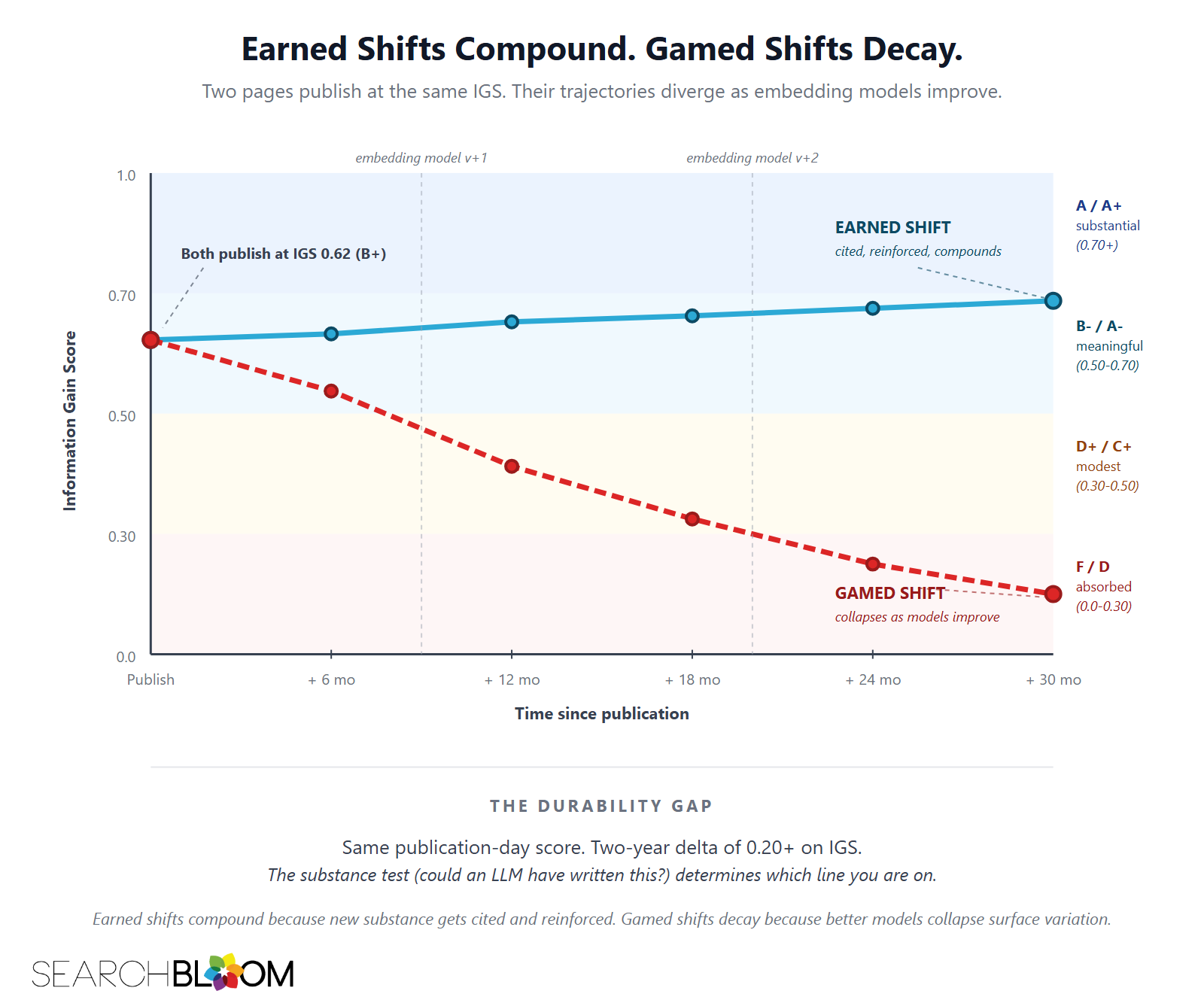
- Earned vector shift comes from new substance. A stat that did not exist before, a quote in a voice with no embedding twin, a named failure mode with cohort specificity. Earned shifts compound.
- Gamed vector shift comes from surface manipulation. Synonym swaps, jargon substitution, padded paragraphs. Gamed shifts decay as embedding models improve.
- Direction matters as much as magnitude. A shift away from the SERP median that is also off-topic kills retrieval before it kills cosine similarity. Useful shifts move you away from peer pages while staying inside the topical orbit.
- Each of the 12 Information Gain Techniques produces a characteristic shift signature. Stacking four to six produces a multi-dimensional shift that is harder for competitors to converge on than any single direction.
- Searchbloom measures shift with the Information Gain Score (IGS = 1 minus the maximum cosine similarity to the top-10 competitors). Letter grade B-minus (IGS 0.50) is the citation threshold. A-minus (0.65) is where citation slots get won reliably.
What Vector Shift Actually Is
An embedding is a list of numbers (typically 768 to 3,072 dimensions) that encodes the meaning of a piece of content the way a language model interprets it. Two pieces of content with similar meanings produce similar embeddings. Cosine similarity is the standard math for comparing them: 1.0 means the two embeddings are identical in direction, 0.0 means they are orthogonal, and most real-world content for the same query lands between 0.4 and 0.9.
The SERP median centroid is the average embedding position of the top-ranking pages for a given query. When a thousand articles all answer the same question in roughly the same way, their embeddings cluster tightly around that centroid. Any new article that repeats the consensus framing lands near the cluster and gets absorbed into AI synthesis without attribution.
Vector shift is the change in your document's embedding position relative to that centroid after a content edit. Imagine the SERP median as a tight cluster of pins on a 2D map. Most new pins land inside or right next to the cluster. The pins that get cited in AI Overviews and Large Language Models are the ones that land in unoccupied corners inside the topical orbit. Vector shift is the motion from one of those positions to the other.
The Information Gain Score formula (covered briefly in the pillar and in operational depth in the dedicated Information Gain Score deep-dive) is one specific way to score the magnitude of that shift: IGS = 1 minus the maximum cosine similarity between your document and any of the top-10 competitors.
Why "Engineer a Vector Shift" Is the Wrong Framing
The dominant framing in 2026 SEO content treats vector shift as a technique operators execute directly. Krish Srinivasan introduced the term in March 2026 to describe deliberately lowering cosine similarity to the SERP median. The term has propagated through the SEO content ecosystem since, and most coverage repeats the verb: engineer a vector shift, architect semantic divergence, design a shift away from the cluster.
The verb is the problem. You cannot move the vector directly. The vector is the embedding model's interpretation of your content. The only input you control is the content itself. Change the content; the vector moves. Try to change the vector without changing the content, and you produce one of two predictable failure modes:
- Synonym swaps and jargon substitution. Rewriting "increase conversion" as "elevate conversion outcomes" produces a measurable cosine delta in some embedding models. The cosine number moves. The meaning does not. Embedding models trained on the next snapshot of the web learn to collapse these surface variations back toward the original meaning. The shift evaporates.
- Off-topic divergence. Adding paragraphs about adjacent topics, citing irrelevant sources, or padding the page with material that has nothing to do with the target query genuinely lowers cosine similarity to the SERP median. It also lowers cosine similarity to the head term, which means the page stops being retrievable. You have shifted the vector, but in the wrong direction.
The right framing: do the substance work (the 12 Information Gain Techniques); the vector shift is the receipt that the work happened. Vector shift is what an editorial process produces when the content actually has new substance. It is not what an editorial process aims for.
Earned vs Gamed Vector Shift
This is the distinction Searchbloom uses internally and the one that does not appear in any of the existing top-10 coverage of vector shift. Every shift falls into one of two categories:
| Earned Vector Shift | Gamed Vector Shift | |
|---|---|---|
| Source | New substance on the page that did not exist in the corpus before | Surface manipulation of existing meaning (synonyms, jargon, padding) |
| Examples | SME quote with no embedding twin, proprietary aggregate data, named failure mode with cohort specificity | Synonym substitution, restructuring without rewriting, irrelevant section padding |
| Detection test | Could ChatGPT have written this paragraph from existing sources? No. | Could ChatGPT have written this paragraph from existing sources? Yes. |
| Durability | Compounds. Subsequent training corpora absorb the new substance and reinforce the shift. | Decays. Better embedding models collapse the surface variation; AI Overviews learn to filter for citation-worthy passages. |
| Citation behavior | Cited at the passage level with attribution; quote often pulled directly | Absorbed into AI synthesis without attribution; rarely surfaces as a named source |
The detection test is the operationally useful piece. Before you score IGS, run the paragraph through the question: could an LLM have produced this from existing sources? If the answer is yes, any vector shift you measure is likely gamed. If the answer is no, the shift is earned. The math will not tell you the difference. The test will.
This is also why earned shifts compound and gamed shifts decay. When the next major training corpus ingests the web, an earned shift adds a new data point that did not exist before, and other publishers cite it, and the embedding region your content occupies becomes recognized vector space. A gamed shift adds nothing the corpus did not already have, just rephrased; the next embedding model is a separate training run on a richer corpus, and richer corpora are better at collapsing surface variation. The shift you measured today gets canceled.
Direction Matters: Topical Shift vs Off-Topic Drift
Vector shift is two-dimensional, and most coverage treats it as one-dimensional. The two dimensions:
- Distance from the SERP median centroid. Higher is better, up to a threshold. This is what IGS measures.
- Distance from the topic centroid (the head-term embedding). Higher is worse, past a threshold. This is what topical relevance measures.
A useful shift moves you away from peer pages and stays close to the topic. A failed shift, what we call off-topic drift, moves you away from peer pages and away from the topic. Drift looks like differentiation in the IGS column and looks like irrelevance in the retrieval column. AI search engines retrieve on relevance first, then differentiate within the retrieved set. A page that drifts off-topic does not get retrieved at all, so its IGS becomes academic.
The way to measure both dimensions at the same time: compute cosine similarity to (a) the top-10 peers and (b) the head-term query embedding. Useful shifts increase the delta to peers without lowering the delta to the query. Drift increases delta in both.
This is the operational reason the 5-to-7 Rule from the pillar specifies distinct, attributable insights. An insight that is novel but not topical produces drift. An insight that is novel and topical produces shift. The qualifier matters.

The 12 Techniques as 12 Shift Directions
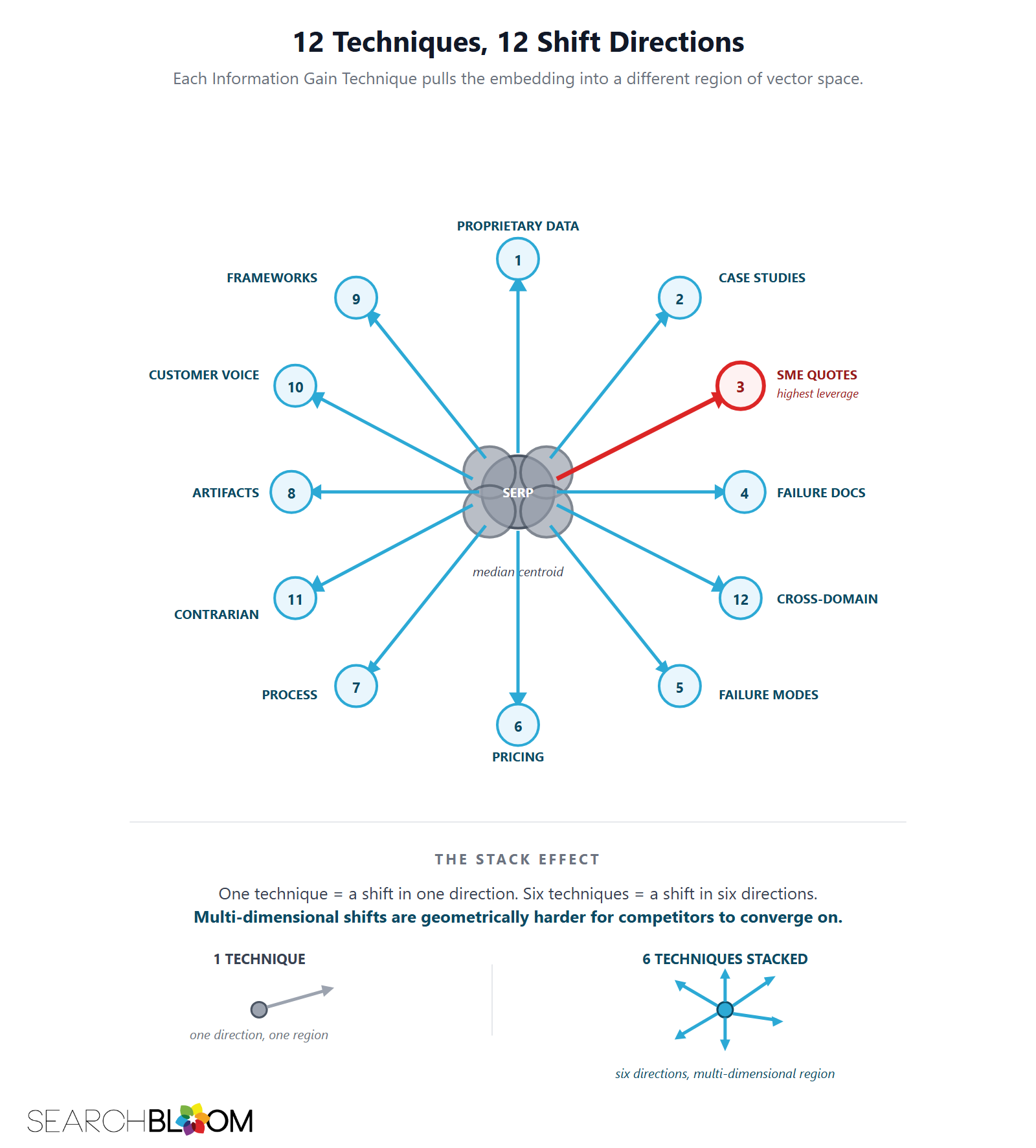
Each of the 12 Information Gain Techniques produces a characteristic signature in vector space. Different techniques shift the embedding in different directions, which means stacking multiple techniques produces a multi-dimensional shift that is structurally harder for competitors to reproduce.
A few of the directional signatures we have observed:
- SME quotes (technique 3) shift the embedding toward voice-rich neighborhoods. A specific person's phrasing produces a fingerprint that no LLM can fabricate, because the fingerprint is the cadence and word selection of one human, not the consensus voice of a corpus.
- Proprietary aggregate data (technique 1) shifts toward stat neighborhoods that no other publisher has access to. The numbers themselves are uncopyable until they are published. Once published they become a citation hook.
- Failure documentation (technique 4) shifts toward survivorship-bias-adjacent regions of vector space that most pages avoid. The web is biased toward "here is the playbook that worked." Articles that name what did not work are structurally rare and embed in sparse regions.
- Contrarian framings (technique 11) shift toward unoccupied centroid regions. When a thousand articles agree X is true, an article that argues X is wrong (with primary-source evidence) lands where no other article currently sits.
- Cross-domain synthesis (technique 12) shifts toward intersection regions that exist only when two fields are combined. Behavioral economics applied to plumbing service pricing produces an embedding that does not appear in either field's corpus alone.
A piece using one technique produces a shift in one direction. A piece using six techniques produces a shift in six directions, which is geometrically much harder for a competitor to converge on than a single-direction move. This is the operational case for the 5-to-7 Rule: not just more insights, but more different kinds of insight, each pulling the vector toward a region most pages do not reach.
How to Measure a Vector Shift Pre-Publish
The mechanics of an IGS pre-publish check, illustrated on a hypothetical priority page:
Imagine a draft targeting the query "best content marketing tools." Pull the top-10 ranking pages and embed each one (text-embedding-3-large from OpenAI, voyage-3 from Voyage AI, or BGE-M3 from BAAI all work; the specific model matters less than using the same model across all comparisons). Embed your draft the same way. Compute cosine similarity to each of the 10. Find the closest match.
IGS = 1 - max(cos_sim(your_draft, competitor_i))
In the worked example, the closest competitor matches at 0.69 cosine. IGS = 1 - 0.69 = 0.31. On the 13-grade scale from the pillar, that is a D+. Absorbed without citation. The math told you, before you published, that you do not differentiate.
You rework. You add a direct quote from your CMO on a perspective that does not appear in any of the 10 competitors (technique 3). You publish the actual price ranges for each tool you have run procurement on, with the cohort that drives each price tier (technique 6 plus technique 5). You take a contrarian stance that two of the most-cited tools are overpriced for teams under a specific size, with the cost-per-output math (technique 11). You re-embed and re-score. The new closest match is at 0.38 cosine. IGS = 0.62. B+. Citation candidate.
Two things to notice. First, the substance changed. There is a quote that did not exist in the corpus before. There are price ranges most competitors avoid disclosing. There is a stance most articles dodge. Second, the shift was earned. If you had instead rewritten "best tools" as "most effective platforms" and stuffed in 200 words of synonym variation, the cosine number might have moved a similar amount in some embedding models. The retrieval-side embedding models would still cluster you with the original peers, because the meaning has not changed. Your IGS would look better today and decay within months.
The pre-publish workflow we use at Searchbloom: IGS analysis against the top-10, identify the techniques to deploy, rework, re-score, publish at B-minus or above. Pages that score below B-minus go back to the editorial queue. The math is the floor, not the ceiling.
What This Means for Your Editorial Process
Three operational changes follow from treating vector shift as a receipt rather than a strategy.
- Add an IGS check to the pre-publish workflow. Pulling top-10 embeddings and scoring against them takes 15 minutes per priority page with current tooling. Most editorial teams discover whether their draft differentiates after publication, by watching rankings. The math lets you know before publication.
- Run the earned-versus-gamed test before scoring. Read each section and ask: could an LLM have produced this from existing sources? If yes, the section is gamed regardless of what IGS says. Rework with a real technique deployment, not a cosmetic rewrite.
- Watch for neighborhood saturation. A shift that earned a citation in 2025 may not in 2026 as competitors copy successful angles. Re-score priority pages quarterly against the current top-10 rather than the top-10 as it stood at publication time. Vector neighborhoods drift; your shift relative to them drifts with it. The pattern is most pronounced in enterprise SEO engagements with deep priority page lists, where a competitor publishing one strong piece can shift the centroid for an entire category overnight.
None of these change the headline conclusion: vector shift is what your editorial process produces when the substance is real. It is not a separate workstream. It is the receipt for the workstream you are already running.
Questions and Answers
What is the difference between vector shift and information gain?
Information gain is the substance: new knowledge or insight on the page that did not exist in the corpus before. Vector shift is the mathematical fingerprint of that substance, measured as the change in your document's embedding position relative to the top-ranking competitors. High information gain produces vector shift. Vector shift without information gain (synonym swaps, padding) is gameable and decays.
Can I engineer a vector shift directly?
No. The vector is what an embedding model thinks of your content. You cannot edit the embedding; you can only edit the content the embedding is computed from. The right framing: change the substance using the 12 Information Gain Techniques, and the vector shift follows as a receipt.
What is the difference between earned and gamed vector shift?
Earned vector shift comes from new substance: a stat that did not exist before, a quote in a voice with no embedding twin, a named failure mode with cohort specificity. Gamed vector shift comes from surface manipulation: synonym swaps, jargon substitution, paragraph padding. Earned shifts compound across training corpora. Gamed shifts decay as embedding models improve and AI Overviews learn to filter for citation-worthy passages.
Does vector shift apply only to AI Overviews or to all search?
Both. AI Overviews and Large Language Model citations rely on retrieval-augmented generation, which uses cosine similarity at query time, so vector shift directly determines which pages get pulled into the citation set. For Google surfaces, optimizing for AI Overviews and AI Mode is still SEO: Google states its generative AI features are rooted in its core Search ranking and quality systems, with no special files or markup required and spam policies applying to AI responses. The vector shift framing applies to the third-party RAG engines (ChatGPT, Perplexity, Claude) and to your own scoring program.
How big a vector shift do I need?
On Searchbloom's 13-grade scale, IGS 0.50 (B-minus) is the practical citation threshold. IGS 0.65 (A-minus) is where citation slots get won reliably. Below 0.30 (D), the page is absorbed without attribution. Above 0.85 (A+), the page is so different from the top-10 that topical relevance starts to break, and retrieval suffers.
What are the most common ways operators game vector shift?
Three patterns: (1) synonym swaps and jargon substitution that move cosine numbers without changing meaning, (2) paragraph padding with adjacent or off-topic material that lowers similarity to peers but also lowers similarity to the query, and (3) AI rewrites of existing content that produce surface variation without new substance. Each shows up in IGS measurements as a temporary improvement that decays within one or two embedding-model release cycles.
Will an LLM detect a gamed vector shift?
Increasingly, yes. Frontier embedding models released since late 2024 (text-embedding-3-large, voyage-3, BGE-M3 and successors) collapse surface variation more aggressively than their predecessors. AI Overviews and ChatGPT search apply additional filters for citation-worthiness on top of retrieval. The honest read for 2026 and beyond: gamed shifts decay faster every cycle. The technique that worked in 2023 does not work in 2026.
What embedding model should I use to compute IGS at home?
Any current general-purpose embedding model: text-embedding-3-large (OpenAI), voyage-3 (Voyage AI), or BGE-M3 (BAAI) all produce calibrated IGS scores in our internal testing. The specific choice matters less than consistency: use the same model across your draft and all 10 competitors so the cosine math is comparable.
How does vector shift relate to topical authority?
Topical authority is the breadth and depth of a publisher's coverage across an entire topic over time. Vector shift is the novelty of any single piece relative to current top-10 competitors. The two compound. A site with strong topical authority that publishes pages with earned vector shift wins citation share consistently. A site with topical authority but no shift gets crawled but absorbed. A site with shift but no authority struggles to be retrieved in the first place.
How often does the SERP median centroid move?
Often enough to matter. Each time a competitor publishes a piece with earned vector shift, the centroid drifts toward that new region of vector space. Each time a low-shift piece is removed or deindexed, the centroid drifts the other way. In our internal testing across Searchbloom partner engagements, priority-page IGS scores measured at publication and re-measured at 90 days drift by 0.05 to 0.15 in either direction without the page itself changing. Re-scoring quarterly is the operational answer.
Does vector shift work the same on Bing, Perplexity, Claude search, and ChatGPT search?
Directionally yes; specifics vary. Each retrieval system uses its own embedding model and its own retrieval pipeline, so the cosine math is not identical across products. The structural pattern (citation goes to pages with measurable separation from the top-10 competitor cluster) holds across all of them. The IGS framework is product-agnostic; the specific number moves slightly depending on which embedding model you use to compute it.
Where does vector shift fit inside the MERIT Framework?
Vector shift is the mathematical signature of work done in the Evidence pillar, surfaced through the structural changes of the Relevance pillar, and made measurable by the Transformation pillar. The MERIT Framework treats Information Gain Density as the substance, IGS as the measurement, and vector shift as the underlying motion the measurement captures. The pillar (Information Gain) covers MERIT in detail.
The Bottom Line
Vector shift is the receipt, not the strategy. Information Gain Density is what produces it. The Information Gain Score is what measures it. The 12 Information Gain Techniques are how you author it. Earned shifts compound; gamed shifts decay. The 2026 SEO content ecosystem has converged on treating vector shift as a technique operators execute. The honest read of the math is that you cannot move the vector without moving the substance, and the substance work is the work that was always going to matter.
For the broader framework underneath this piece, see the parent article on Information Gain in SEO, which covers the 5-to-7 Rule, the 12 Techniques, the IGS letter grade scale, and where vector shift fits inside the MERIT Framework.
Information gain is one of six components of Corpus Engineering, the systems-level discipline for AI visibility. The other five are corpus accessibility, semantic structure, corpus expansion, retrieval optimization, and corpus maintenance.
