

"The model that scored your page last quarter isn't the model scoring it this quarter. Most SEO engagements aren't tracking this level of granularity."
~ Cody C. Jensen, CEO & Founder, Searchbloom


Vector Shift is the move you publish. Corpus Drift is the move the world makes around your fixed page. Vector Drift is the third move. The axes themselves rotate when the embedding model is upgraded. Same page. Same corpus. New math.
Vector Drift is a named property inside Component 6 of Corpus Engineering. The parent article defines it in one line: the same content lands in a new vector position when the model is upgraded. This piece is the full treatment of that line.
The closest mental model is a Google core update. Your content was the same. The ranking math changed. Every dashboard had to be re-baselined. Vector Drift is that pattern, applied to the embedding layer of the retrieval stack, on a 60 to 90 day cadence.
TL;DR
- Vector Drift is the change in your content's vector position when the model is upgraded. Same words. New model. New position.
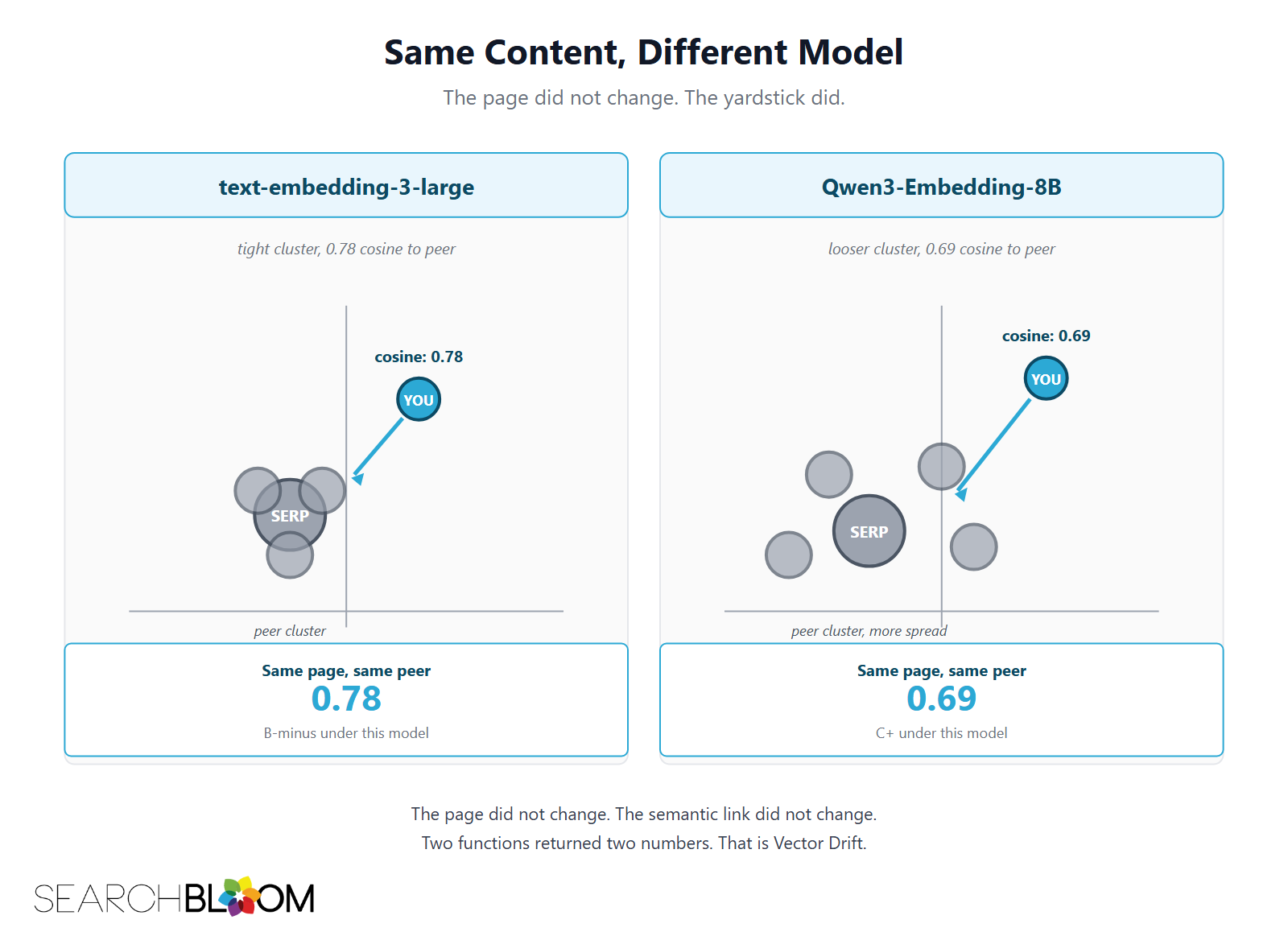
- The mechanism is simple. Cosine values differ across models. A page that scored 0.78 against the SERP centroid under text-embedding-3-large may score 0.69 under Qwen3-Embedding-8B. The page did not change. The yardstick did.
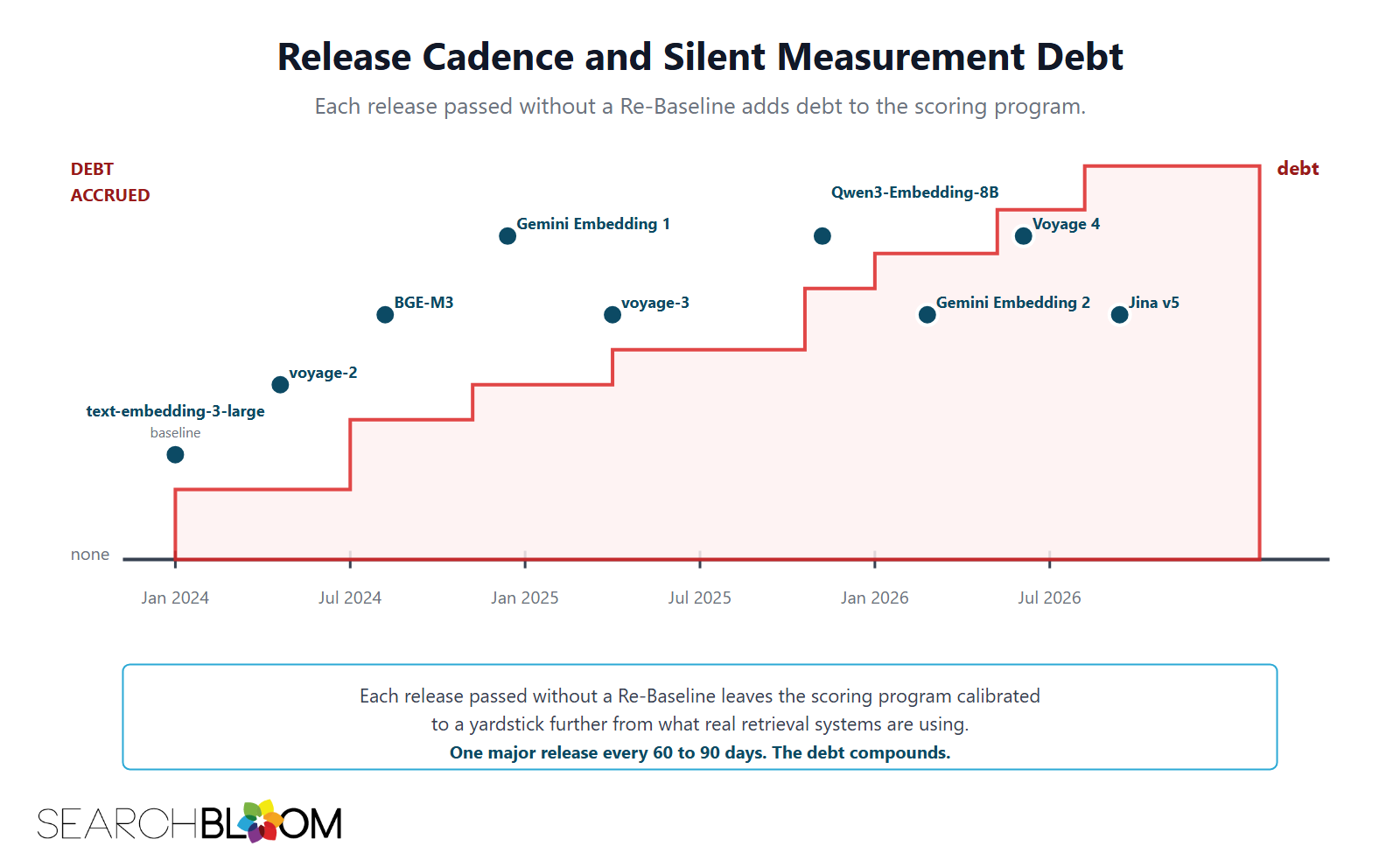
- Release cadence is the urgency. One major embedding model every 60 to 90 days through 2025-2026. Any scoring program tracking content over months runs inside a versioned setup without a versioning rule.
- Vector Drift is the mechanism behind the decay of gamed Vector Shifts. Better models collapse surface tricks. Earned substance compounds because new training data reinforces it.
- Working response: Re-Baselining via The Embedding Migration, the workflow piece in this sub-cluster.
- Framework slot: Component 6 of Corpus Engineering. Sibling to Corpus Drift and Semantic-Relationship Drift.
Why Vector Drift Matters Now
Release cadence is the case for urgency. A short look at the 2025-2026 embedding model release list makes the point:
- Gemini Embedding 2: March 2026
- Qwen3-Embedding-8B: late 2025
- Voyage 4: April 2026
- Jina Embeddings v5: April 2026
- text-embedding-3-large: January 2024 baseline still in active use across many programs
One major release every 60 to 90 days. Any program that tracks Information Gain Score, citation rates, or cosine deltas over months runs inside a versioned setup. The versioning rule itself is missing.
Back to the core update lens. Your content did not change. The ranking math did. Every report across the line had to be re-baselined or thrown out. Vector Drift is that, repeated every two to three quarters, for retrieval-driven SEO.
What Vector Drift Is
The Corpus Engineering article defines it in one line: the same content lands in a new vector position when the model is upgraded.
Why that happens: the embedding model is the function that maps content to a vector. When the function changes, the vector changes, even though the content did not. Cosine similarity comes from those vectors. So the cosine number changes too.
Vector Drift is unforced by design. Vector Shift is what you publish when you edit content. Corpus Drift is what the world makes around you. Vector Drift is what the embedding model makes underneath both. Your page is fixed. Your corpus is fixed. The math moved.
The Mechanism: Cosine Values Differ Across Models
Two embedding models trained on different data, with different shapes, will not return the same cosine values on the same content pairs. This is not a bug. It is what we expect from two models built on their own.
Take a typical SEO content pair: your page versus a strong peer on the same head term. The pair might score around 0.78 cosine under text-embedding-3-large. The same pair under Qwen3-Embedding-8B might land at 0.69. Under Voyage 4, perhaps 0.74. The pages did not change. The semantic link between them did not change. Three models returned three numbers because three functions were applied.
The cosine spread itself shifts too. text-embedding-3-large clusters typical peer pairs in one band. Newer models often run looser, with more spread. A 0.65 to 0.80 band under one model can become a 0.55 to 0.75 band under another. The number changed. The underlying difference did not.
This is why grade thresholds drift across models with no edits. An IGS of 0.55 under the old model may have meant a B-minus. The same content under the new model scoring 0.48 is not always worse. The yardstick shrank.
Vector Drift vs Vector Shift vs Corpus Drift
The three-way distinction in one panel:
| Property | What Moves | What Caused It | Layer of the Stack |
|---|---|---|---|
| Vector Shift | Your page repositions relative to the cluster | You changed content | Authored, on your calendar |
| Corpus Drift | The cluster moves around your fixed page | Competitors and entities evolved | Detected, quarterly cadence |
| Vector Drift | The coordinate system rotates underneath everything | The embedding model was upgraded | Triggered, migration event |

All three live inside Component 6 of Corpus Engineering. All three erode an IGS scoring program over time. Each one calls for its own response. The cadences differ: Vector Shift is editorial work, Corpus Drift is a quarterly cycle, Vector Drift is a migration event.
The Earned-Gamed Connection
The Vector Shift article named two kinds of durability: earned shifts compound, gamed shifts decay. Vector Drift is what drives that decay curve.
Gamed shifts are surface tricks. Synonym swaps. Word reshuffles. Padding with nearby terms that score well under the current model but add no real substance. Better models collapse that surface noise. Newer training data is broader and deeper. The function is sharper. A trick that won 0.05 cosine under text-embedding-3-large will flatten out under Voyage 4. The model has seen the trick a thousand times. It learned to factor it out.
Earned shifts are real substance. New data. Expert insight. Contrarian framing from lived experience. New training data absorbs that substance and locks in its position. Cosine scores on earned content tend to hold or rise under model upgrades. The new model understands the substance better, not despite it.
Vector Drift is the third durability bucket. Not earned, not gamed, not edited at all. It is the math itself walking out from under you.
Detection
The workflow is simple. Pick 10 to 15 anchor pages (the Anchor Set) that stand in for your priority set. Embed each one under the old model and the new model. Compute the cosine similarity between the two vectors for each page. That cosine is the same-content cross-model score. The closer to 1.0, the more stable the page across the swap. The lower it falls, the more Vector Drift on that page. One caveat on the mechanism. Production retrieval is hybrid: a lexical engine retrieves a candidate set, a neural model re-scores it, and Google's stack adds proprietary entity and author embeddings. Single-vector cosine is a proxy for that pipeline, not the pipeline itself.
Roll the per-page scores up to a median across your anchor set. That median is your program-level Vector Drift signal. If the median is above 0.95, the swap is stable. If the median falls below 0.90, the program is in material Vector Drift territory.
The Embedding Audit covers the per-page math. Vector Drift uses that same math, run across two models instead of two time periods.
Four Working Tiers of Vector Drift
| Tier | Same-Content Cross-Model Cosine | Editorial Response |
|---|---|---|
| Stable | over 0.97 | Note the migration. Continue with prior baselines. |
| Mild | 0.93 to 0.97 | Re-baseline priority pages under the new model. Update grade thresholds. |
| Material | 0.85 to 0.93 | Re-baseline the full priority set. Re-score the SERP cluster. Update all letter-grade mappings. |
| Breaking | under 0.85 | Treat as a full migration event. The Embedding Migration workflow applies in full. Do not compare scores across the boundary without re-baselining. |
Tier ranges are working anchor points, not universal cosine values. The numbers are for the audit; the property is for the conversation.
Five Failure Modes of Ignoring Vector Drift
Silent score corruption. A program scores priority pages each month under whatever embedding model the vendor is now serving. Vendors swap models without notice. Cosine scores drift down across two quarters. Nobody links the drift to the model swap. Nobody is tracking model versions. The team starts editing pages to fix scores that were never broken.
False trend lines on stakeholder reports. A quarterly report shows a 12-point drop in average IGS across the priority set. The report frames the drop as a content quality issue. What happened: the embedding model was upgraded mid-quarter. The old baseline no longer fits, and the fix list is wrong. Any page-level edits driven by the report are noise at best.
Cross-report contradiction across quarters. Q2 says a page scores B+. Q4 says the same page scores B-minus. Nothing changed. The audit ran under two different models. The partner asks which one is right. Neither, on its own. Both, against their own baseline. The talk goes nowhere without a versioning rule.
Model-shopping bias on partner reports. Without a Re-Baseline rule, an analyst can quietly pick the model that gives the best score on a report. The bias is mostly unconscious. It is also undetectable from outside. Vector Drift is the gap that makes this possible.
Vendor lock-in by inertia. A team picks one embedding model in 2024 and never revisits the choice. By 2026 the model is two generations behind. The scoring program is tuned to a yardstick that no longer reflects what real retrieval systems use. The migration is overdue, but nobody on the team owns the call.
Where Vector Drift Sits in the Framework
Component 6 of Corpus Engineering: Corpus Maintenance. The component that names the time side of the practice.
Sibling to Corpus Drift, the landscape-side drift named in the Corpus Engineering vs Relevance Engineering article. Sibling also to Semantic-Relationship Drift, the entity-evolution drift covered in its own piece. Three drifts, three mechanisms, three cadences, one Component 6.
The response to Vector Drift has its own workflow piece. The Embedding Migration covers the eight-step Re-Baseline rule in detail. This piece scopes the concept. The workflow piece scopes the practice.
Operational Response Preview
The rule is to Re-Baseline. Headline shape, at high level:
- Tag every score with the embedding model and version that produced it.
- Pick a stable anchor page set (10 to 15 pages that stand in for the priority corpus).
- Trigger Re-Baseline on every model upgrade.
- Run parallel embedding on the anchor set under the old and new models.
- Compute the same-content cross-model cosine spread.
- Sort the swap into a tier (stable, mild, material, breaking).
- Re-score the priority set under the new model.
- Publish the new baseline and grade thresholds to the program.
The full workflow lives in The Embedding Migration. This concept piece sets the words and the case. The workflow piece sets the practice.
Questions and Answers
What is Vector Drift?
Vector Drift is the change in your content's vector position when the embedding model is upgraded. Same words. New model. New vector position. The math moved, not the content.
How is Vector Drift different from Vector Shift?
Vector Shift is the move you publish when you edit content. Vector Drift is the move the embedding model makes underneath your fixed content. Both change cosine scores. Only Vector Shift shows up on your content calendar.
How is Vector Drift different from Corpus Drift?
Corpus Drift is the landscape moving. Vector Drift is the axes moving. Same page, same model, new peers is Corpus Drift. Same page, same peers, new model is Vector Drift.
How is Vector Drift different from Semantic-Relationship Drift?
Semantic-Relationship Drift is the entity-evolution sibling: who is semantically next to whom, and how strongly, shifts over time as entities evolve. Vector Drift does not depend on that. The math changes whether or not entity links changed.
How often does Vector Drift actually trigger?
Roughly every 60 to 90 days across the major embedding model vendors in 2025-2026. Most programs do not need to re-baseline on every release. A working default is to re-baseline on every other major release of the model in active use.
How large is the cosine shift between specific model pairs in practice?
Working note: text-embedding-3-large to Voyage 4 tends to land in the 0.93 to 0.97 cross-model cosine band on stable English SEO content (mild Vector Drift). Cross-shape jumps (text-embedding-3 to Qwen3-Embedding) often land in 0.85 to 0.93 (material). Multilingual or vertical-specific shifts can drop below 0.85 (breaking). Run the parallel embedding on your own anchor set before you assume.
Does this apply to intra-site embedding workflows too?
Yes, and arguably more so. Intra-site retrieval pipelines (semantic search, internal RAG, related-content modules) are wholly tied to the embedding model the team picked. Vector Drift on intra-site work can hide silent drops in retrieval quality. The corpus is fixed and the queries look the same, so nobody notices.
What about reranker models?
Rerankers face the same drift. The mechanism is the same: a new function trained on new data returns new scores. The Re-Baseline rule applies to rerankers, dense retrievers, and any other model in the retrieval stack.
Can the detection run inside Screaming Frog v22, or does it require Python?
Either. Screaming Frog v22 supports custom JavaScript and external API calls. The parallel embedding can run there for small priority sets. A Python pipeline scales better for programs tracking 50 or more priority pages on a strict swap cadence.
When should I migrate vs hold?
Hold when the cross-model cosine on your anchor set sits above 0.97 and the new model offers no clear edge on your retrieval surface. Migrate when the new model is what real third-party retrieval systems are using (embedding APIs in live RAG pipelines at partner companies). Google's AI Overviews and AI Mode run on its core ranking, not a public embedding you migrate. Migrate also when the cross-model cosine falls below 0.93 and the program needs a fresh baseline anyway.
Where does Vector Drift fit inside the MERIT Framework?
Inside Transform. MERIT names Transform as the pillar that keeps and adapts the corpus over time. Vector Drift is the model-side mechanism that Transform-pillar work has to account for.
The Bottom Line
Vector Drift is the unforced move of the coordinate system itself when the embedding model is upgraded. Your page stays the same. The peer cluster stays the same. The math underneath both rotates, and every cosine number you took before the migration becomes a number from a different yardstick.
Embedding models are versioned parts of the stack. The Re-Baseline rule (covered in detail in the forthcoming Embedding Migration article) is how a scoring program survives the cadence. Without it, every IGS report is a snapshot of a yardstick that has moved on.
