


"A citation is what a model finds about you today. Parametric knowledge is what it already believes, and that belief shapes what it goes looking for."
~ Cody C. Jensen, CEO & Founder, Searchbloom


Parametric knowledge optimization is the work of influencing what lands in a large language model's training data, so the model describes and recommends a brand better. Graphite's Gregory Druck, Ethan Smith, and Bevin Benson named and defined it in October 2026, building on the term parametric knowledge: what a model learned in training and now stores in its weights.
This is not a new name I'm putting on old work, and it is not a claim that citations stopped mattering. Graphite named the practice and published the first large dataset on it. This post adds a second one: Searchbloom's own test of 450 AI answers, what it showed about who holds the catalog, and how to run the same test on your brand.
The short version:
- It works on memory, not citations. Citation work changes what a model finds. Parametric knowledge optimization changes what it already knows.
- Graphite named it in October 2026. The idea behind it is older, and the prior work deserves credit too.
- Memory still counts when a model searches. In our test, the brands a model named from memory were the brands it named with search on.
- Naming you is not citing you. Only 14.6% of 1,590 citations pointed to the 10 brands' own sites.
- Someone else holds the catalog. A project management vendor outside the 10 drew more citations than any of their own sites, with "best tools" lists.
- Each model has its own catalog. GPT-5.5 cited Asana's own site in 27% of its answers; the other 2 models did in 3% to 4%.
- I'd measure memory and citations, model by model, before deciding where the budget goes.
What Parametric Knowledge Is
What does a model know about your brand before it searches anything?
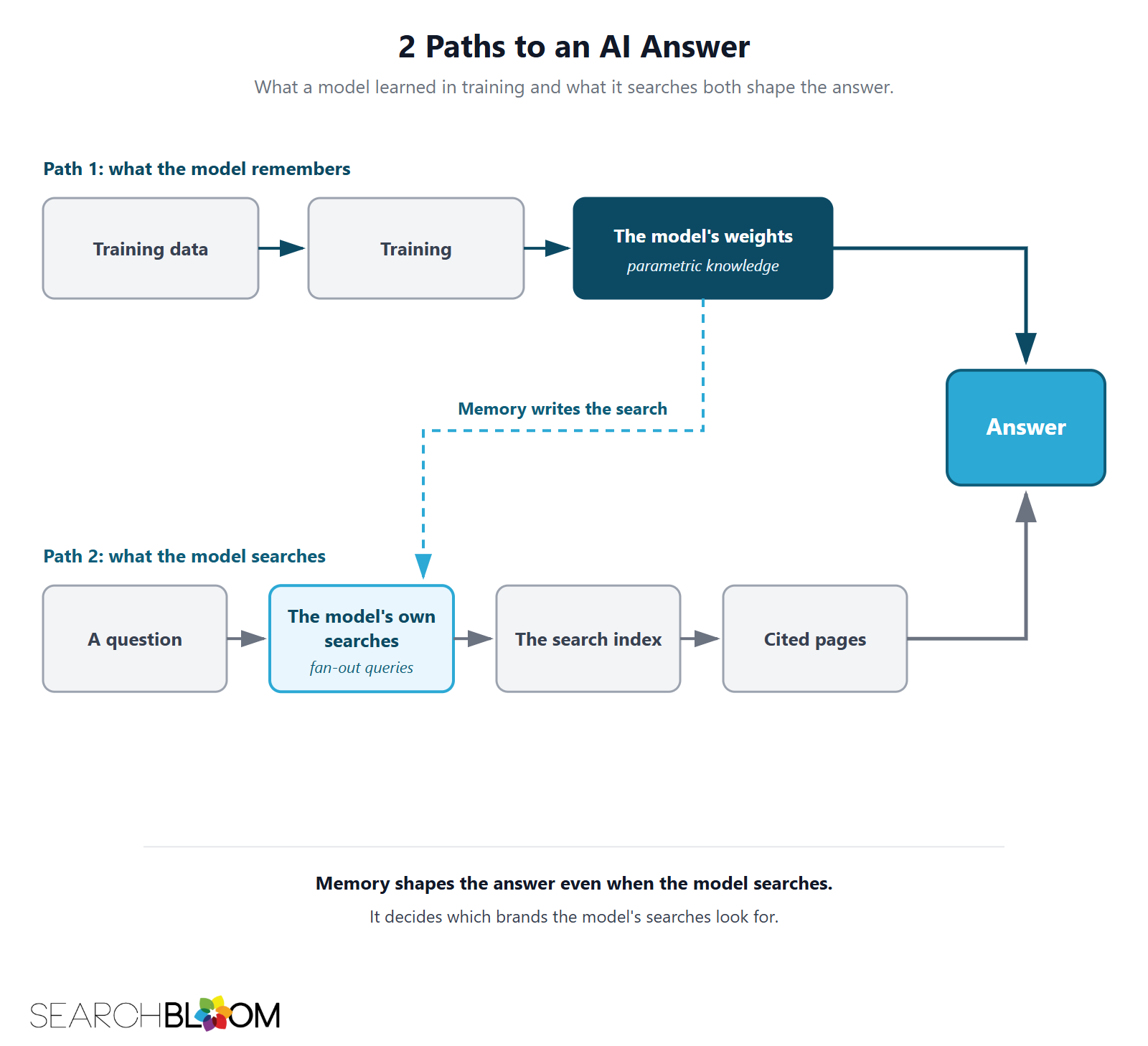
Parametric knowledge is what a large language model (LLM) absorbed during training and stores in its parameters, or weights. The model doesn't keep the pages it read. It keeps a compressed memory of them.
The version I use with partners is the librarian who forgets. The model has read every book in the building and still forgets. Popular brands are the books it can recite; everything else has to be in the catalog, the search index it checks when it looks something up.
The scale makes this hard to reason about. Epoch AI estimates GPT-5 trained on at least 30 trillion tokens, a figure Graphite cites. A model that searches usually pulls tens of pages and cites 4 to 7.
How It Differs From Citation Work
If AI assistants search more every month, why care about memory?
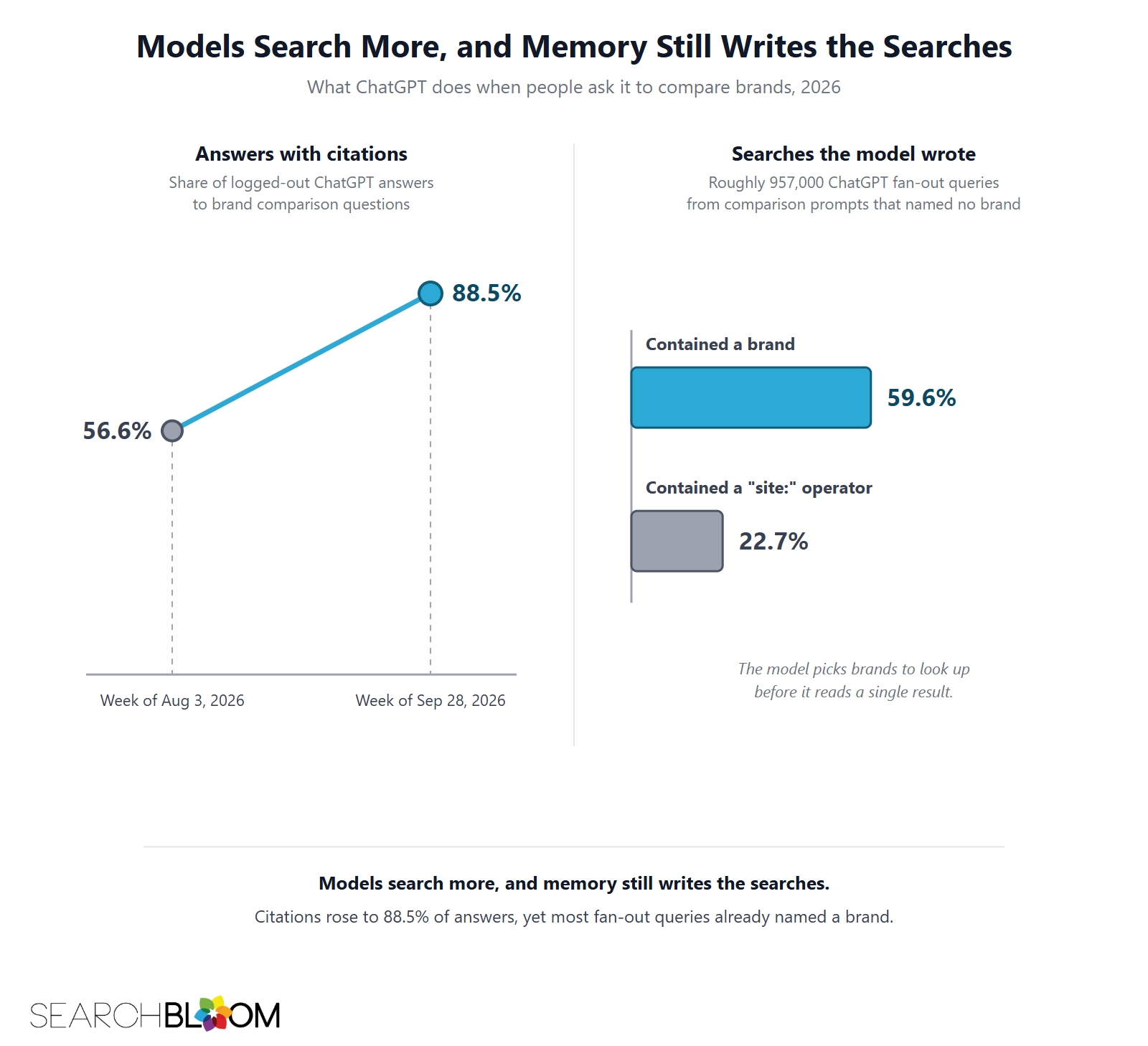
Graphite measured logged-out ChatGPT answers to brand comparison questions, and the share with citations rose from 56.6% in the week of August 3, 2026 to 88.5% in the week of September 28, 2026. If almost every answer runs a search, citation work looks like the whole job.
It isn't, for 3 reasons.
First, search is not universal. Graphite also cites Similarweb data showing only 7% of ChatGPT responses in the United States, across all prompt types, carry citations. Different data, different collection methods, but the gap is large enough to matter.
Second, memory writes the search. Across roughly 957,000 ChatGPT fan-out queries (the searches a model writes for itself) from 22,953 comparison prompts that named no brand, 59.6% contained a brand and 22.7% contained a "site:" operator. The model picks brands to look up before it reads a single result.
Third, memory predicted visibility in searched answers. Graphite found a brand's visibility with search turned off predicted its visibility with search turned on, at every level of how often the brand appeared on the pages the model cited. Showing up on cited pages was not enough on its own.
So the 2 kinds of work answer different questions. Citation work asks whether a model finds and cites your page today. Parametric knowledge optimization asks whether the model already believes you belong in the answer.
What Our Test Found
What happens when you measure memory and citations side by side?
Graphite's fan-out data comes from ChatGPT. I wanted to see the memory and citation split across 3 labs, so Searchbloom ran a small test on October 27, 2026, in a category we have no stake in: project management software. We asked 25 questions that named no brand, such as "What project management software is best for startups?", 3 times each. They went through the developer platforms for GPT-5.5, Claude Sonnet 5.5, and Gemini 3 Flash, once with web search off and once with it on. That is 450 answers, scored for 10 brands.
3 things stood out.
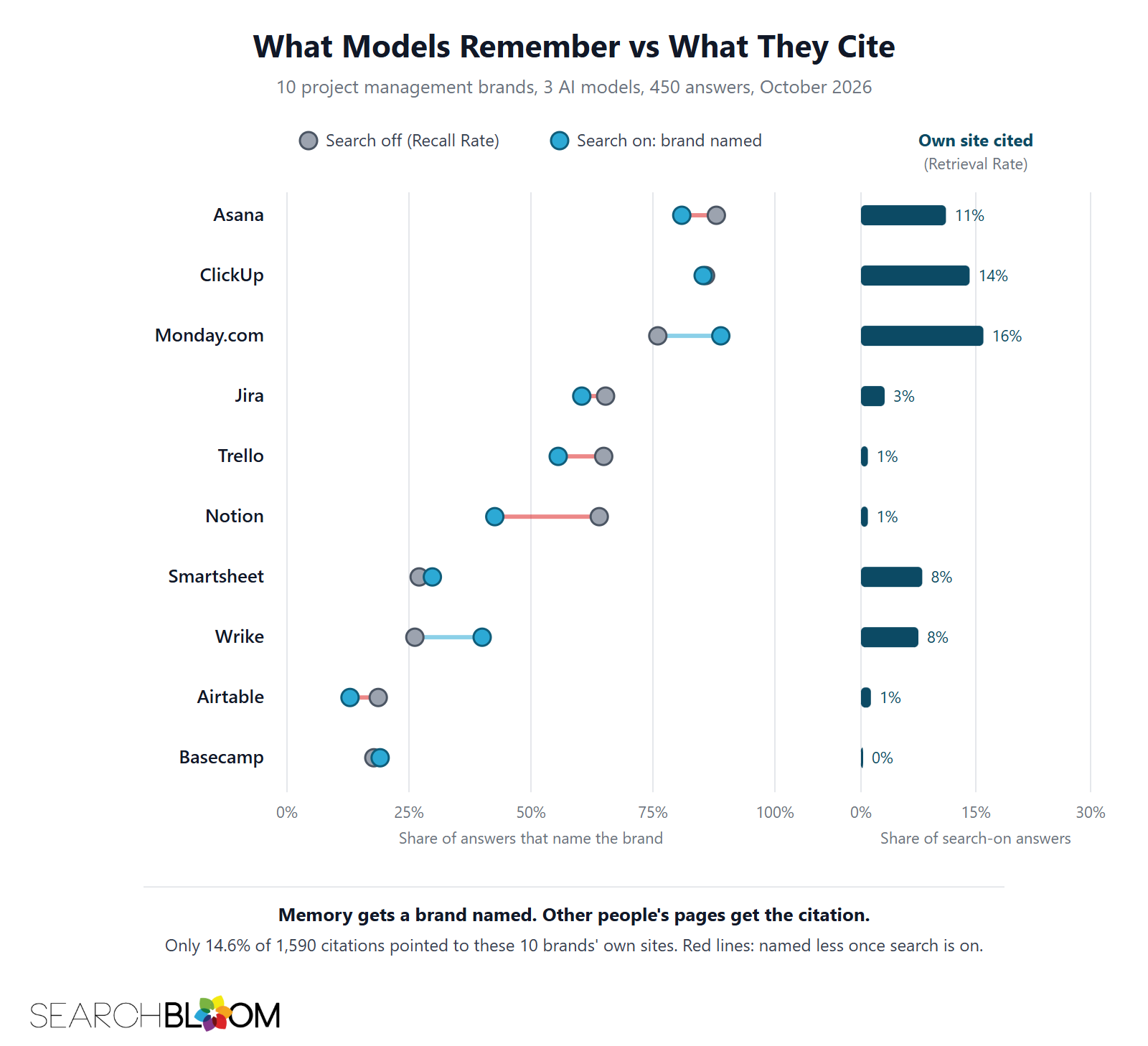
Memory predicted who got named with search on. Across the 10 brands, Recall Rate and search-on mentions ranked the brands in nearly the same order. The rank correlation was 0.92 for GPT-5.5, 0.91 for Gemini, and 0.84 for Claude. That is the pattern Graphite found, in a different category.
A model naming you is not the same as a model citing you. With search on, the 3 models produced 1,590 citations. Only 14.6% pointed to the 10 brands' own sites. The models named Asana in 88% of answers from memory, yet cited its own pages in only 11% of search-on answers. They cited Notion's own pages in under 1%.
Search lifted some brands and cost others. Notion fell from 64% of answers with search off to 43% with search on, and Trello fell from 65% to 56%. Monday.com rose from 76% to 89%, and Wrike from 26% to 40%. Notion fits the "remembered, not retrieved" box from the librarian model: strong memory, little of its own content in the catalog.
My read: memory gets a brand into the answer, and the pages the model finds decide whether it stays there. Most of those pages belong to someone else.
The limits are real. This is 1 category, 1 day, 25 questions, and 3 models, run through developer platforms rather than the consumer apps. A gap of a few points is noise. I'd treat it as a demonstration of the method, not a benchmark.
The Catalog Belongs to Someone Else
Those 1,590 citations came from 281 different sites. The single most-cited site was not one of the 10 brands. It was ONES, a project management vendor we didn't track, and it drew 168 citations, more than ClickUp's own site (53), the most-cited of the 10. Every ONES link we could see went to a "best tools" style list post, and ONES pages showed up in 70 of the 225 search-on answers. The next most-cited site, The Digital Project Manager, is an independent review site with 80 citations.
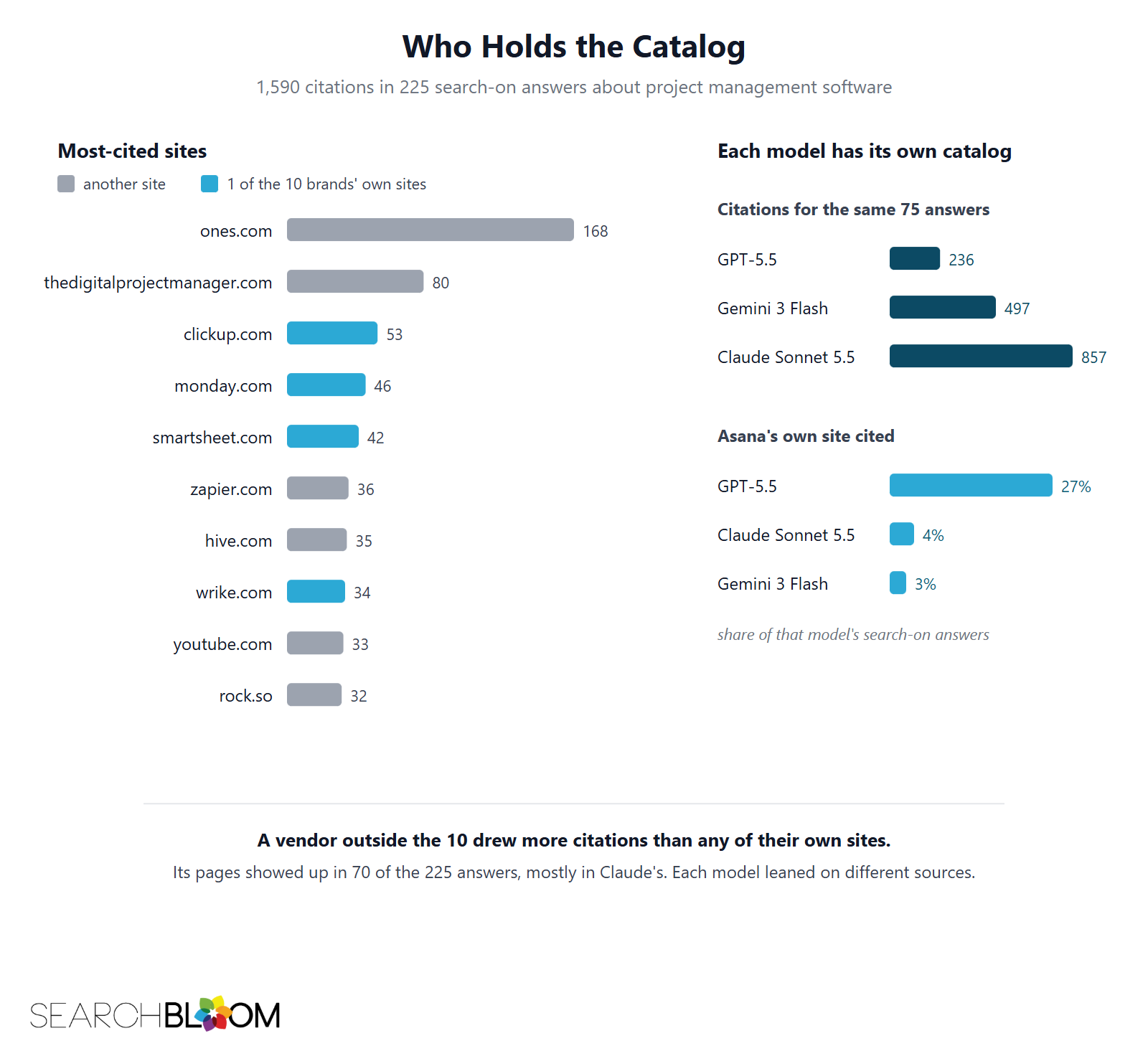
That is the catalog in practice. When a model searches, it reads roundups and reviews first and the brands' own pages a distant second. The work that moves Retrieval Rate is earning a place on other people's pages, and the cited-site list from a test like this is the outreach list.
Each Model Has Its Own Catalog
The 3 models did not read the same web. For the same 75 search-on answers, Claude produced 857 citations, Gemini 497, and GPT-5.5 236. Claude leaned hardest on list posts: ONES alone took 132 of its citations. Gemini mixed in YouTube and Reddit. GPT-5.5 cited the vendors' own sites more often than the other 2, which is why Asana's own site showed up in 27% of its answers and only 4% of Claude's and 3% of Gemini's.
A single blended AI visibility number hides that. I'd report Recall Rate and Retrieval Rate per model, because a brand can hold a strong place in 1 model's catalog and barely show up in another's.
What Moves Memory
What can a brand actually do about what a model remembers?
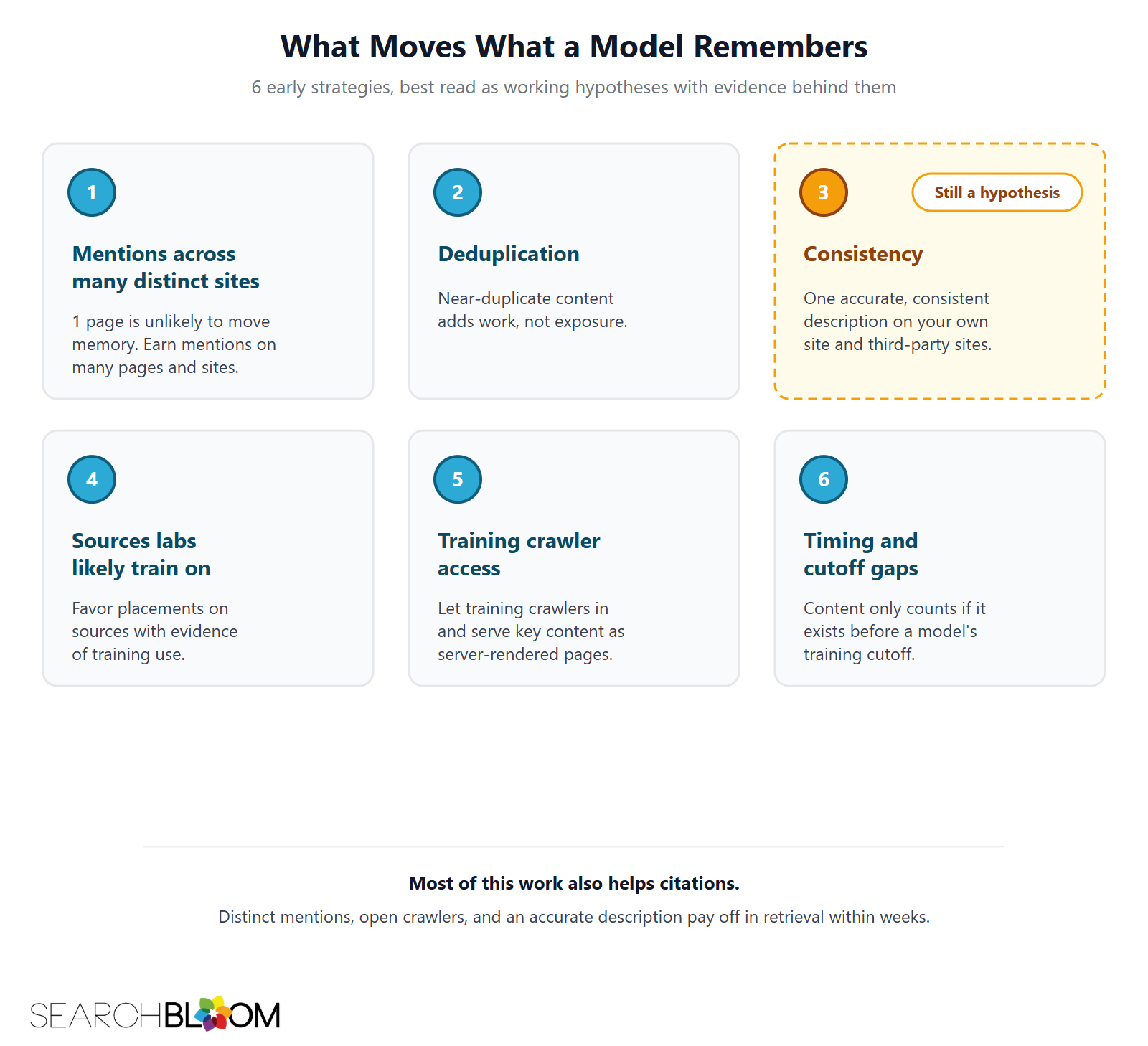
Graphite lays out 6 early strategies, and I'd read them as working hypotheses with evidence behind them. Mentions on many distinct pages and sites help, the same footprint that drives third-party corroboration in the Mentions pillar of the MERIT Framework. Near-duplicate content adds nothing, because AI labs deduplicate pages before training. An accurate, consistent brand description everywhere likely helps; Graphite labels that a hypothesis, and it is the same work as entity optimization. Sources with evidence of training use likely count for more, such as Reddit, which has data deals with Google and OpenAI, and Wikipedia, which OpenAI has disclosed as a training source. Training crawlers such as GPTBot, ClaudeBot, and CCBot have to reach your pages, and so do the rules behind Google-Extended and your firewall; the crawler access chapter covers each bot. And content has to exist before the training cutoff.
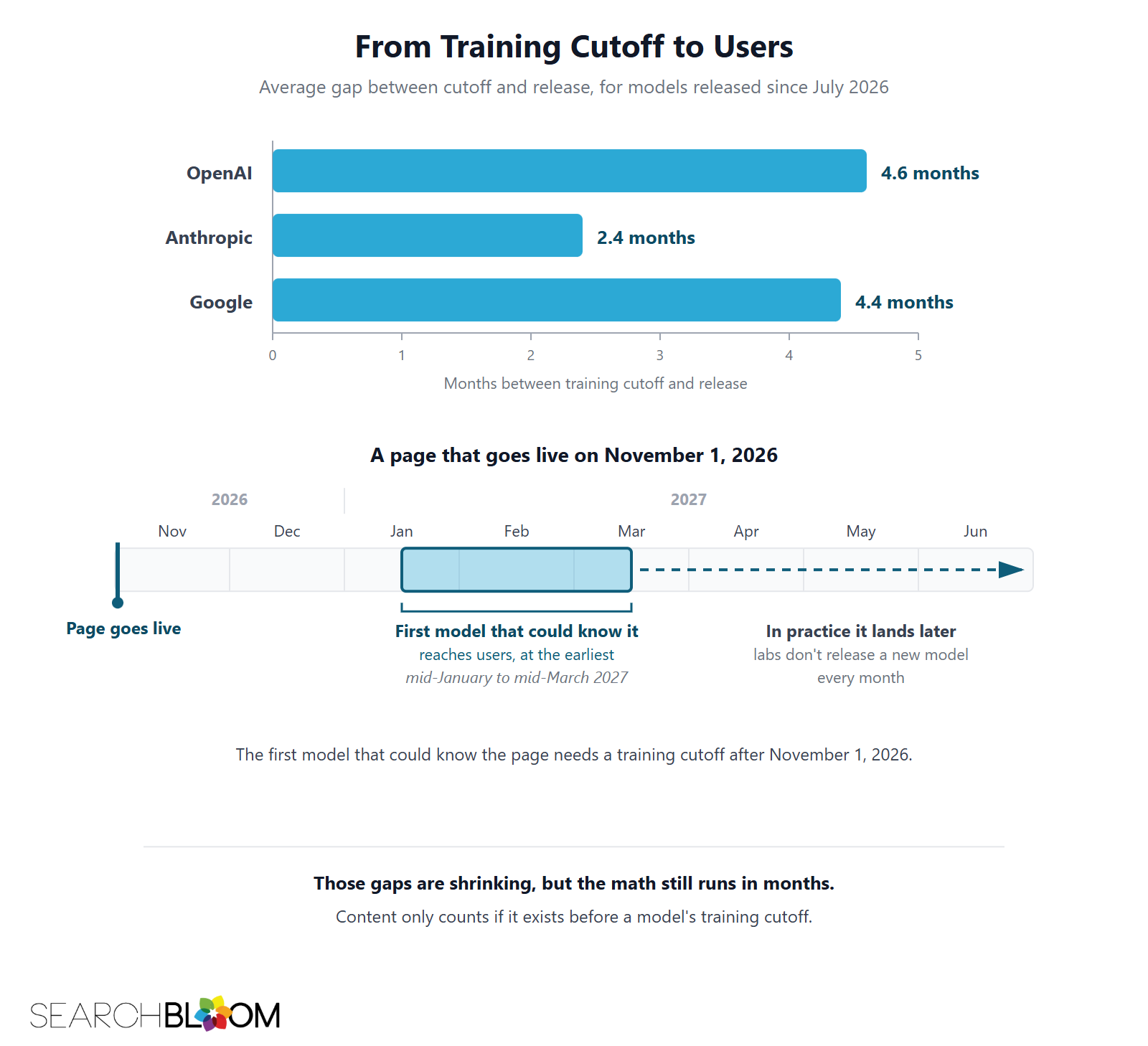
Timing is the one teams underestimate. For models released since July 2026, Graphite measured average gaps between training cutoff and release of 4.6 months for OpenAI, 2.4 months for Anthropic, and 4.4 months for Google. Take a page that goes live on November 1, 2026. The first model that could know it needs a later cutoff, and at those averages it would reach users between mid-January and mid-March 2027 at the earliest. In practice it lands later, because labs don't release a new model every month.
How to Run This Test on Your Own Brand
How do you know whether a model remembers you, and who holds your catalog?
I'd track the 2 measurements I introduced with the librarian model:
- Recall Rate: the percentage of category prompts, with search turned off, where the model names your brand. This is the memory measurement.
- Retrieval Rate: the percentage of search-enabled answers in your category that cite your pages. This is the citation measurement.
Here's how I'd run it, the same way we ran ours:
- Write 20 to 30 questions your buyers ask that name no brand. Mix category, use case, team size, and comparison questions.
- Pick the brands. Yours plus 5 to 10 competitors. Match product-line names too: our first pass missed answers that only said "monday dev".
- Run each question 3 or more times per model, with search off and on. Use each lab's developer platform, since the consumer apps decide on their own when to search. SparkToro's January 2026 research found under a 1 in 100 chance that ChatGPT or Google's AI returns the same list of brands in any 2 of 100 responses, so a single run proves nothing.
- Score 3 numbers per brand and model: Recall Rate, how often the brand is named with search on, and Retrieval Rate. Log every cited site as well.
- Read the results 2 ways. The brand numbers place you in 1 of the 4 boxes from the librarian model. The cited-site list tells you whose pages to get onto.
- Repeat on a schedule. I'd rerun Retrieval Rate monthly and Recall Rate each time a lab releases a new model, since a release is the only time memory can change. Hold the question set steady, the way I'd hold a stable measurement set steady across model upgrades.
Our 450 calls ran in parallel and finished in about 10 minutes.
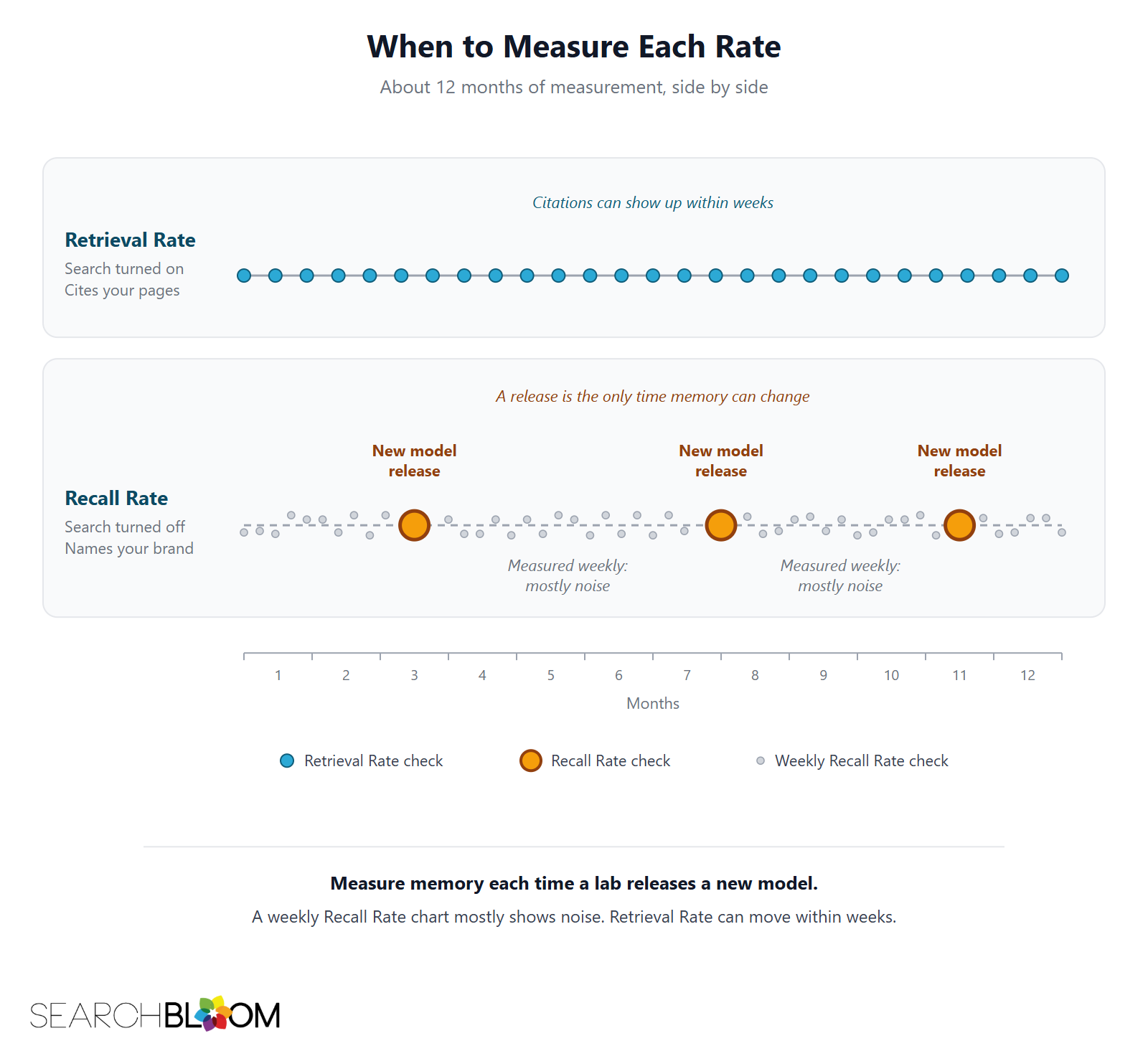
The honest limit: training data is huge, private, and slow to reflect changes, and models can't reliably say which training documents shaped an answer. I'd expect the memory side of a report to lag the work by months and set the reporting cadence to match.
How It Relates to Corpus Engineering
Is this a new discipline or part of an existing one?
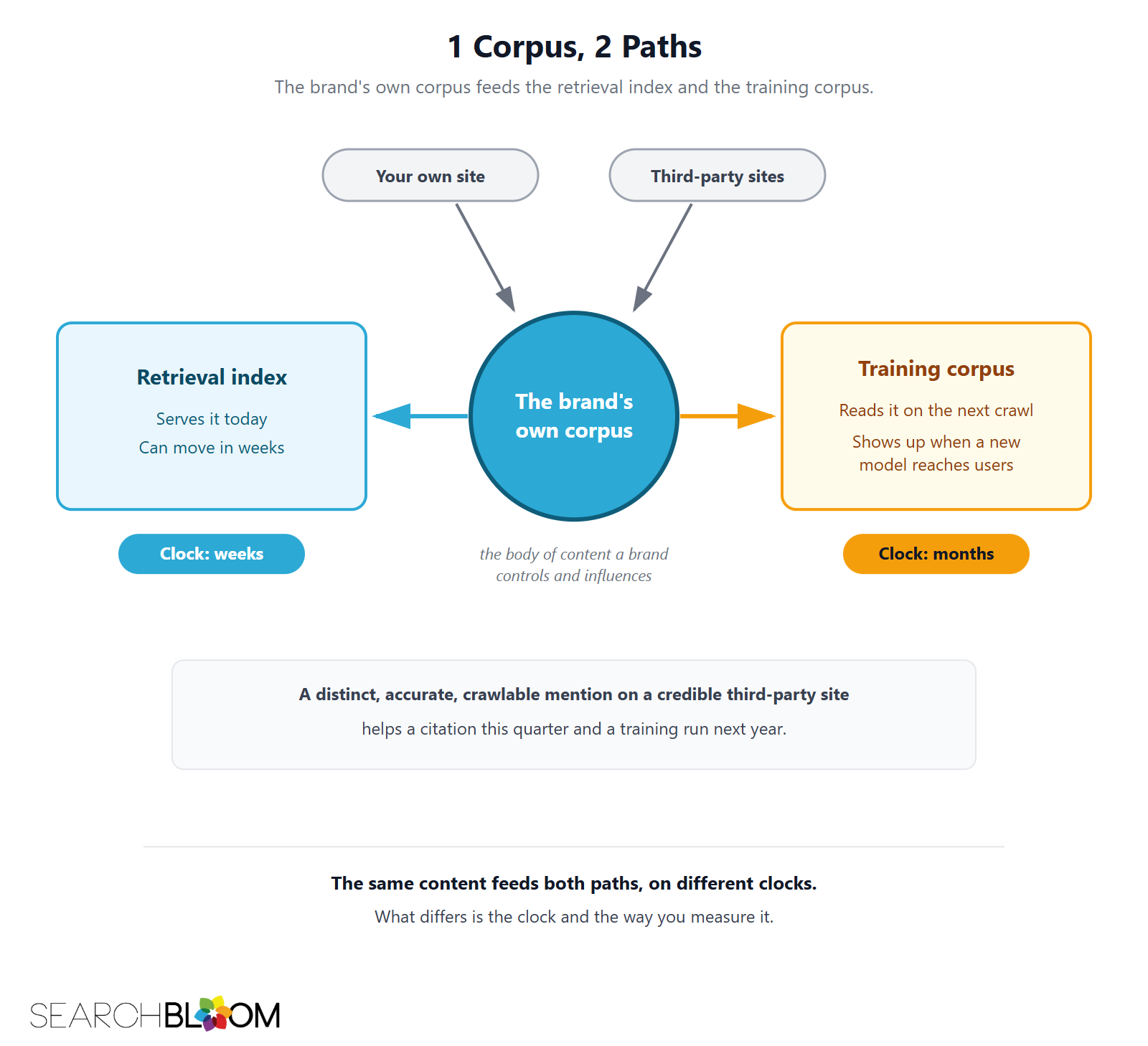
Parametric knowledge optimization covers the training side. Corpus Engineering, the discipline I named in May 2026, covers the brand's own corpus: the body of content a brand controls and influences. That corpus feeds both paths. The training corpus reads it on the next crawl. The retrieval index serves it today.
That overlap is the practical point. A distinct, accurate, crawlable mention on a credible third-party site helps a citation this quarter and a training run next year. What differs is the clock and the way you measure it.
Where the Idea Came From
Who named it, and who was working on the idea before the name?
Graphite named it. Their definition: parametric knowledge optimization "aims to improve how models describe and recommend a brand by influencing the training set." The term, the framing, and the first large dataset on it are theirs.
The idea underneath, that what a model learned in training competes with what it retrieves, has a longer history. None of the work below used the term. All of it worked on the same split. In date order:
- 2021: Longpre and co-authors. Entity-Based Knowledge Conflicts in Question Answering found that when a retrieved passage disagrees with what a model learned, models lean on memory, a habit the authors tied to hallucination.
- June 2025: Shane H. Tepper. The LLMO White Paper, Version 1.0, separated parametric knowledge in the weights from external retrieval as 2 ways a brand surfaces.
- March 2026: Duane Forrester. When the Training Data Cutoff Becomes a Ranking Factor argued for publishing a brand's foundational claims well before training windows close. His line: "The only mechanism that changes parametric memory is a new model training run."
- April 2026: the MERIT Framework. The April 2026 edition of my MERIT Framework whitepaper, first published in October 2025, separates training-baked errors that wait for retraining from retrieval-baked errors that can clear in days.
- May 2026: Sentiment Shaping. My Sentiment Shaping model treats training as its own sentiment layer, one that only changes at a new cutoff.
- August 2026: Beyond the Corpus. Beyond the Corpus named the corpus gap: the space outside a model's training data where fresh, first-party content earns the citation.
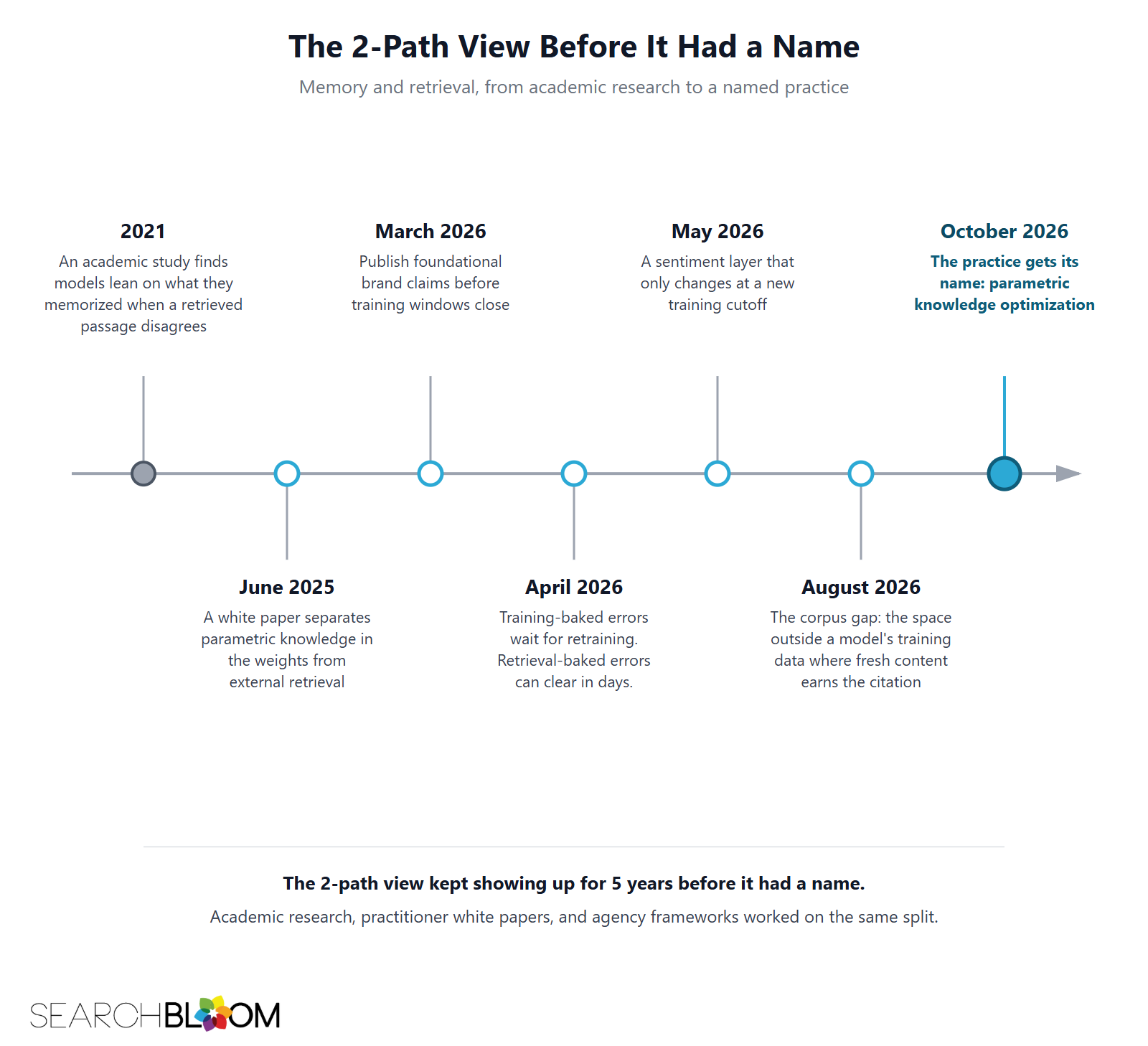
Credit for the name goes to Graphite. The lineage shows the 2-path view kept showing up for 5 years before it had one.
The Real Costs and Limits
Who should fund this now, and who should wait?
The case against starting is real. Feedback takes months, a brand has little control over what lands in a training set, and the consistency effect is still a hypothesis.
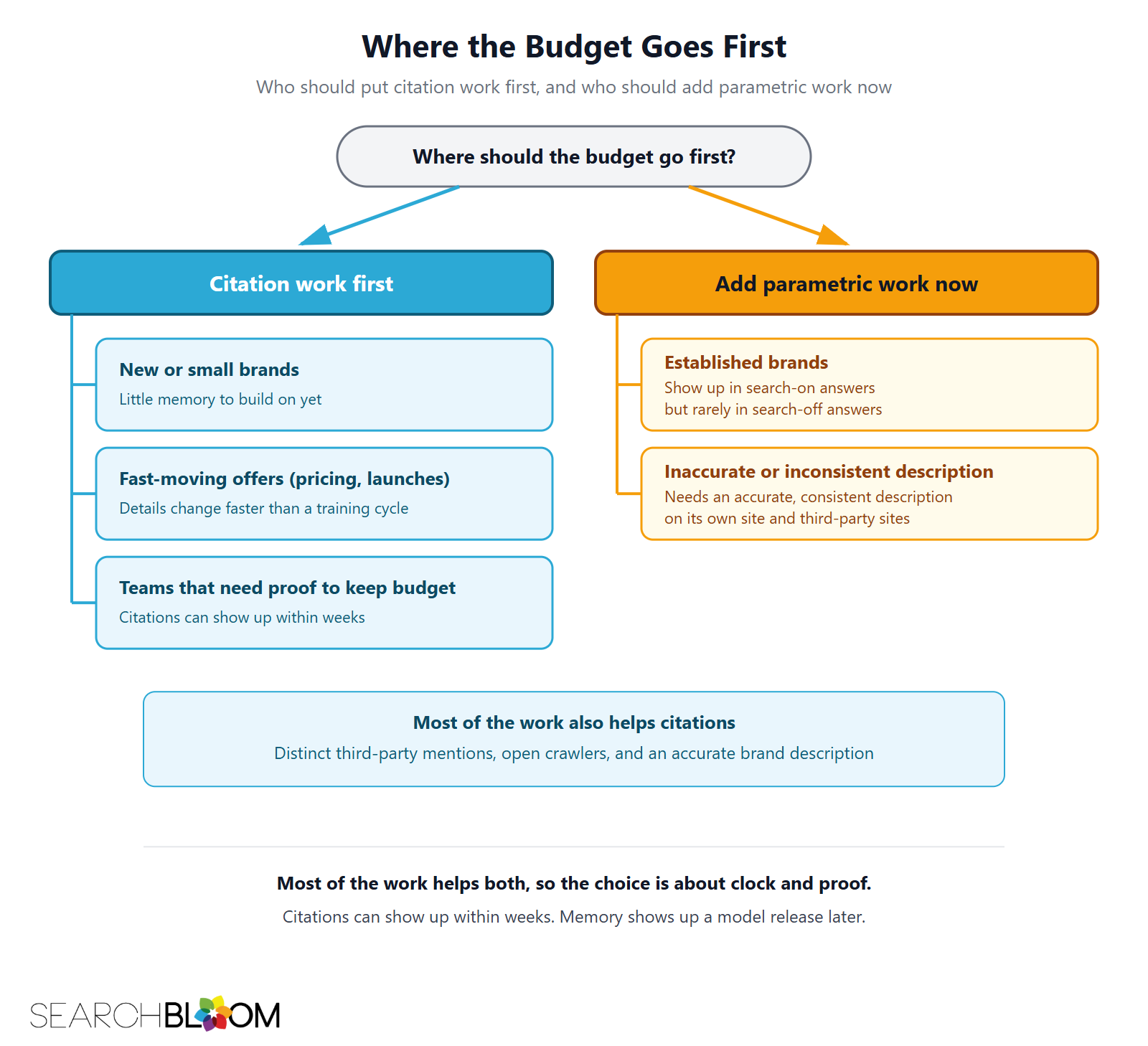
My read is that the risk is smaller than it looks, because most of the work also helps citations. Distinct third-party mentions, open crawlers, and an accurate brand description pay off in retrieval within weeks, whether or not the next model remembers more.
Where I'd put citation work first:
- New or small brands. With little memory to build on, retrieval is where you can get named this quarter.
- Fast-moving offers. Pricing, launches, and most details that change faster than a training cycle have to win through retrieval.
- Teams that need proof to keep budget. Citations can show up within weeks. Memory shows up a model release later.
Where I'd add parametric work now: established brands that show up in search-on answers but rarely in search-off answers, and any brand whose description online is inaccurate or inconsistent.
Questions and Answers
What is parametric knowledge optimization?
Parametric knowledge optimization is the work of influencing what lands in a large language model's training data, so the model describes and recommends a brand better. Parametric knowledge is what a model learned in training and stores in its weights.
Who coined parametric knowledge optimization?
Graphite's Gregory Druck, Ethan Smith, and Bevin Benson named and defined it in research published October 16, 2026. Earlier work by Longpre and co-authors, Shane H. Tepper, Duane Forrester, and Searchbloom covered the same split between memory and retrieval without using the term.
How is it different from optimizing for AI citations?
Citation work changes what a model finds and cites when it searches. Parametric knowledge optimization changes what the model already believes before it searches. Graphite found that belief shapes the searches themselves: 59.6% of roughly 957,000 ChatGPT fan-out queries from prompts that named no brand contained a brand.
What did Searchbloom's test find?
Across 450 answers from GPT-5.5, Claude Sonnet 5.5, and Gemini 3 Flash about project management software, the brands a model named from memory were the brands it named with search on, with rank correlations of 0.84 to 0.92. Only 14.6% of 1,590 citations pointed to the 10 brands' own sites, and a vendor outside the 10 drew the most citations with "best tools" lists.
How do you measure parametric knowledge optimization?
I'd track Recall Rate, the share of category prompts with search turned off where a model names the brand, next to Retrieval Rate, the share of search-enabled answers that cite the brand's pages, per model. I'd measure Recall Rate each time a lab releases a new model, because memory only changes then.
The Bottom Line
A citation is what a model finds about you today. Parametric knowledge is what it already believes, and that belief shapes what it goes looking for.
Graphite gave the work a name and the first real data. The work itself overlaps heavily with what earns citations: distinct mentions, accurate descriptions, and open crawlers. The difference is the clock. I'd measure both before deciding how much of the budget waits on the next model release. That call is yours.
