
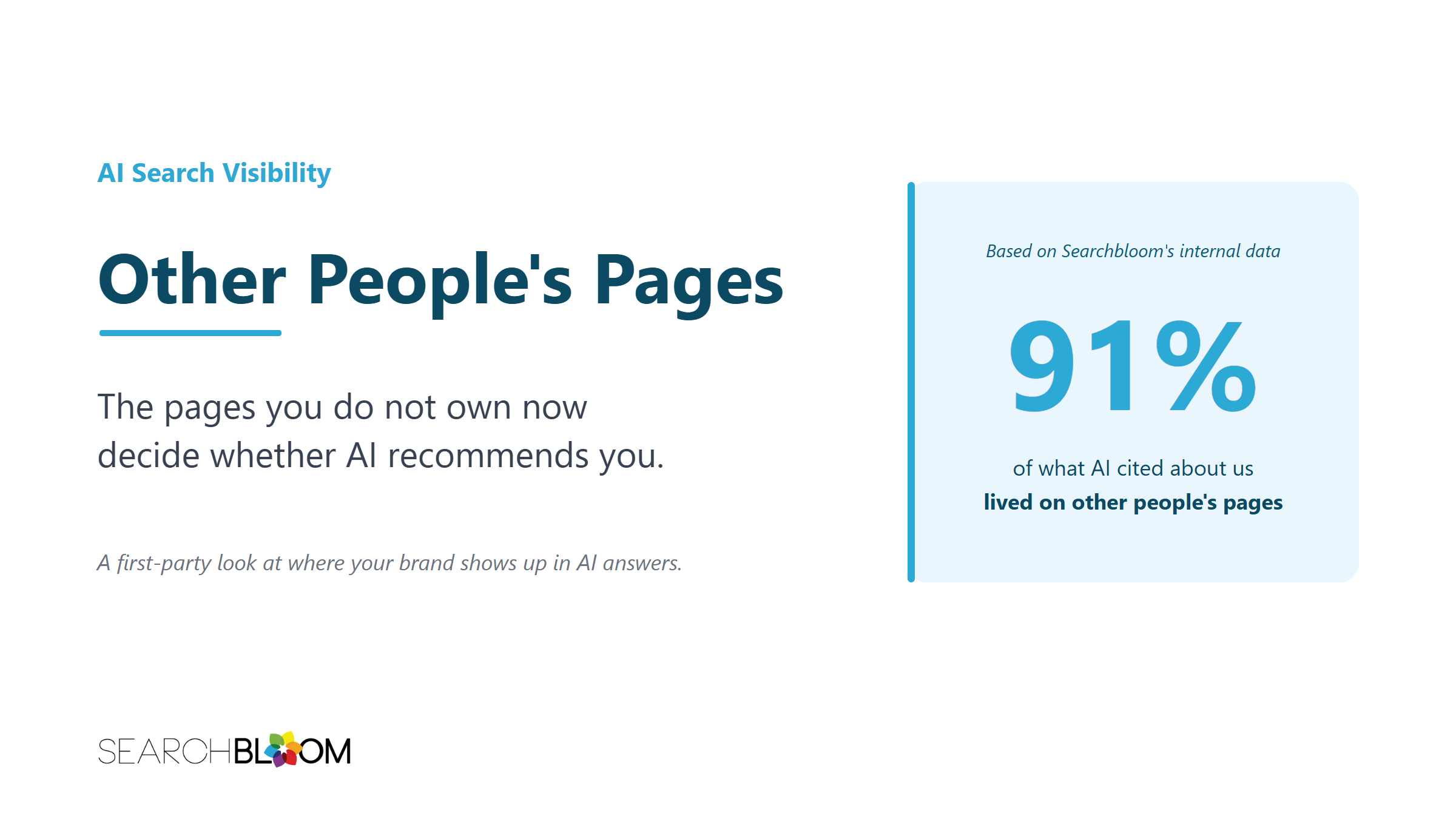
"The page that decides whether AI recommends you is usually not a page you own. More often, it is one somebody else wrote about you."
~ Cody C. Jensen, CEO & Founder, Searchbloom


This is not another post telling you that AI search is a brand new discipline that just made everything you know about SEO worthless. It is not a pitch to buy GEO or AEO as separate line items with their own retainers. It is a look at where your brand actually shows up inside an AI answer, measured on our own data, and the uncomfortable part is this: it is mostly not on your website.
I have a name for the pages that do the work. Other People's Pages. OPP. And yes, if you are old enough, you now have Naughty by Nature stuck in your head. Good. That is the point. It is the one label in this whole conversation you will actually remember.
One thing up front, because it is the part most people get backwards. This is not an argument to ignore your own website. It is the opposite. You do not get talked about on other people's pages unless you have first built something worth talking about: a real brand, real results, and the site, the SEO, and the content underneath them. Other people's pages are the payoff for being good, not a substitute for it. What follows is about where that payoff shows up, and why it is the part AI actually reads.
TL;DR
- Your own site is a small slice of what AI repeats about you. Across 68,631 AI answers in our own category, searchbloom.com was 8.9% of everything the models cited. The other 91.1% was OPP, the pages we earned.
- AI reads the live web to answer, not its memory. 92.5% of those answers were grounded in a real-time web search.
- The most-cited source about SEO agencies is a directory, not any agency. Clutch.co, not a single company's own site.
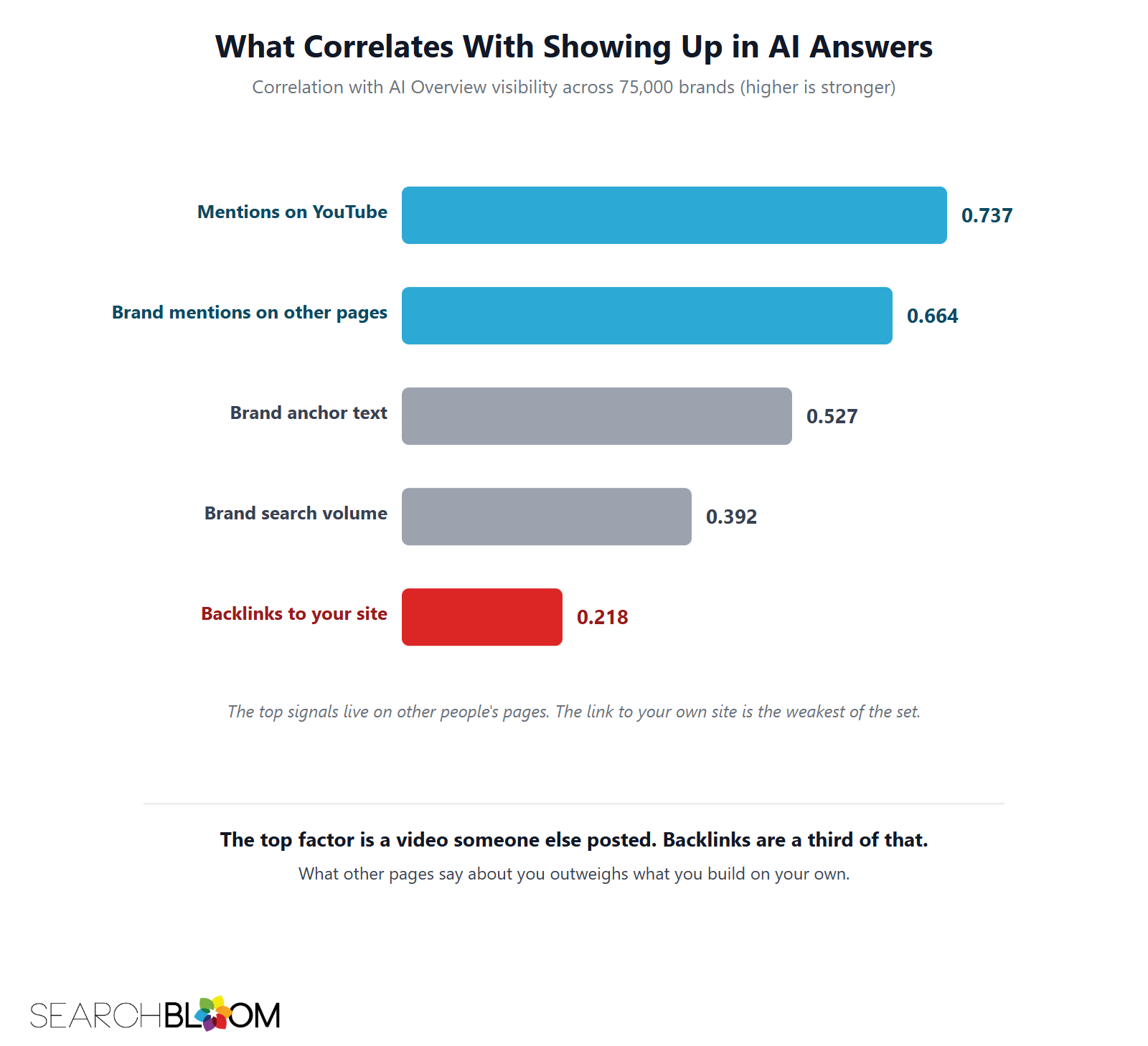
- The strongest known signal for AI visibility sits off your site. Brand mentions on other people's pages correlate with AI visibility at 0.664. Backlinks, 0.218.
- The headline percentage is a sales pitch. One study says third-party pages drive 84% of AI citations, others say 85% and 86%; a neutral one flips it and puts your own website at just 2.9%. Same reality, sliced to sell four different products.
- You cannot edit other people's pages. That is the job now.
Your own site is a sliver of what AI repeats, and I can prove it on ours
When AI gets asked about your category, whose pages does it actually read?
We track this for ourselves the same way we track it for partners. Our AI-visibility tracking runs the real buyer questions through the AI engines every day and records what they cite. Over the last 90 days that came to 68,631 answers across 146 questions and 8 engines.
Here is the number that should stop you. Of every source those answers cited, searchbloom.com accounted for 8.9%. Everything else, 91.1%, was somebody else's page. On raw retrievals the split is wider still, 93% to 7%.
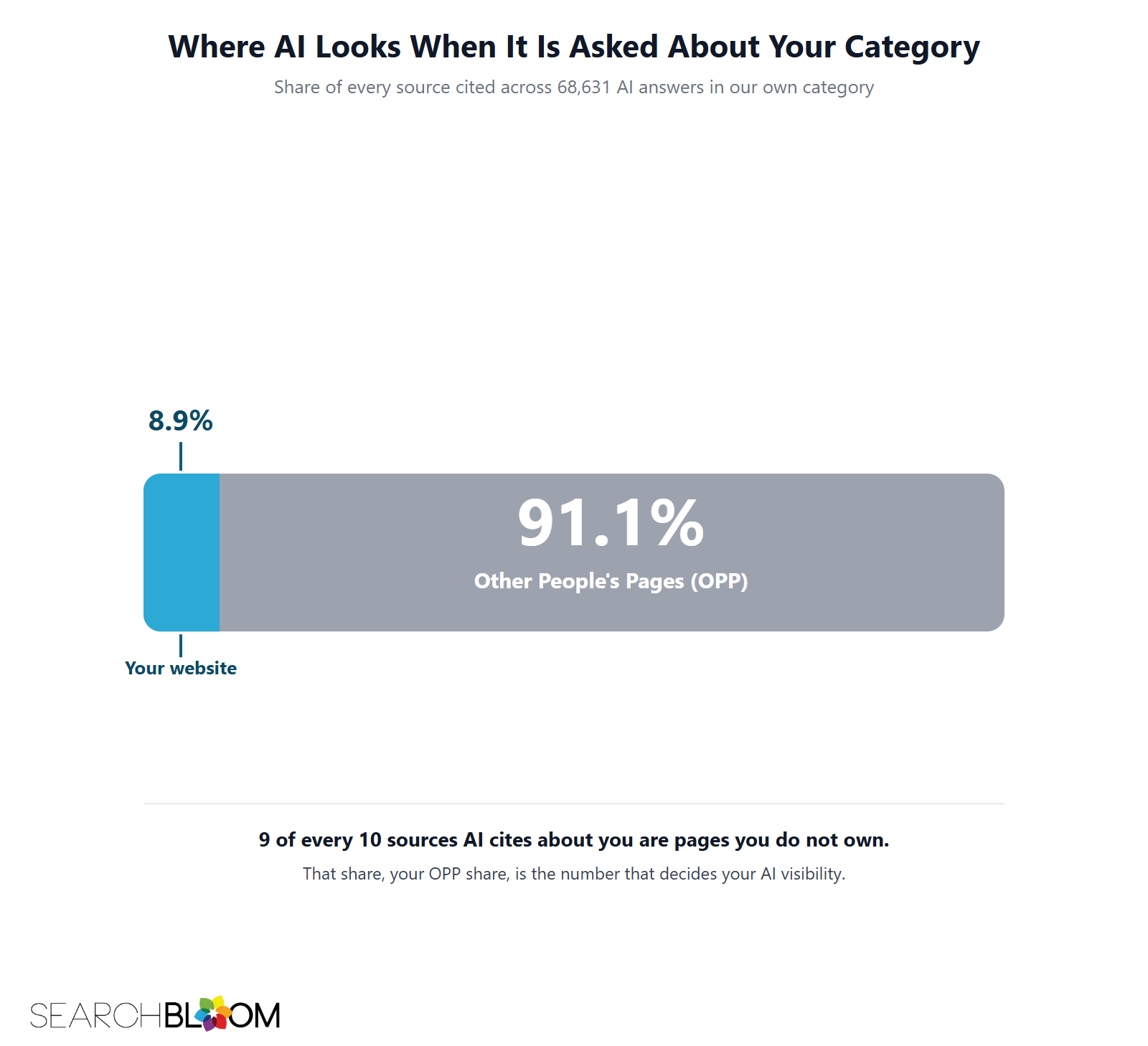
I will give the metric a name, because the field is missing one: your OPP share. The percentage of everything AI cites about you that lives on pages you do not own. Ours is 91%. If yours is lower, you are not winning. You are either invisible or you are talking to yourself.
The single most-cited domain was not us and it was not a competitor. It was Clutch, a directory. We came 2nd, the only company in the top 2 that is not a listings site. The 3rd source the engines leaned on was Reddit, ahead of Semrush and ahead of every agency in the set. Here is the part that should land: we out-cite every individual competitor we track, and it still does not save us. Our own site is that 8.9% sliver, and the one source sitting above us is a directory we do not own.
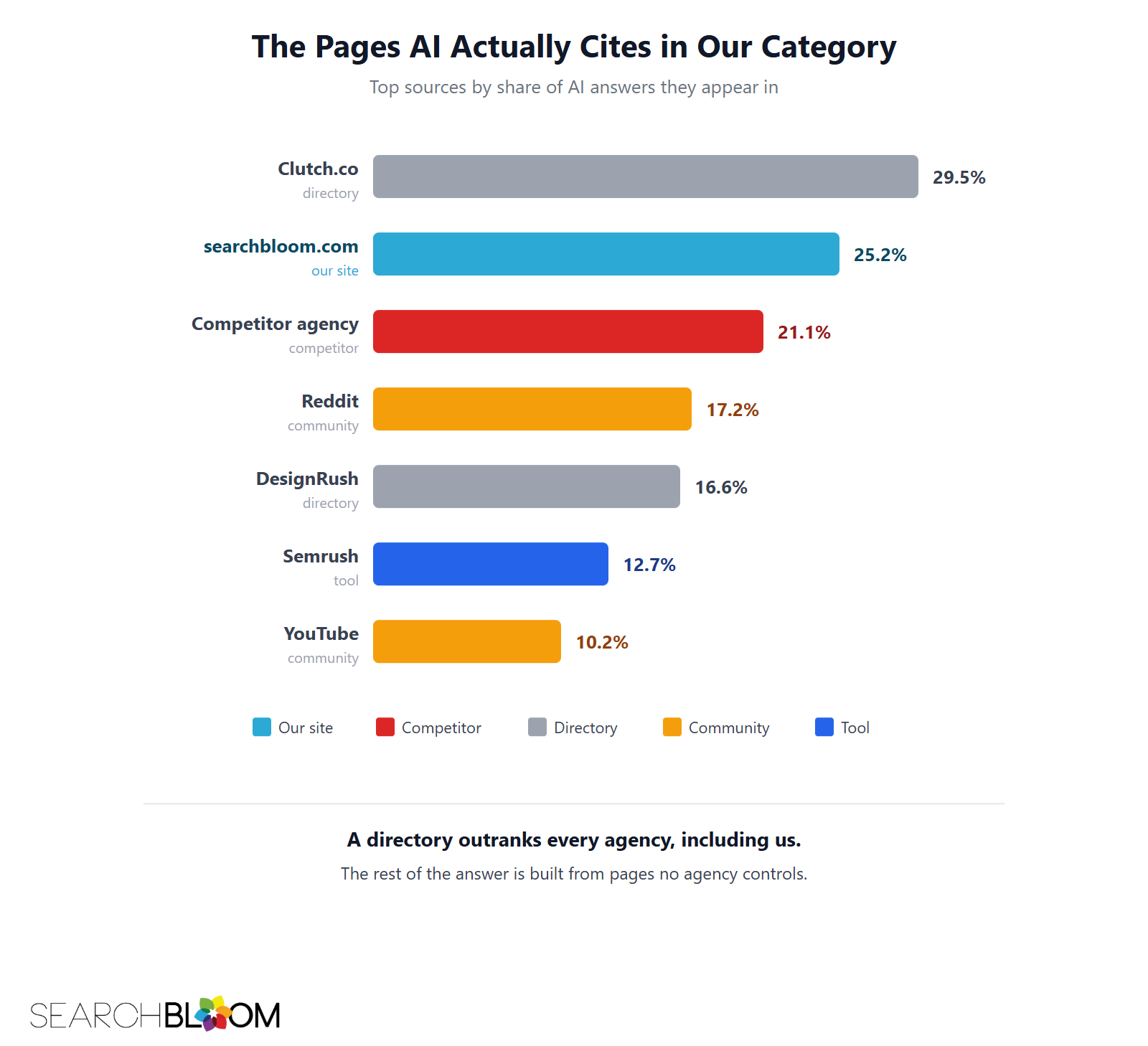
Read that back. On the questions that decide who gets hired in our category, an AI spends 9 words out of 10 reading pages we do not control. We can write the best SEO content on the internet, and we work hard to, and it still only accounts for a sliver of what the machine repeats.
Now the part that number does not say on its own. That 91% is not something we bought or gamed. It is what deserving it looks like from the outside. Those pages exist because we have spent more than a decade being good enough at search that other people write about us, review us, and cite us. You do not earn an OPP share like that by farming mentions. You earn it by being worth mentioning: a real brand, real results, and the SEO and content foundation on your own site that wins the attention in the first place. The mentions come after that work, never instead of it.
Why a model trusts a stranger's page about you more than your own
Why would a machine believe someone else's page about you over the page you wrote yourself?
Because your own page is the one page guaranteed to be biased. Every company says it is the best. A model that wanted the truth learned to check what everyone else says and look for agreement. The technical word is consensus. The plain version: the machine trusts the crowd, not the company doing the talking.
Ahrefs put a number on it. They looked at 75,000 brands and measured what correlates with showing up in Google's AI Overviews (the study is here). Brand mentions on other pages came in at 0.664. The single strongest signal in the whole study was mentions on YouTube, at 0.737, which is to say the top factor for whether Google's AI names you is a video somebody else posted. Backlinks, the thing our industry spent 20 years chasing, came in at 0.218. Ahrefs' own VP of marketing wrote the sentence I wish I had written first: the content on your own website is by far not as valuable as the content about you on other people's pages.
There are 3 ways a mention on somebody else's page ends up in your answer. It gets into the training data, so the model is more willing to say your name at all. It gets retrieved live at answer time, so the model sees you attested across independent sources right now. And it builds an association between your brand and your category, so when someone asks the category question, your node lights up.
None of those 3 is a link you built. All 3 are pages you influenced.
Credit where it is due: most of this really is just SEO
Is any of this new, or did we rebrand off-page SEO to sell a new retainer?
The skeptics have a case, and I want to give it to you straight before I take it apart, because most of it is correct. Google's own documentation says optimizing for AI is still just SEO. Ahrefs published a piece titled, plainly, that it is all just SEO. And about 94% of AI Overviews cite at least one page that already ranks in the top 20 organic results. If you are good at SEO, you are already most of the way here. The people selling GEO as a brand new religion with a brand new invoice are, in a lot of cases, selling you the thing you already bought.
The disagreement is not about whether the fundamentals changed. They did not. It is about what the unit of victory became.
In classic SEO the unit was the ranked URL, ideally yours. In AI search the unit is the corroborated citation, usually not yours, and it behaves differently because an LLM is probabilistic, not deterministic. There is no fixed first place. Ask the same question 10 times and you get a spread of answers. The number that matters is your mention rate, the share of those answers that name you at all, and the lever that moves it is corroboration: the more independent pages attest to you, the higher the odds the model reaches for your name on any given run. That shift breaks 3 things we used to believe.
Unlinked mentions matter now. A mention of your brand with no link attached did almost nothing for classic rankings. For AI visibility it is the single strongest signal we can measure. The link was never the point. The mention was.
Sentiment is a ranking input, not just a reputation problem. A backlink was sentiment-blind; a link from a page that hated you passed the same equity as one that loved you. An AI reads the words around your name and forms an opinion before a buyer ever reaches you. Being described badly across other people's pages can cost you the recommendation outright.
Consensus beats authority. One strong link from a high-authority site used to move the needle. Now the machine wants to see you agreed upon across independent, different kinds of sources: a directory, a forum, a review site, a news mention. Volume of links is out. Agreement across independent sources is in.
The "X% of citations" number is a sales pitch
If everyone agrees third-party pages matter, why can nobody agree on the number?
Because the number is downstream of what the vendor sells. Watch.
Muck Rack, a PR platform, studied 25 million links and says 84% of AI citations are earned media. Buy PR.
AirOps, which sells an offsite tool, says 85% of brand mentions come from third-party pages, and that a brand is 6.5 times more likely to be named through someone else's content than its own. Buy the offsite tool.
Yext, which sells listings management, says 86% of AI citations come from brand-managed sources, and counts your directory listings and review profiles as yours. Buy listings management.
A neutral aggregation with nothing to sell put the brand's own website at 2.9% of citations.
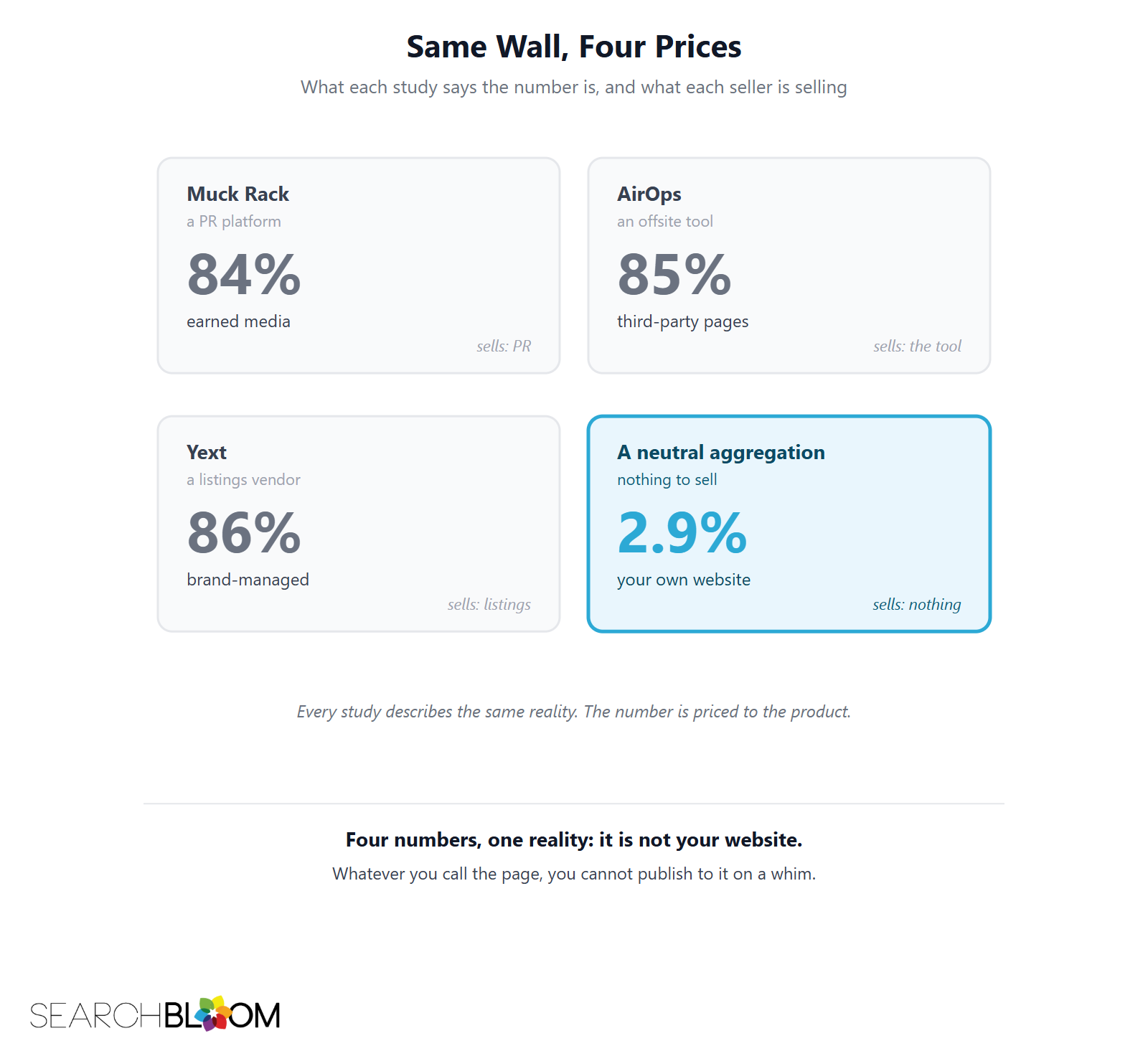
They are all describing the same wall. They painted the bricks different colors to match the product. Here is the tell that cuts through it: whether you call your G2 profile yours or somebody else's, it is not your website, and you cannot publish to it on a whim. Yext calls it managed because managed sells listings. Muck Rack calls it earned because earned sells PR. The practical answer does not care what you call it. You win AI search on pages you influence but do not host. Our own 8.9% sits right inside their range, and I have nothing to sell you inside this paragraph, which is the only reason to trust that number over the other 4.
The OPP playbook: how to get on pages that are not yours
If the pages are not yours, how do you get on them?
You earn your way on, slowly, which is the whole reason so few brands do it. And earn is the word. Every technique below works only when the thing underneath it, your product, your service, your actual results, is genuinely worth recommending. Get that right first, or none of this lands. What follows is the Mentions pillar of MERIT, the AI-search methodology we run for partners, and it sits inside the full AI SEO playbook on our site. Mentions is the third-party validation work; the last move below, being the source, is the Evidence pillar. Here is where the citations in our category actually come from, and what I would do about each.
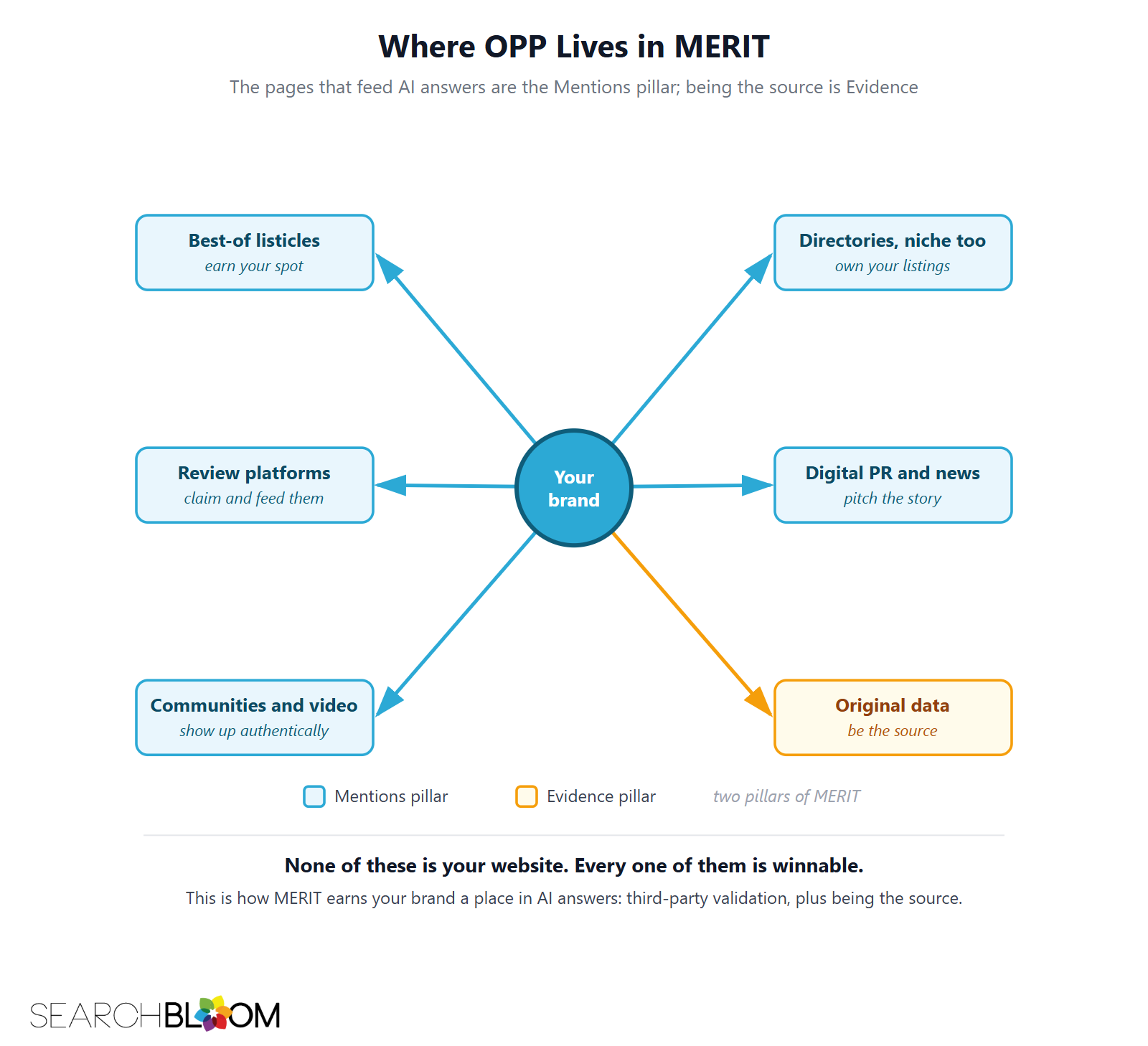
Best-of listicles. The "best SEO company" and "best X for Y" articles are where recommendation questions get answered. The engines pull them heavily, and freshness matters: 79% of the best-lists AI cited were updated this year, a quarter of them within the last 2 months. I would find every credible list in your category, earn a legitimate spot on it, and keep after the ones that refuse to update.
Review platforms. Wherever your customers leave ratings, an AI is reading them, and review sites show up in about a third of AI Overview answers, with the top 5 accounting for 88% of all review-platform citations. Which sites matter depends on your category. In B2B software it is G2, Capterra, TrustRadius, Software Advice, and Gartner Peer Insights. For local and consumer businesses it is your Google Business Profile, Yelp, Trustpilot, and the Better Business Bureau. Home services live on Angi, HomeAdvisor, Thumbtack, and Houzz. Healthcare runs on Healthgrades, Zocdoc, Vitals, and RateMDs. Restaurants and travel run on Yelp, TripAdvisor, and OpenTable. Whatever your category, being absent from its review sites usually means being absent from the answer, so I would treat a steady flow of real reviews as an always-on line item, not a quarterly push.
Directories, general and niche. Before an AI recommends anyone, it checks the lists that already decide who counts in a category, and most of those are vertical directories. Lawyers are ranked on Avvo, Justia, Super Lawyers, and Martindale-Hubbell. Doctors on Healthgrades and Zocdoc. Home pros on Angi, Houzz, and Thumbtack. Real estate on Zillow and Realtor.com. Restaurants on Yelp and OpenTable. Weddings on The Knot and WeddingWire. Contractors and dealers on their own trade indexes. Agencies, us included, on Clutch, DesignRush, and GoodFirms. On top of the niche ones sit the directories everybody needs: Google Business Profile, Bing Places, and Apple Business Connect. Many of these double as review platforms; the point is that every category has 2 or 3 listing sites the model treats as the authoritative index of who does what you do. A complete, consistent, well-reviewed profile on them is some of the highest-return OPP work there is, because those are the exact pages the model reaches for when someone asks for a recommendation.
Reddit and real communities. Reddit was the 3rd most-cited source in our own data. You cannot fake your way in, and you should not try; it is icky, and the platform and the FTC both punish it. What works is genuine, specific, experienced answers from real accounts. I would show up as a human who knows the topic, not as a brand running a play.
Video, especially YouTube. Remember which signal was strongest in that 75,000-brand study: mentions on YouTube, at 0.737, ahead of everything else. The engines treat video as a first-class source, and YouTube is the 2nd-largest search engine on its own. This is not about your brand channel alone. It is about being present in the review videos, comparisons, and how-tos other people make, and giving your own clips a clear, spoken, transcribable answer the model can lift. Video is a Relevance-pillar move in MERIT too, the same citable content in a format the engines increasingly reach for.
Digital PR and earned media. This is the engine under that 84% number. Newsworthy data and commentary that journalists actually cover produces mentions across dozens of independent pages at once. It is the most direct way to build consensus honestly.
Be the source everyone else cites. The most durable position is the one where your data, your study, your quote is the thing the listicle writer and the journalist pull from. This is the Evidence pillar, and the whole idea behind publishing content with real information gain. Then you are not chasing the pages. The pages are chasing you.
One caution, so you do not read this as the whole job. OPP is the off-site half of MERIT, our AI-search methodology: Mentions, the third-party validation above, and Evidence, being the source. The other half lives on your own site, where it still counts. Relevance is content the engines can retrieve and quote. Inclusion is the technical and entity work that lets them read you at all. Transformation is measuring it over the multi-year horizon this takes. The whole framework is in our methodologies. OPP is the highest-return work right now, and it sits inside that bigger system.
Two things nobody tells you about winning here
Once you are winning, what takes it away?
Two things, and almost nobody writes about either.
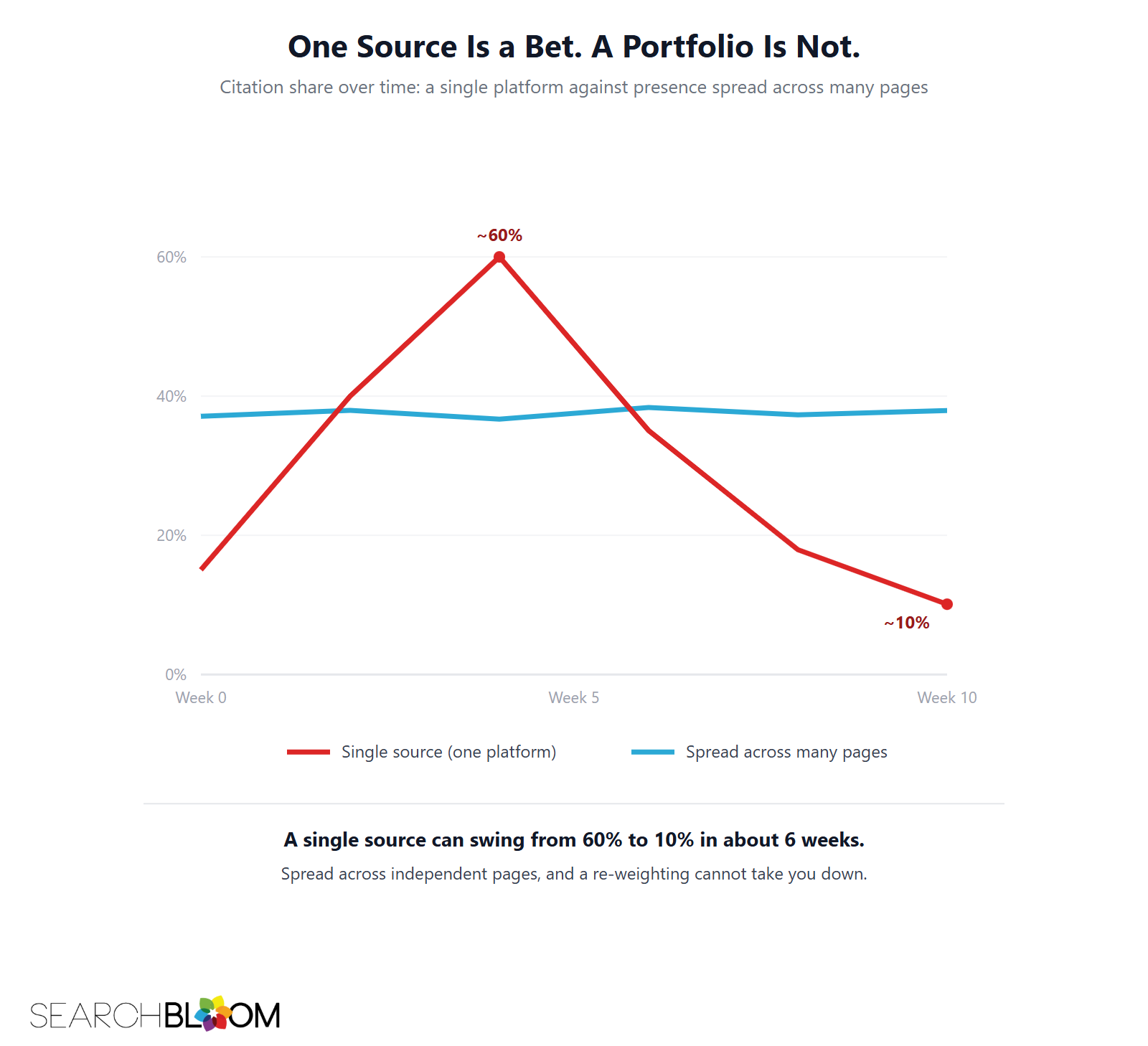
Volatility. The citation mix reprices fast. In one stretch in 2025, Reddit's share of what ChatGPT cited swung from roughly 60% to roughly 10% in about 6 weeks. If your entire presence rode on one source, you just lost most of it in a month and a half. This is the real argument for OPP as a portfolio. Betting everything on your own site is one kind of concentration risk. Betting everything on Reddit is the same mistake wearing a different shirt. Spread across many independent pages, and a single re-weighting cannot take you down. It is also why Transformation, the measurement pillar of MERIT, is not optional: you cannot manage an OPP share or a mention rate you are not tracking.
Sentiment. Getting cited is half the job. The other half is what the citation says. An AI can name you and frame you badly in the same sentence, and that is worse than being left out, because the buyer reads the verdict before they ever reach your site. Half of OPP work is getting onto the pages. The other half is fixing what they say about you once you are there.
One more thing worth watching. The pages that decide B2B software recommendations are consolidating. In early 2026, G2 bought Capterra, Software Advice, and GetApp from Gartner, which puts more than half of the world's software-review influence under a single owner, right as AI leans on those reviews harder than ever. OPP is not only a content strategy now. It has a platform-risk dimension, and I would not want every egg in a basket one company just bought.
Questions and Answers
What are "other people's pages" in AI search?
They are the pages you do not own that AI engines read when they answer a question about your brand or your category: best-of listicles, review platforms, Reddit threads, directories, news articles, and video. In our own data, 91% of what AI cited about our category lived on pages like these rather than on our website.
Why do other people's pages matter more than my own website for AI visibility?
Because an AI looks for consensus across independent sources, and your own website is the one source guaranteed to be biased in your favor. When many separate pages describe your brand the same way, the model treats that agreement as the truth and repeats it.
How do I get my brand onto other people's pages?
It starts with being genuinely worth recommending; you cannot shortcut that. Once you are, earn a spot on the credible best-of listicles in your category, keep a steady flow of fresh reviews on platforms like G2, Capterra, and Trustpilot, show up as a real person in communities like Reddit, run digital PR that journalists cover, and publish original data other people cite.
Is this just off-page SEO with a new name?
The fundamentals overlap, and most of your existing SEO still helps. Three things are genuinely different: unlinked brand mentions now carry real weight, sentiment in the surrounding text is a ranking and recommendation input, and consensus across independent kinds of sources matters more than any single high-authority link.
The Bottom Line
Here is the whole thing. Be worth talking about, then make sure the web is talking. Your own site is not where AI decides, but it is where you prove who you are and what you do, and without that proof there is nothing true for anyone else to repeat. So do the work to be genuinely good, build the brand and the foundation that show it, and the payoff lands where AI actually reads: on other people's pages. Our own data puts that at 91%. The job was never to skip the fundamentals and chase mentions. It is to deserve them first, and then earn the right to be the answer everybody else repeats.
You down with OPP? At this point it is not really a choice. You just have to be worth it first, and then be on those pages before your competitor is.
