

Information gain is the only SEO signal that erodes because you succeeded at it. I coined the term Information Gain Decay in our information gain guide, and this is its full treatment. The short version: links compound, authority compounds, information gain does the opposite. Every differentiated piece you publish saturates its own topic and raises the bar for your next one. Publish a novel insight and competitors absorb it, the models that power retrieval start treating your framing as the topic's new center, and the distance that earned you citations quietly closes. Your insight becomes everyone's baseline. You end up competing against your past self.


The guide names the phenomenon. This piece goes deeper on four fronts: the mechanism (who actually moves the saturation set, and the three vectors that do it), the rate (why it runs fast in one category and slow in another), detection (how to catch the erosion before your citation share drops, not after), and response (when to re-gain a page, when to split it, and when to retire it). I'll close with the asymmetry that should shape your whole content budget: first-party data is the only information gain with no half-life, and that's a mechanical fact, not a slogan.
What Is Information Gain Decay?
Information Gain Decay is the erosion of a page's measurable differentiation over time, caused by the success of that differentiation. When you publish an insight the top-ranking set doesn't have, your page sits at a distance from the consensus, and that distance is what retrieval systems reward with citations. Then the field absorbs the insight and the consensus center migrates toward you. Nothing on your page got worse. The insight is as true as it ever was. What's gone is the distance.
The loop runs in four steps. You publish something distinct. Retrieval systems cite it, because citation flows to the source that adds what the rest of the set lacks. The citations make the insight visible, so competitors adopt it and the next wave of pages is written with your framing already in it. The scored set now contains your idea everywhere, so your page's distance from that set shrinks, and with it the reason to cite you.
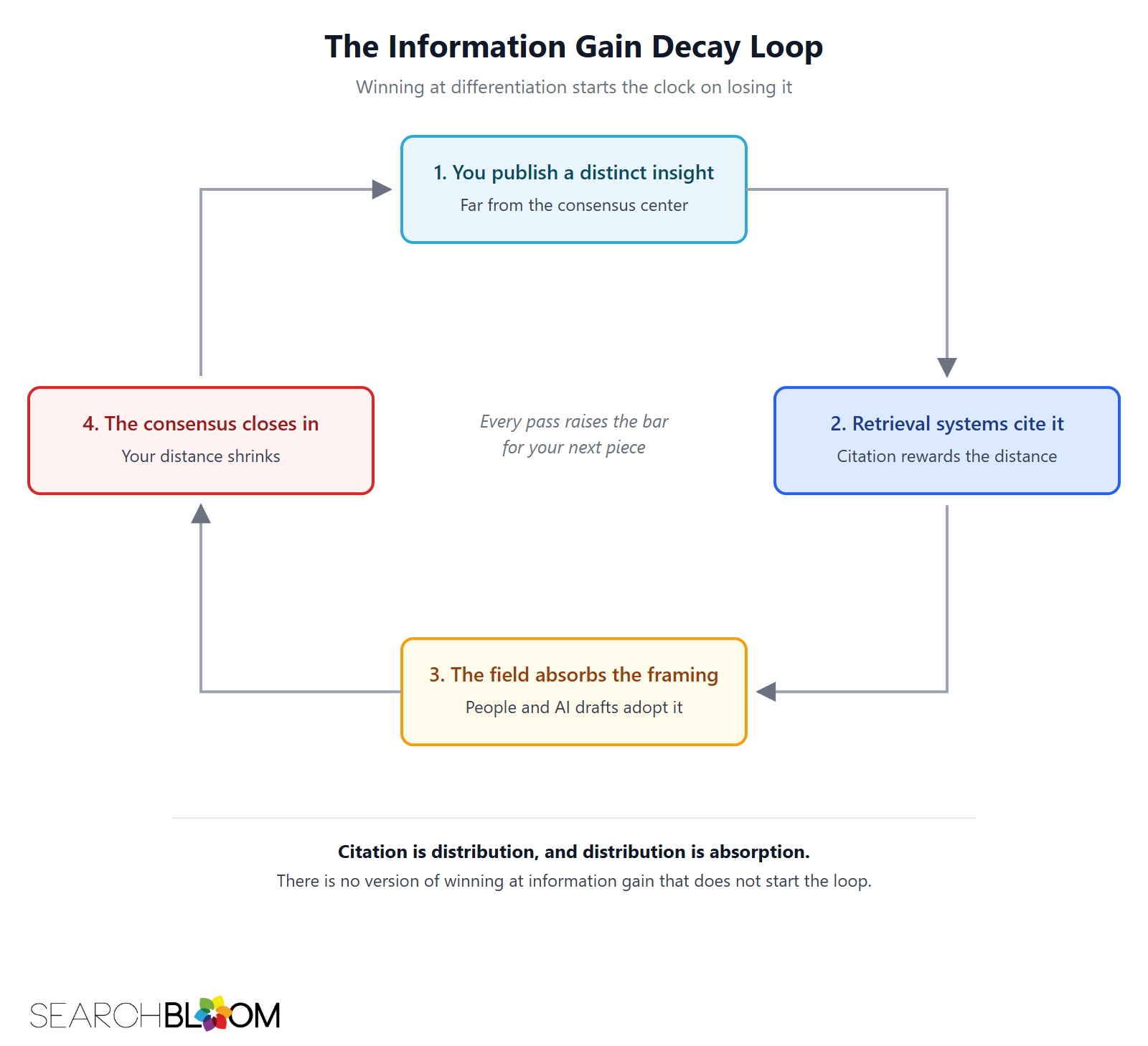
Notice what that loop implies: the mechanism of your win is the mechanism of your loss. Citation is distribution, and distribution is how insights get absorbed. There's no version of winning at information gain that doesn't start the clock on losing it.
Why Does Information Gain Erode While Links Compound?
Links and authority are records of the past. Information gain is a comparison against the present. A link you earned three years ago still exists and still counts. Information gain has no such persistence, because it's not stored anywhere. It's recomputed every time a retrieval system compares your page against the live competing set, and the comparison set never stops moving. Compounding signals are ledgers. Information gain is a snapshot, and the background of the snapshot redraws itself.
Economics named this pattern a century ago. Joseph Schumpeter argued that the profit from innovation is real but temporary: being first earns you a margin, imitation erodes it, and the only durable advantage comes from assets imitators can't reproduce. Information gain behaves exactly like a Schumpeterian rent. The insight earns citations while it's scarce. Publication is what makes it scarce no longer.
Here's where I break with the content decay industry. The standard story treats content decay as entropy, something that happens to neglected pages: staleness, outdated screenshots, drifting search intent. Information Gain Decay inverts that. It isn't neglect, and it isn't random. It's proportional to how good the insight was. A page with no information gain can't lose any; a near-duplicate page is immune, because there's nothing in it worth absorbing. If your differentiation is eroding fast, that's evidence you published something worth taking.
"Information Gain Decay is the receipt. If your edge never erodes, you never had one to begin with."
~ Cody C. Jensen, CEO & Founder, Searchbloom
Who Moves the Saturation Set? The Three Vectors of Information Gain Decay
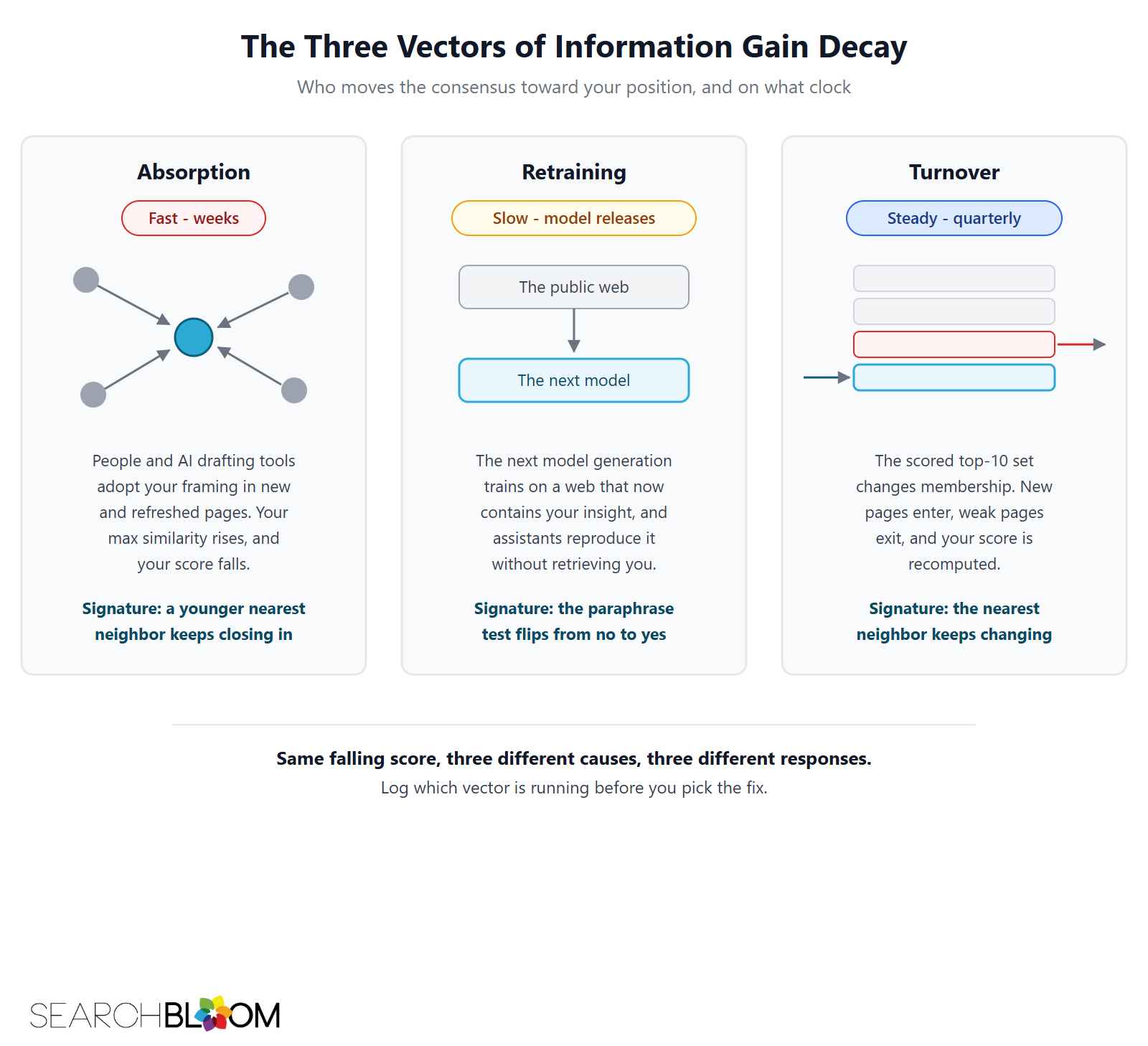
Three forces move the consensus toward your position, and they run on different clocks with different fixes. Competitor absorption: people and their AI drafting tools adopt your framing in new and refreshed pages. Model retraining: the next generation of LLMs and embedding models trains on a web that now contains your insight. Index turnover: the top-10 set you're scored against changes membership. Most eroding pages show all three at once, but one usually dominates, and the response depends on which.
Absorption: competitors adopt your framing
This is the fast vector, and it moves in weeks. Your published text is free to reproduce. Editors read it and borrow the frame. More importantly, AI drafting tools reproduce it without anyone reading you at all: once your framing is cited and quoted around the web, it shows up in AI-assisted drafts across your category, because those drafts regress toward the consensus, and the consensus now includes you. Nobody copies verbatim. They absorb the structure, the argument, the angle. Each adopting page lands closer to yours in embedding space, your maximum similarity to the set rises, and your score falls.
Retraining: the models learn your insight
This is the slow vector, and it moves on model release cadence. An LLM's output is bounded by its training data. When a model trains on a web snapshot that contains your framing, two things change. AI assistants can now reproduce your insight without retrieving you, so a paragraph that once passed the "could ChatGPT have written this from existing sources" test starts failing it. And embedding models trained on that snapshot represent the topic's center as nearer to your position. This is not the same thing as a model upgrade re-scoring your content. Vector Drift is the yardstick changing shape. The retraining vector is the yardstick learning the territory you claimed.
Turnover: the scored set changes membership
This is the quarterly vector. New pages enter the top 10, refreshed peers move, weak pages exit, and your score is recomputed against a different set. Turnover is the general case of the field moving on its own, which our Corpus Drift piece covers in full. The distinction is causal direction. Corpus Drift is the corpus moving for any reason, in any direction, around any page. Information Gain Decay is the specific case where the corpus moves toward you, because of you. Corpus Drift happens to every page. Information Gain Decay only happens to pages that earned something.
Here's how the neighboring concepts in our framework divide the territory:
| Concept | What moved | Why it moved | Your role in it |
|---|---|---|---|
| Information Gain Decay | The consensus center, toward your position | Your insight was absorbed | You caused it by winning |
| Corpus Drift | The surrounding corpus, any direction | Competitors, entities, topics evolve | Bystander |
| Vector Drift | The embedding model's coordinates | Model upgrade | Bystander |
| Vector Dilution | Your own whole-page vector, toward the center | Your page covers too much shared ground | You caused it by overbuilding |
| Citation Half-Life | Your citation count, downward | All of the above, downstream | Outcome, not cause |
How Fast Does Information Gain Decay?
Expect measurable erosion inside a quarter on competitive topics. In our internal testing across partner engagements, priority pages re-scored at 90 days drift 0.05 to 0.15 on the Information Gain Score without a single edit. But the rate isn't uniform across categories, and the variance has drivers you can read in advance.
Three things set the speed. First, publishing velocity: a category that publishes daily turns its top-10 set over faster than one that publishes quarterly, and every turnover event is an absorption opportunity. Our citation data shows the same gradient by content type, with news citations fading in days, statistics in one to three months, and technical reference holding six to twelve, a spread we documented in our citation half-life research. Second, copyability: a framing can be absorbed in one read, while a proprietary number can be quoted but never regenerated. What kind of information gain you published determines how much of it can leave. Third, AI drafting density: the more of your category drafts with LLMs, the faster absorption runs, because adoption of your framing no longer requires anyone to read you. It happens at machine speed, in every draft the model touches.
One tension is worth resolving, because our own data looks contradictory at first read. Our citation half-life numbers show that high-scoring pages hold citations longest: an A-grade page holds 12 to 16 weeks, an F-grade page under 2. But I just argued the best insights attract the fastest copying. Both are true, and the reconciliation matters: absorption pressure scales with insight quality, but so does starting distance. The best pages erode fastest in absolute terms and still outlive everything else, because they start from higher altitude. Erosion rate is descent speed. Survival is altitude.
How Do You Detect Information Gain Decay Before Citation Share Drops?
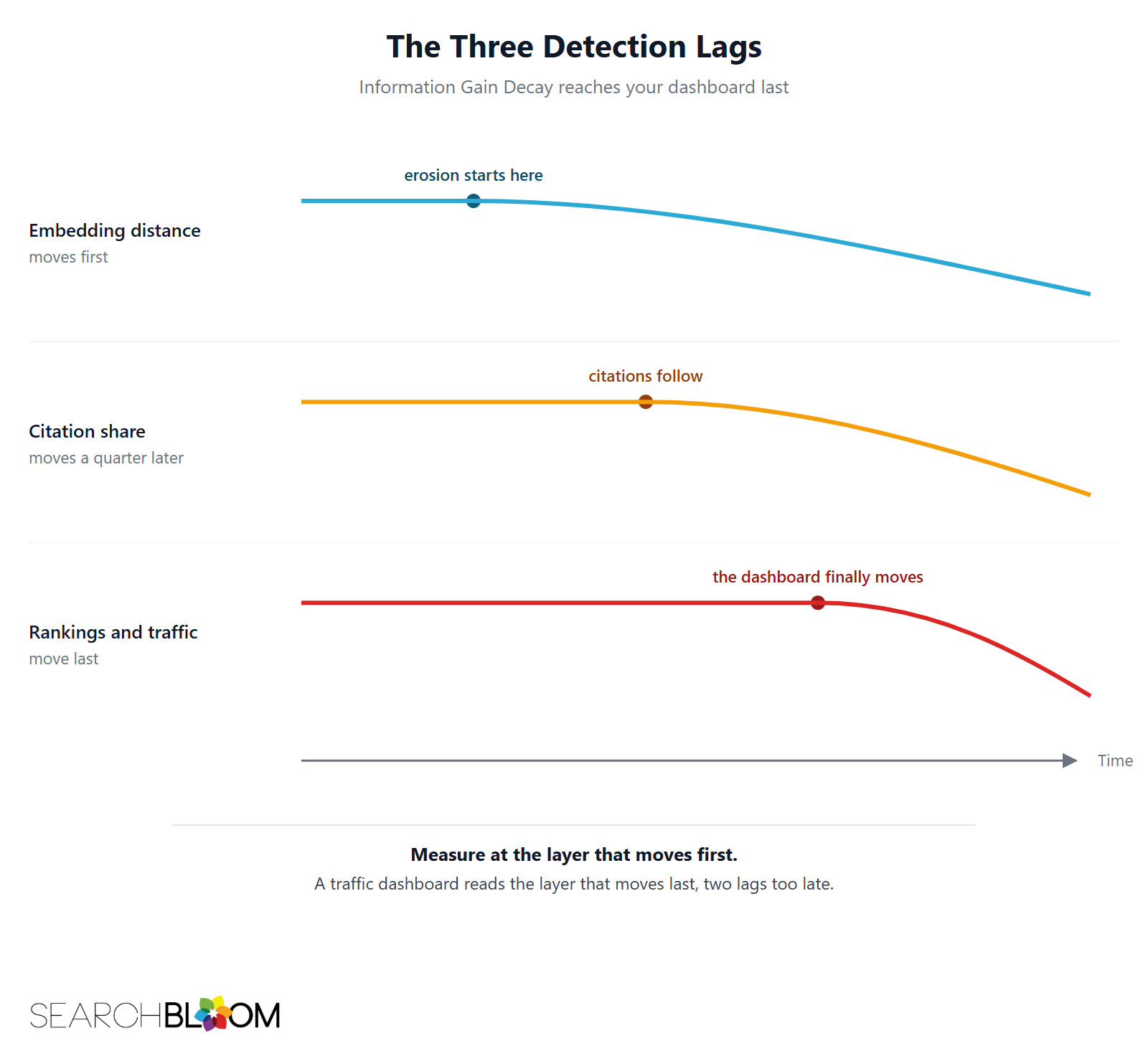
Information Gain Decay shows up in your embedding math a quarter or more before it shows up in your citation share, and citation share moves before rankings and traffic do. That ordering is the entire detection strategy: measure at the layer that moves first. If your detection layer is a traffic dashboard, you're reading the layer that moves last, and by the time it moves, both upstream layers are already gone.
Four leading indicators, in the order I'd implement them:
1. Re-score on a cadence, and log your nearest neighbor's identity. Quarterly re-scoring with the Information Gain Score is the baseline, but the score alone doesn't tell you which of the three vectors is running. Add one field to the log: which page is your maximum-similarity competitor, and when was it published. When your nearest neighbor is younger than your page and closing distance each quarter, that's absorption: someone wrote toward your position. When the nearest neighbor keeps changing identity, that's turnover. Same falling score, different diagnosis, different response.
2. Re-run the paraphrase test quarterly. The third of the three criteria for a counted insight asks whether ChatGPT could have written your paragraph from existing sources. Treat that test as a gauge with a shelf life, not a publish gate. A "no" at publication degrades to "yes" as the corpus absorbs you and models retrain on it. Prompt a current frontier model with your target query each quarter. The day it reproduces your framing without retrieving you is the day your information gain reached the training layer.
3. Search your framing verbatim. Take your most distinctive phrasings and structures and search them on a cadence. Count the pages using your framing without citing you. That count is your absorption velocity, and it's readable months before any score moves, because pages adopt your language before they accumulate enough of your substance to shift the centroid.
4. Watch AI answers for your ideas without your name. AI visibility tools track whether your brand gets cited. Track the inverse too: how often the answer contains your idea and not your name. Attribution stripped from adoption is Information Gain Decay completing itself at the answer layer.
Log all four next to each score: the score, the embedding model and version it was computed under, the nearest neighbor's URL and publish date, the paraphrase test result, and the unattributed adoption count. Five fields, once a quarter, per priority page. That's the whole system.
The Five Failure Modes of Managing Information Gain Decay
Every one of these comes from a real pattern we see in how teams handle differentiated content after it wins. Naming them is cheaper than repeating them.
The Victory Lap Freeze. In-house teams that land a breakout piece stop re-scoring it. The page that made the brand's name becomes a trophy instead of a position, and trophies don't get defended. Your most successful page is usually your least monitored, which means the highest-value erosion in the portfolio runs unwatched.
The Refresh Mirage. Teams running traffic-triggered content decay playbooks respond to erosion with date bumps, stat swaps, and an "updated" label. That treats a distance problem as a freshness problem. Retrieval systems detect surface refreshes, and none of it moves your page away from a consensus that migrated toward you.
The Flat Traffic Blindfold. B2B teams with long sales cycles read stable organic traffic as stable differentiation. Traffic is the last layer to move. A page can hold traffic for two quarters after its information gain is fully absorbed, then lose citations and rankings in the same month, and the drop reads as sudden when it was eighteen months of visible upstream erosion.
The Imitation Panic. Founder-operators who see their framing everywhere respond by rewriting the original page to reclaim the idea, louder. You can't out-distance a consensus you created by restating it. The rewrite adds shared ground, which pulls the page toward the center it's trying to escape.
The Attribution Consolation. Thought-leadership teams count unattributed adoption as influence. "Everyone uses our framework now" is not a win when nobody cites the source. Influence without attribution is the erosion finishing the job, and celebrating it delays the response.
What's the Right Response to Information Gain Decay?
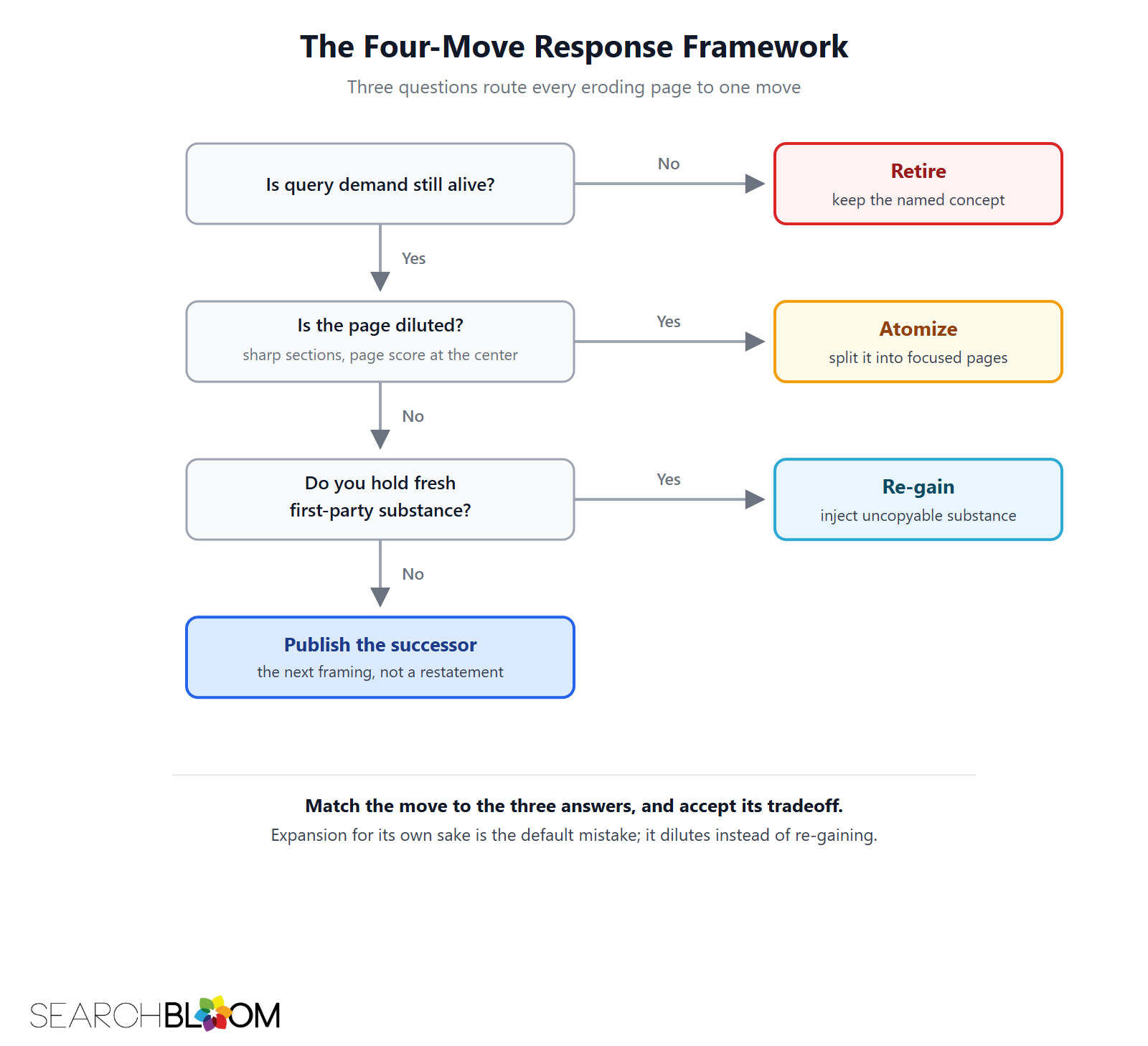
Four moves cover every eroding page: re-gain it, atomize it, publish its successor, or retire it. The right one hangs on three questions. Is query demand still alive? Which of the three vectors did the damage? And do you hold an asset competitors can't copy, like a data pipeline, live engagement results, or operational access? Answer those three and the framework below picks the move, along with the tradeoff you're accepting when you make it.
| Move | When it's the right call | The tradeoff you accept |
|---|---|---|
| Re-gain | Demand alive, and you hold fresh first-party substance to inject | Costs real SME and data time, and every re-gain raises your own future bar |
| Atomize | Demand alive, and the page is diluted: sharp sections, but a whole-page score at the consensus center | More pages to maintain, and link equity gets redistributed |
| Publish the successor | Demand alive, absorption complete, and the old page has no new substance to receive | Two pages now share the topic; the successor must be the next framing, not a restatement |
| Retire | Demand dying, and no uncopyable asset remains | You give up residual citations a slow-dying page would still collect |
Two of these need expansion, because they're the ones teams get wrong.
Re-gain means new substance, not more coverage. The instinct on a slipping page is to expand it, and expansion is usually the move that dilutes it further: added coverage is shared ground, and shared ground pulls the whole-page vector toward the center. A re-gain that works injects what the saturation set still lacks, which after full absorption means new data, new failure documentation, or a new stance. If you have nothing in that class to add, you're not re-gaining, you're redecorating.
Retirement is the honest call more often than teams admit. The hardest version is the page whose framing won outright while its query demand faded: your idea's victory and your page's death are the same event. Retire the page and keep the claim. The named concept, the origin, and the canonical explanation move to a durable surface, and the refresh hours go to pages where they buy more citation life. Sunk cost is not a strategy.
Why First-Party Data Is the Only Information Gain Without a Half-Life
A framing can be absorbed by anyone who reads it. First-party data can't, because its value doesn't live in the published text. It lives in the generating process behind the text. A competitor can quote your number, and that's fine; a quote is a citation, which is the win you wanted. What no competitor can do is produce next quarter's number. The text is copyable. The pipeline isn't. That's the whole asymmetry, and it's why proprietary data sits at Technique 1 in our catalog instead of somewhere in the tiebreakers.
Be precise about what "no half-life" means, because our own citation research shows statistics going stale in one to three months. The datapoint expires. The data asset doesn't. Any single number goes stale, gets quoted, gets superseded. The capacity to publish a fresh one on schedule is the asset, and it renews instead of eroding. A published framing is a patent you filed with no enforcement: full disclosure, zero protection, and the clock starts at publication. A data pipeline is a trade secret you renew forever: you disclose this quarter's outputs while keeping the machine that makes them.
There's a second asset class that resists Information Gain Decay, and it's the reason we name things. A framing erodes under paraphrase, but names survive it. Paraphrase rewrites sentence structure and keeps proper nouns, so a named concept carries its attribution through the very process that strips attribution from everything else. I'm convinced this is the mechanism behind what we've watched with our own named concepts: the framing spreads, and the name drags the source along with it. Route your sharpest insights into concepts you own, and absorption starts working for you instead of against you.
Frequently Asked Questions
What is Information Gain Decay in SEO?
Information Gain Decay is the erosion of a page's measurable differentiation over time, caused by the success of that differentiation. Competitors absorb the insight, models train on it, and the consensus center moves toward the page's position, closing the distance that earned citations.
What causes Information Gain Decay?
Three vectors: competitor absorption (new and refreshed pages adopt your framing), model retraining (LLMs and embedding models train on a web that now contains your insight), and index turnover (the top-10 set you are scored against changes membership). Most eroding pages show all three.
How is Information Gain Decay different from content decay?
Content decay describes traffic loss from external causes: staleness, algorithm updates, intent shift. Information Gain Decay is self-caused: your insight was good enough to be absorbed, and the absorption erased your differentiation. Content decay happens to neglected pages. Information Gain Decay happens to winning ones.
How is Information Gain Decay different from Corpus Drift?
Direction of causation. Corpus Drift is the surrounding corpus moving for any reason, in any direction, around any page. Information Gain Decay is the specific case where the corpus moves toward your position because your insight pulled it there.
How is Information Gain Decay different from Vector Drift?
Vector Drift is a model upgrade changing the measurement itself: same content, new coordinates. Information Gain Decay is the measured distance closing because the field absorbed your insight. One is the yardstick changing. The other is the territory being claimed.
How fast does information gain decay?
On competitive topics, measurably within a quarter. Priority pages we re-score at 90 days drift 0.05 to 0.15 in Information Gain Score without edits. Speed scales with category publishing velocity, how copyable the type of information gain is, and how much of the category drafts with AI.
How do I detect Information Gain Decay before citations drop?
Measure at the layer that moves first. Re-score quarterly and log your maximum-similarity competitor's identity and age, re-run the "could ChatGPT have written this" test on your key paragraphs, search your distinctive framing verbatim to count unattributed adoption, and watch AI answers for your ideas appearing without your name.
Can I stop competitors from absorbing my insights?
No, and trying is wasted effort. Publication is distribution, and distribution is absorption. What you control is what you publish (data and named concepts erode slower than framing), how you monitor, and how fast you respond with the next insight.
Does refreshing content stop Information Gain Decay?
Date bumps and stat swaps don't, because Information Gain Decay is a distance problem, not a freshness problem. A refresh only restores information gain if it injects substance the saturation set lacks: new first-party data, new failure documentation, a new stance. Coverage-style expansion usually makes the page less differentiated, not more.
When should I retire a page instead of updating it?
When query demand is dying and you hold no uncopyable asset to inject. The clearest case is a page whose framing was fully absorbed while its query faded: keep the named concept on a durable surface, retire the page, and move the refresh hours to pages where they buy more citation life.
Why doesn't first-party data decay like other information gain?
Because its value lives in the generating process, not the published text. A competitor can quote your number but can't produce next quarter's number. Single datapoints go stale; the pipeline that produces fresh ones renews. Framing is disclosure without protection. A data pipeline is a renewable trade secret.
Does Information Gain Decay affect AI citations or just rankings?
Citations first. Embedding distance erodes before citation share, and citation share moves before rankings and traffic. AI assistants also stop needing to retrieve you once your insight enters their training data, which removes citations even where you still rank.
Does using AI to write content make Information Gain Decay worse?
It accelerates the absorption vector across your whole category. Once your framing is well-represented in the corpus and in training data, every competitor drafting with an LLM reproduces it at zero cost, without reading you. In AI-heavy categories, absorption runs at machine speed.
How often should I re-score pages for Information Gain Decay?
Quarterly for priority pages on competitive topics, matching the re-scoring cadence we recommend for the Information Gain Score. Log the score, the embedding model version, the nearest competitor's identity and publish date, the paraphrase test result, and the unattributed adoption count each time.
The Bottom Line
Information Gain Decay is the tax on publishing anything worth absorbing, and it can't be avoided, only managed. Manage it like a position: re-score quarterly and log who's closing on you, re-run the paraphrase test before the models make it moot, and read unattributed adoption as the warning it is. When a page loses its distance, pick the move deliberately: re-gain with substance, atomize what's diluted, publish the successor, or retire it and keep the claim. And weight your portfolio toward the two assets absorption can't touch: a data pipeline that renews and named concepts that carry attribution through paraphrase. If your plan for a page doesn't include which of the three vectors will come for it, you don't have a durable strategy. You have a head start.
